As most of you know, I write a regular column in the Toronto Star. It's always interesting for me to see which topics generate the most public feedback. My latest screed was on the seal hunt and animal issues generally. It got lots of feeback, almost all positive.
Anything to do with animals always seems to stir things up. The one I did on the spring-bear hunt was another one which got lots of comment, although that was split pro and con.
The next most active response was to my article on the gay marriage issue.
If the Star ever needs a big boost to circulation, I'll do one on homosexual bears.
Apr 25, 2006


Iran
Lots of speculation about whether the Americans (or the Israelis) will hit Iran, perhaps even with nuclear weapons. The real question is, can they be that crazy?
One line of thought is that the Bush people put out the nuclear story to set up public expectations. The idea is that if they then go in for conventional bombing, instead of being outraged, people will breathe a sigh of relief.
Anyway, having been burned with the WMD boogy man once, we are sensible to be skeptical. Who said "Fool me once, shame on you, Fool me twice and---uh---uh---can't fool me." ?
The real reason Bush wants to take out Iran has nothing to do with nukes.
One line of thought is that the Bush people put out the nuclear story to set up public expectations. The idea is that if they then go in for conventional bombing, instead of being outraged, people will breathe a sigh of relief.
Anyway, having been burned with the WMD boogy man once, we are sensible to be skeptical. Who said "Fool me once, shame on you, Fool me twice and---uh---uh---can't fool me." ?
The real reason Bush wants to take out Iran has nothing to do with nukes.
Canadian Politics
PM Harper's government has taken a couple of measures to keep troop casualties off the public radar. The flag on Parliament Hill will no longer fly at half-mast after a death of Canadian soldiers and media will no longer be allowed to photograph the return of the bodies to Trenton base.
It's hard to avoid the conclusion that they are playing from the Bush team P.R. playbook. Why not? They're fighting their wars.
And mimicking the US way of doing things is nothing new for this lot. The farce of a non-voting parliamentary hearing for the new Supreme Court appointee; Harper's surprise visit to the troops in Afghanistan; his made-in-the-USA crime policy; tax-cuts; opposition to Kyoto even the Conservative proposal for an elected Senate. Notice that all their "reforms" make us more like Americans.
I'm old enough to remember when the Conservatives stood for the British connection and accused the Liberals of wanting to Americanize us. I guess they always shilled for the Empire.
Changing gears a little bit; this brings up the whole hoary topic of Canada-US relations. Something Americans never think about but Canadians agonize over continually. A little history; this country started (at least the English bit) as a conservative revolt against the American revolution. The first English settlers in Ontario came in as United Empire Loyalists, none of that Life, Liberty, Pursuit of Happiness nonsense for us. Pass another cup of that lovely English tea, tax-stamp and all. God save the King.
The Americans tried to wipe us out in 1812. That war is mostly a foot-note in American histories, but for a long while in Canada it was the formative national narrative; a heroic epic of resistance to the republican hordes. I don't know what kind of politically correct treacle passes for Canadian history in schools these days, but when I was but a lad (back when rocks were soft) the main topic on the curriculum was the war of 1812. Which we won. Episodes and names from that conflict were drilled into our impressionable little skulls; Lundy's Lane, Laura Secord, the burning of the White-House.
Note on the last; British regulars came ashore in Chesapeake Bay, marched inland, briefly held the city of Washington and torched the president's house. However, most Canadians to this day seem to believe it was colonial militias who did it.
So what's our attitude toward the Americans today? We need to distinguish first off between the general question and the specific one relating to the present administration. Bush couldn't get elected as ward alderman anywhere in Canada. I doubt he could get a job at Tim Hortons.
On the general question; the best way to understand it is to look at Canadian attitudes toward international sporting events, especially hockey tournaments. There's nothing we like better than soundly trouncing the Americans, it's much more satisfying than beating anyone else. However, and this is worth noting, if the Canadians are eliminated from play, our sympathies switch and we generally root for the Americans against everyone else.
Bush once said that Canadians and Americans were like family. I guess so. They are like the big brother. He plays his stereo too loud, he's a jerk and a dumb jock and he tries to hog all the dessert at dinner. He's always picking fights with the neighbour kids, and besides which we're sick of wearing his hand-me-downs. But he's still our brother. And he does have a cool record collection.
It's hard to avoid the conclusion that they are playing from the Bush team P.R. playbook. Why not? They're fighting their wars.
And mimicking the US way of doing things is nothing new for this lot. The farce of a non-voting parliamentary hearing for the new Supreme Court appointee; Harper's surprise visit to the troops in Afghanistan; his made-in-the-USA crime policy; tax-cuts; opposition to Kyoto even the Conservative proposal for an elected Senate. Notice that all their "reforms" make us more like Americans.
I'm old enough to remember when the Conservatives stood for the British connection and accused the Liberals of wanting to Americanize us. I guess they always shilled for the Empire.
Changing gears a little bit; this brings up the whole hoary topic of Canada-US relations. Something Americans never think about but Canadians agonize over continually. A little history; this country started (at least the English bit) as a conservative revolt against the American revolution. The first English settlers in Ontario came in as United Empire Loyalists, none of that Life, Liberty, Pursuit of Happiness nonsense for us. Pass another cup of that lovely English tea, tax-stamp and all. God save the King.
The Americans tried to wipe us out in 1812. That war is mostly a foot-note in American histories, but for a long while in Canada it was the formative national narrative; a heroic epic of resistance to the republican hordes. I don't know what kind of politically correct treacle passes for Canadian history in schools these days, but when I was but a lad (back when rocks were soft) the main topic on the curriculum was the war of 1812. Which we won. Episodes and names from that conflict were drilled into our impressionable little skulls; Lundy's Lane, Laura Secord, the burning of the White-House.
Note on the last; British regulars came ashore in Chesapeake Bay, marched inland, briefly held the city of Washington and torched the president's house. However, most Canadians to this day seem to believe it was colonial militias who did it.
So what's our attitude toward the Americans today? We need to distinguish first off between the general question and the specific one relating to the present administration. Bush couldn't get elected as ward alderman anywhere in Canada. I doubt he could get a job at Tim Hortons.
On the general question; the best way to understand it is to look at Canadian attitudes toward international sporting events, especially hockey tournaments. There's nothing we like better than soundly trouncing the Americans, it's much more satisfying than beating anyone else. However, and this is worth noting, if the Canadians are eliminated from play, our sympathies switch and we generally root for the Americans against everyone else.
Bush once said that Canadians and Americans were like family. I guess so. They are like the big brother. He plays his stereo too loud, he's a jerk and a dumb jock and he tries to hog all the dessert at dinner. He's always picking fights with the neighbour kids, and besides which we're sick of wearing his hand-me-downs. But he's still our brother. And he does have a cool record collection.
Apr 17, 2006
Babylon Bush-Whacked
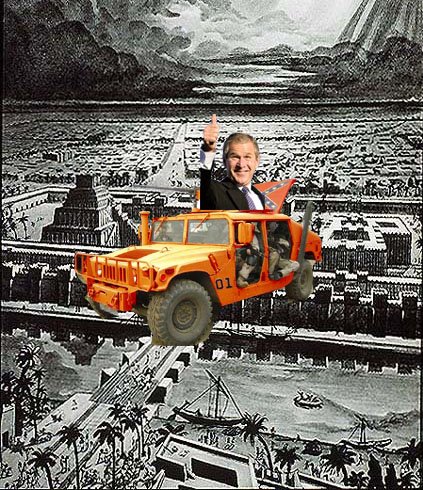
Along with all it's other tragedies and obscenities, war can bring destruction of priceless and irreplaceable treasures; part of the human legacy lost forever. The burning of the Great Library at Alexandria by Julius Caesar's troops; Napoleon's officers using the Sphinx for artillery practise (hence the ruined nose), the British shelling the Parthenon during their intervention in the Greek War of Independence; the list of such military stupidities is a long one.
Apparently as a species we're slow learners. The Americans, it seems, after the invasion of Iraq thought that the site of ancient Babylon would be a nifty place to build a military base. They've pretty well wrecked the place by driving big trucks around, landing helicopters, dumping gravel, even using archaeological debris to fill sand-bags.
You have to wonder what they were thinking. Is American education so bad that not one of the officers involved knew what the hell they were churning up. Didn't anyone say, "hey, this may not be such a good idea guys?"
A friend of mine has a theory which he claims explains unbelievable stupidities like this. He says that in the grand cosmic plan, this is the "special needs" planet. You get born here if you're "developmentally challenged." Keeps the rest of the universe more orderly. Hard to refute sometimes.
Links to the story of how the cowboys trashed Babylon;
from the Guardian
from the New Scientist
Apr 13, 2006
Afghanistan

(Warning, rant to follow. )
At the very end of the nineteenth century the Dominion of Canada sent 7,400 young men to the veldt of South Africa. Of these, 224 were killed. This was a war fought solely for the imperial ambitions of the British Empire, of which Canada was a part. A generation later we sent 626,000 men into the muddy hell-realm of Flanders, losing 61,663 of these. Once again the war had nothing to do with Canada, but was fought between rival European imperial systems. Our Prime Minister, Sir Robert Borden, a good God-fearing capitalist Tory said at the outbreak of war that Canada was "ready, aye ready."
At the start of the 21st century has the spirit of the country's policy changed all that much? Aren't we still acting as the junior partners in other people's imperial wars? Of course the empire is under new management now; the new guys don't go in for so much pomp and circumstance and don't seem to know how to run the show as well as the sahibs did once they get there.
Canadians are by and large uninterested in foreign policy, unless it involves a lot of skating and slap-shooting. Witness the almost complete absence of any reaction to the former Martin government's role in the US engineered coup in Haiti. The Americans didn't like the president, Aristide, because he showed signs of actually wanting to give his people some protection against the sweat-shops run by US corporations there. Never mind he was the people's choice, democratically elected and all. Bang, bang you're out.
And Canada's in like a dirty shirt helping with troops to shore up the new regime, and give the whole affair a spurious air of international legitimacy. We're like the annoying obsequious side-kick of the class bully.
Now Harper, another God-fearing capitalist Tory but new-school, with a predatory neo-con edge, is in charge. He's made a big deal about "improving relations with the Americans" but his first visit to the Imperial capital was a big flop from Canada's point-of-view. No deal on soft-wood lumber (in fact a Canadian back down), no deal on the new passport regulations that will cripple the Canadian tourist trade, no nothing.
Big surprise? Just look at the way the Bushies treat their poodle Blair over in the old Imperial capital. These guys don't make deals, they lay down the law and lesser breeds fall into line.
So, getting to the meat of the rant, what are we doing in Afghanistan? Wouldn't have anything to do with a pipe-line for Caspian gas now would it? Oh, yeah it's about democracy. That's the new buzz word for the Empire. So long as you vote for the guy they want. Or can be made to seem like you voted for the guy they want. Democracy in Afghanistan is about as likely as snow in Tahiti.
It came out this week that when Canadian troops take prisoners in Afghanistan they hand them over to "Afghan authorities." Presumably for a nice hot cup of cocoa. A military spokesman said this was in respect of Afghanistan's sovereignty.
Several questions arise from this scenario. Why are we going along with the charade that Afghanistan's government is sovereign? (or Canada's for that matter, but I digress.) What do you think happens to the poor sods when the "Afghan authorities" get hold of them? Can Canada's military be liable as accomplices to torture?
If we are going to be fighting as junior partners in Imperial wars, why can't we do what we did in every other war and set up proper P.O.W. camps, and run them according to the Geneva convention? Do we have to sink into the same moral sewer as Abu Ghraib?
The US is holding thousands of people in a new-school gulag archipelago from Guatanamo Bay to Bagram to shadowy locations in Eastern Europe and Central Asia. What is the legal basis for their detention? Just the president's say-so as far as anyone can see.
If any semblance of legality were involved these prisoners would be sorted into three categories. Those taken in combat would be awarded P.O.W. status and treated accordingly. Those involved in criminal acts, including terrorism, would be properly charged by the relevant authorities in the jurisdiction were the crime was committed and given a fair trial. The rest, probably the vast majority, would be paid compensation and set free.
If Canada had any back-bone, we'd insist that something like this be done before we sign up on any more campaigns against the Boers (or whoever is annoying the Imperial power by rudely sitting on natural resources). But, hey, aren't the Leafs on tonight?
Apr 12, 2006
What? Not like Spam?
Some lame-brain has been spamming this blog. I've seen this crap on other blogs too - "Hey, Great Blog! You might want to click here for free software, blah blah."
So I've enabled the word verification option. My apologies but I think the annoyance of typing in a nonsense word when you post is probably less than wading through spam when you read the comments.
So I've enabled the word verification option. My apologies but I think the annoyance of typing in a nonsense word when you post is probably less than wading through spam when you read the comments.
Apr 11, 2006
Last Post on Narnia
I've finished the Narnia books and want to make a few more observations.
The very last book in the series "The Last Battle" is basically an account of the Narnian apocalypse. The world ends, Aslan the Lion-Christ winnows the wheat from the chaff and all the good creatures go to a heaven Narnia for evermore.
C.S. Lewis was not only a good story-teller, but an interesting theologian. He makes heaven to be a "realer" version of Narnia (and likewise the earth's heaven is a realer version of earth.) One of the characters, a professor, references Plato in an aside. The mundane Narnia and Earth are called the Shadowlands. The children get to visit a heavenly England.
This is an intriguing take on the Christian idea of eternity. Nevertheless, even as clever a heaven as Mr. Lewis' perforce seems rather insipid to a Buddhist. It's all green grass and lolly-pops, for sure, but it's still all conditioned isn't it? The idea of conditioned existence prolonged for ever, even in a perfect Narnia, has a horrific edge if you think about it.
Notching down from the metaphysical a bit; I've commented before on Lewis' use of language and I'd like to cite one example. Remember this is from a children's book written in the fifties.
The children are about to leap into a churning waterfall in the heaven-Narnia;
That kind of syntax must be what comes of teaching Latin and Greek in the schools.
The very last book in the series "The Last Battle" is basically an account of the Narnian apocalypse. The world ends, Aslan the Lion-Christ winnows the wheat from the chaff and all the good creatures go to a heaven Narnia for evermore.
C.S. Lewis was not only a good story-teller, but an interesting theologian. He makes heaven to be a "realer" version of Narnia (and likewise the earth's heaven is a realer version of earth.) One of the characters, a professor, references Plato in an aside. The mundane Narnia and Earth are called the Shadowlands. The children get to visit a heavenly England.
This is an intriguing take on the Christian idea of eternity. Nevertheless, even as clever a heaven as Mr. Lewis' perforce seems rather insipid to a Buddhist. It's all green grass and lolly-pops, for sure, but it's still all conditioned isn't it? The idea of conditioned existence prolonged for ever, even in a perfect Narnia, has a horrific edge if you think about it.
Notching down from the metaphysical a bit; I've commented before on Lewis' use of language and I'd like to cite one example. Remember this is from a children's book written in the fifties.
The children are about to leap into a churning waterfall in the heaven-Narnia;
"Isn't it wonderful?"said Lucy "Have you noticed one can't feel afraid even if one wants to?"
"By Jove, neither one can." said Eustace after he had tried.
That kind of syntax must be what comes of teaching Latin and Greek in the schools.
Meditation on Voidness
Lately I've been experimenting with the Meditation on Voidness from the Cula-Sunnata Sutta. I've also taught it as a guided meditation to groups and people seem to get something out of it so long as they don't let themselves get lost in speculative thought (trying to figure it out)
This is a wonderful practise which has received very little attention. Here are instructions in a nut-shell.
The meditation proceeds through a series of contemplations. The whole trick of making it work is to remember that nothing new is added at any stage. On the contrary, each stage is a successive subtraction. You advance through the stages by a process of selective non-attention.
1 - Begin with contemplation of village - this is a simple mindfulness exercise. Be aware of your surroundings, as they actually are, the room, the furnishings, any other people. Don't analyze or judge or compare. Just hold the surroundings in mindful awareness. When this is established, extend your imagination beyond the visible surroundings to take in the immediate area, the street etc., extending only as wide as is comfortable for you.
2 - Next, move on to contemplation of forest. (In scriptural useage village is a word for the whole human constructed world, forest for the natural environment.) Simply remove all human constructions from the previous mind-field and focus only on the natural world, the plants and trees especially. Remember, selective non-attention. You don't add anything, you subtract. The "forest" was a part of the first contemplation, now you make it the foreground by non-attention to "village."
3 - Next, by selective non-attention to the living world you move on to contemplation of earth. By non-attention to the living growth, become aware of the wide earth-element underlying things. Be aware in the imagination of the hills and valleys, bowls for any nearby lakes, etc. Allow your field of imaginative awareness to expand until you are holding the whole globe of this planet in awareness.
4 - Next, by non-attention to earth one should become aware of space. At first, this will be the space occupied by the earth. Removing the earth from awareness, space becomes the foreground. (Again note it was present all along - we subtract and do not add) Space by it's nature has no boundaries, so the idea of an earth-sized area should quickly dissolve into boundlessness. Hold the awareness of boundless space.
5 - Your consciousness is now filling boundless space. Okay, stop noticing space and only pay attention to the boundlessness of consciousness. Mind without limit.
6 - In the next contemplation, we stop paying attention to boundless mind and let the mind rest in nothingness.
7 - If you're able to take it this far, eventually even nothingness starts to seem "busy". In the next step we remove the concept of nothingness from our field of awareness and rest in the field called "neither-perception-nor-nonperception." Don't try to figure it out. The name is meaningless really, it's what's left when you remove nothingness.
After holding this for a while, return to the body with some mindful breathing before getting up. Good luck with this if you are inspired to try it; let me know if it works for you.
This is a wonderful practise which has received very little attention. Here are instructions in a nut-shell.
The meditation proceeds through a series of contemplations. The whole trick of making it work is to remember that nothing new is added at any stage. On the contrary, each stage is a successive subtraction. You advance through the stages by a process of selective non-attention.
1 - Begin with contemplation of village - this is a simple mindfulness exercise. Be aware of your surroundings, as they actually are, the room, the furnishings, any other people. Don't analyze or judge or compare. Just hold the surroundings in mindful awareness. When this is established, extend your imagination beyond the visible surroundings to take in the immediate area, the street etc., extending only as wide as is comfortable for you.
2 - Next, move on to contemplation of forest. (In scriptural useage village is a word for the whole human constructed world, forest for the natural environment.) Simply remove all human constructions from the previous mind-field and focus only on the natural world, the plants and trees especially. Remember, selective non-attention. You don't add anything, you subtract. The "forest" was a part of the first contemplation, now you make it the foreground by non-attention to "village."
3 - Next, by selective non-attention to the living world you move on to contemplation of earth. By non-attention to the living growth, become aware of the wide earth-element underlying things. Be aware in the imagination of the hills and valleys, bowls for any nearby lakes, etc. Allow your field of imaginative awareness to expand until you are holding the whole globe of this planet in awareness.
4 - Next, by non-attention to earth one should become aware of space. At first, this will be the space occupied by the earth. Removing the earth from awareness, space becomes the foreground. (Again note it was present all along - we subtract and do not add) Space by it's nature has no boundaries, so the idea of an earth-sized area should quickly dissolve into boundlessness. Hold the awareness of boundless space.
5 - Your consciousness is now filling boundless space. Okay, stop noticing space and only pay attention to the boundlessness of consciousness. Mind without limit.
6 - In the next contemplation, we stop paying attention to boundless mind and let the mind rest in nothingness.
7 - If you're able to take it this far, eventually even nothingness starts to seem "busy". In the next step we remove the concept of nothingness from our field of awareness and rest in the field called "neither-perception-nor-nonperception." Don't try to figure it out. The name is meaningless really, it's what's left when you remove nothingness.
After holding this for a while, return to the body with some mindful breathing before getting up. Good luck with this if you are inspired to try it; let me know if it works for you.
Apr 7, 2006
Don't Kill the Cute Ones


Pop-quiz; which one is cuter? Which one suffers more at the hands of man? Which one do you give a damn about?
Let's face it, there's a world of hypocrisy surrounding this whole seal-hunting business. Agreed, it's horrid and barbaric and unneccessary and should be banned. But I can't help wondering why there isn't a hundredth part of the outrage over the much crueler practises of modern factory-farming.
Did you know that pigs are the most intelligent mammals outside of the primates? If you have the stomach for it here's a video clip of where your morning bacon comes from. Real hell-realm stuff. You can also check out this piece by Mark Morford on the seal-hunt double-standard. If you're not familiar with his work, he's one of the cleverest and wittiest columnists out there. A modern Swift.
Apr 5, 2006
Technical Difficulties
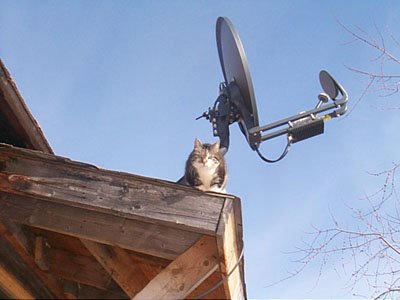


You may have noticed I haven't posted in several days. There's a good excuse beyond simple laziness this time - our internet connection was down. We have a strange mix of technologies here and this time it shut us down.
We are off the grid - our only electronic link to the outside world is via a satellite dish on the roof of the cabin. This is a log cabin built in the 1930's by a Swedish settler. A little history - this area of Canada (NW Ontario) was the last area open for home-steading, which continued well into the 20th century long after all the good land further west was settled. (Or stolen to put it more accurately) It's all bog and bedrock here is why.
Look at the workmanship on the corners; check out these dove-tails. This was done by a gentleman named Ragnor Skogman who was still around when I first moved up here in the early 80's. I don't know exactly where he is now, but if he took a human rebirth he'd be about twenty now and I hope he's having lots of fun.
Now check out the tool he made those dove-tails with. That's it in the second photo, hanging in a place of honour on the side of the cabin. That's right, Ragnor hewed the logs with a broad-axe.
The cabin was built to government specs. You had to clear one acre and built a twenty by twenty building to get clear title. There isn't an inch extra. The acre is now a mowed field. I doubt it was ever very productive. We only have about an inch of topsoil.
I should also note that the cabin was built right on the ground. In the early eighties Kema Ananda, founder of the Arrow River Community Center (now Forest Hermitage) renovated the building and put it on cement blocks. These tend to float about a bit when the ground heaves in the spring.
Not a problem really until we fast forward to the 21st century and put a satellite dish on the roof. (Powered by solar) This is aimed at a geo-synchronous satellite 35,000 km up. A small shift this end is a wild swing on the other end. The repair guy said it had shifted between and eighth and a quarter of an inch. If I wasn't getting stupid in my old age I'd do the math, but I bet at the high end that translates into tens of miles.
Anyway, moral of the story - if you don't want troubles like this pick a century and stick with it. Given my druthers, I think I'd take the fifteenth.
Mar 21, 2006
Anyone Remember Kosovo?
We live in an age that is increasingly coming to resemble George Orwell's 1984 of perpetual war. One thing peace-loving people must guard against most is the assault of the war-mongers on our minds. War propaganda is a fine art. The enemy must be portrayed as evil incarnate, even if, especially if, they are innocent victims of our aggression.
The British in WW I printed drawings of German troops marching with bayoneted Belgian babies. Before Hitler's invasion of Poland, the German press was full of atrocity stories of hapless German farm families being killed and burnt by Polish mobs. And who can forget the infamous "Kuwaiti Incubator Babies?" (If you don't remember, you owe it to yourself to click the link.) The Weapons of Mass Deception are almost too obvious to mention in this context, although it worked well enough at the time.
One episode in recent history where the propaganda seems to have fooled most people at the time, and in fact they mostly remain fooled, is the Kosovo War of 1999. Clinton's War. The official line, dutifully pushed by most media, was that this war was a purely humanitarian effort to save the Kosovar Albanians from genocide. Milosevic was portrayed as a Hitler-like demon. (Funny how all our enemies are painted with the same comic moustache sooner or later.)
No VIrginia, if you read it in the Times, it ain't necessarily so. Anyone with critical faculties intact ought to have been suspicious at the time. Wars are expensive operations, fought for real politik reasons of strategic and economic advantage, and NATO is not a charitable organization. It's now pretty apparent that the atrocity stories were exaggerated, if not wholly cooked up. The trial at the Hague was a quasi-legal circus, but even so Milosevic was running circles around the prosecution until they muzzled him.
Now his more than slightly suspicious death. Conveniently just before his defence team was going to subpeona Bill Clinton. Milosevic's death is a good opportunity to re-examine the myths and propaganda surrounding this whole sorry episode. A good place to start might be Nebojsa Malic's sharp piece on Antiwar.com.
The British in WW I printed drawings of German troops marching with bayoneted Belgian babies. Before Hitler's invasion of Poland, the German press was full of atrocity stories of hapless German farm families being killed and burnt by Polish mobs. And who can forget the infamous "Kuwaiti Incubator Babies?" (If you don't remember, you owe it to yourself to click the link.) The Weapons of Mass Deception are almost too obvious to mention in this context, although it worked well enough at the time.
One episode in recent history where the propaganda seems to have fooled most people at the time, and in fact they mostly remain fooled, is the Kosovo War of 1999. Clinton's War. The official line, dutifully pushed by most media, was that this war was a purely humanitarian effort to save the Kosovar Albanians from genocide. Milosevic was portrayed as a Hitler-like demon. (Funny how all our enemies are painted with the same comic moustache sooner or later.)
No VIrginia, if you read it in the Times, it ain't necessarily so. Anyone with critical faculties intact ought to have been suspicious at the time. Wars are expensive operations, fought for real politik reasons of strategic and economic advantage, and NATO is not a charitable organization. It's now pretty apparent that the atrocity stories were exaggerated, if not wholly cooked up. The trial at the Hague was a quasi-legal circus, but even so Milosevic was running circles around the prosecution until they muzzled him.
Now his more than slightly suspicious death. Conveniently just before his defence team was going to subpeona Bill Clinton. Milosevic's death is a good opportunity to re-examine the myths and propaganda surrounding this whole sorry episode. A good place to start might be Nebojsa Malic's sharp piece on Antiwar.com.
Narnia Continued
Thanks for all the comments about Narnia. I'm into the third book now. (The Horse and his Boy) One slightly disturbing aspect is a racist undertone. I say "slightly disturbing" because, unfortunately, it was all too common in books of that era. The hero of the book is a young Narnian boy who was shipwrecked as a baby in the southern empire of Calormen. The Calormenes are described as haughty, cunning and cruel. And swarthy of skin.
"This boy is manifestly no son of yours, for your cheek is as black as mine but the boy is fair and white like the accursed but beautiful barbarians who inhabit the remote North."
There is also the militarist angle which showed up in the other books, a playing out of the good vs. evil dualism implicit in Lewis' version of Christianity.
But it's a literary angle that I'd like to blog about; I find it irresistible to compare Lewis' Narnia to Tolkien's Middle Earth. The two men knew each other, were in fact close friends and members of an informal literary society called the Inklings. They would read manuscript chapters to each other and no doubt influenced one another's thinking. There is some obvious similarity of both style and substance (although it is only fair to compare the Narnia books to the Hobbit so far as style goes - both being intended for the young.)
One striking difference is the much higher degree of verisimilitude and internal consistency in Tolkien. The Narnia stories I've read so far show a lot of quite loose continuity. For example, in the Lion, the Witch and the Wardrobe much is made of the visiting English children being "children of Adam and Eve" and the various talking animals, satyrs and nymphs of the world apparently regard humans as quite an oddity.
Now, in the Horse and his Boy, there seems to be a whole race of (beautiful white) Narnian humans amongst the other creatures.
Also, the geography of Narnia is sketchy at best, and there is certainly no attempt at developing languages or real histories for the various races. Tolkien's world, on the other hand, was worked out in painstaking detail. In fact, Tolkien was a linguist and his first creation in the oeuvre were the languages of the elves and Numenoreans, which he did as an exercise in linguistic structure. He then began speculating about what kind of people might speak these languages, and worked up the SIlmarillion as a result. The published books came later, and were fitted into a pre-existing history and geography.
Narnia, on the other hand, seems almost an afterthought. A colourful backdrop for fairy stories with a Christian message. Tolkien too, was a Christian, but his message is much less overt (and perhaps even less orthodox and more pagan in spirit.) Some critics of Tolkien have indeed charged him with not including a religion for his world. This charge seems to me totally unwarranted. The men and elves of Middle Earth were so close to the gods (the Valar) that no formal religion was needed.
Changing gears a little, it's also occurred to me to wonder whether the Narnia movies coming out just now aren't possibly a Christian counter-stroke to the success of the Harry Potter books.
"This boy is manifestly no son of yours, for your cheek is as black as mine but the boy is fair and white like the accursed but beautiful barbarians who inhabit the remote North."
There is also the militarist angle which showed up in the other books, a playing out of the good vs. evil dualism implicit in Lewis' version of Christianity.
But it's a literary angle that I'd like to blog about; I find it irresistible to compare Lewis' Narnia to Tolkien's Middle Earth. The two men knew each other, were in fact close friends and members of an informal literary society called the Inklings. They would read manuscript chapters to each other and no doubt influenced one another's thinking. There is some obvious similarity of both style and substance (although it is only fair to compare the Narnia books to the Hobbit so far as style goes - both being intended for the young.)
One striking difference is the much higher degree of verisimilitude and internal consistency in Tolkien. The Narnia stories I've read so far show a lot of quite loose continuity. For example, in the Lion, the Witch and the Wardrobe much is made of the visiting English children being "children of Adam and Eve" and the various talking animals, satyrs and nymphs of the world apparently regard humans as quite an oddity.
Now, in the Horse and his Boy, there seems to be a whole race of (beautiful white) Narnian humans amongst the other creatures.
Also, the geography of Narnia is sketchy at best, and there is certainly no attempt at developing languages or real histories for the various races. Tolkien's world, on the other hand, was worked out in painstaking detail. In fact, Tolkien was a linguist and his first creation in the oeuvre were the languages of the elves and Numenoreans, which he did as an exercise in linguistic structure. He then began speculating about what kind of people might speak these languages, and worked up the SIlmarillion as a result. The published books came later, and were fitted into a pre-existing history and geography.
Narnia, on the other hand, seems almost an afterthought. A colourful backdrop for fairy stories with a Christian message. Tolkien too, was a Christian, but his message is much less overt (and perhaps even less orthodox and more pagan in spirit.) Some critics of Tolkien have indeed charged him with not including a religion for his world. This charge seems to me totally unwarranted. The men and elves of Middle Earth were so close to the gods (the Valar) that no formal religion was needed.
Changing gears a little, it's also occurred to me to wonder whether the Narnia movies coming out just now aren't possibly a Christian counter-stroke to the success of the Harry Potter books.
Mar 16, 2006
Notes on Narnia
When I was a lad (back when rocks were soft) one of my favourite fiction series was the C.S. Lewis Narnia books. Hearing that there is movie series coming out piqued my curiosity to pick them up again. So far I'm through the first two in the series (the Magician's Nephew and the Lion, the Witch and the Wardrobe)
It's kind of a strange experience to revisit Narnia after more than four decades of life experience. The books bring up a number of reflections;
First, pedagogical; the level of vocabulary and complex ideas are surprising in a children's book. Did C.S. Lewis just not know how to write for children, or was the education system just that much better in 'forties? One suspects the latter, because not only myself but many children of my generation and older read the books with great delight and I don't remember being baffled by them.
Second, literary; C.S. Lewis is a good writer. He has an elegant way of putting things and a wry sense of humour that shows through again and again. I've read many of his works for adults, including his science-fiction series beginning with Out of the Silent Planet and the same good style shows up there too. (I'll take the opportunity here to plug my own Letters from Mara, which are a Buddhist spin on Lewis' Screwtape Letters. By the way, Letters from Mara is forthcoming as a Wheel Book from BPS)
Third, spiritual; it's no secret that Lewis was a devout Christian, although judging from his works perhaps a wee bit heterodox. The Christian symbolism in the first two books is pretty evident. Aslan the lion is the Christ of Narnia, he is even killed and rises from the dead to save the world.
I'm all for inter-faith dialogue and all that, but don't have any time for the position that "all religions teach the same thing underneath." Some aspects of the Christian mythos in the Narnia books just can't be translated into a Buddhist framework. There is the creationist angle in the Magician's Nephew when Aslan calls the world of Narnia into being by singing, but we can let that slide.
A more practical concern is the inherent dualism of good and evil that drives the plot. There is the good lion and all his good creatures on one side and there is the evil witch and her hordes of demons and spooks on the other. Good and evil, to this sort of Christian, are inherent qualities of being. Buddhists don't like using those words. The closest equivalent is the classification of ethical states into kusala and akusala, which translate most literally as skilful and unskilful.
There is a curious sutta in which Moggallana has an encounter with Mara and in the course of their discussion it comes out that Moggallana himself had been the Mara of a previous world-age. Since the Mara is the closest Buddhist equivalent of the Devil, it transpires that even the Devil in Buddhism is not beyond redemption. This is not the case in orthodox Christianity where the damned are damned forever. (We can add that rebirth into the Buddhist hells is also a temporary state, not eternal damnation.)
Furthermore, this dualism of good vs. evil presupposes the necessity of a struggle, even to the death, with the forces of darkness. This sets up a convenient framework for fiction, but has disturbing implications for real life. In the Narnia stories, Aslan leads the good creatures in an actual battle against the witch and her minions. The protagonist, the English boy Peter, is given a sword by Father Christmas no less and slays an evil wolf with it.
This theologically sanctioned warfare may seem harmless in the context of Narnia where talking animals and other odd creatures are battling goblins and monsters, but it can and does play out in the real world too. All the various crusades were driven by this idea. During the Albigensian crusade in France against the heretic Cathars of Languedoc, one of the French generals asked a bishop how his men could know who to spare when massacring a captured town. (He was concerned that some good Catholics remained among the Cathars.) The bishop's reply was "Kill them all, God will sort them out."
This isn't just an historical relic either, but is a powerful force in the world today. Just witness the rhetoric used by the Bush administration with all their talk of "evil-doers" vs. "good-guys." When the enemy is an irredeemable orc, the Geneva Conventions don't apply.
It's kind of a strange experience to revisit Narnia after more than four decades of life experience. The books bring up a number of reflections;
First, pedagogical; the level of vocabulary and complex ideas are surprising in a children's book. Did C.S. Lewis just not know how to write for children, or was the education system just that much better in 'forties? One suspects the latter, because not only myself but many children of my generation and older read the books with great delight and I don't remember being baffled by them.
Second, literary; C.S. Lewis is a good writer. He has an elegant way of putting things and a wry sense of humour that shows through again and again. I've read many of his works for adults, including his science-fiction series beginning with Out of the Silent Planet and the same good style shows up there too. (I'll take the opportunity here to plug my own Letters from Mara, which are a Buddhist spin on Lewis' Screwtape Letters. By the way, Letters from Mara is forthcoming as a Wheel Book from BPS)
Third, spiritual; it's no secret that Lewis was a devout Christian, although judging from his works perhaps a wee bit heterodox. The Christian symbolism in the first two books is pretty evident. Aslan the lion is the Christ of Narnia, he is even killed and rises from the dead to save the world.
I'm all for inter-faith dialogue and all that, but don't have any time for the position that "all religions teach the same thing underneath." Some aspects of the Christian mythos in the Narnia books just can't be translated into a Buddhist framework. There is the creationist angle in the Magician's Nephew when Aslan calls the world of Narnia into being by singing, but we can let that slide.
A more practical concern is the inherent dualism of good and evil that drives the plot. There is the good lion and all his good creatures on one side and there is the evil witch and her hordes of demons and spooks on the other. Good and evil, to this sort of Christian, are inherent qualities of being. Buddhists don't like using those words. The closest equivalent is the classification of ethical states into kusala and akusala, which translate most literally as skilful and unskilful.
There is a curious sutta in which Moggallana has an encounter with Mara and in the course of their discussion it comes out that Moggallana himself had been the Mara of a previous world-age. Since the Mara is the closest Buddhist equivalent of the Devil, it transpires that even the Devil in Buddhism is not beyond redemption. This is not the case in orthodox Christianity where the damned are damned forever. (We can add that rebirth into the Buddhist hells is also a temporary state, not eternal damnation.)
Furthermore, this dualism of good vs. evil presupposes the necessity of a struggle, even to the death, with the forces of darkness. This sets up a convenient framework for fiction, but has disturbing implications for real life. In the Narnia stories, Aslan leads the good creatures in an actual battle against the witch and her minions. The protagonist, the English boy Peter, is given a sword by Father Christmas no less and slays an evil wolf with it.
This theologically sanctioned warfare may seem harmless in the context of Narnia where talking animals and other odd creatures are battling goblins and monsters, but it can and does play out in the real world too. All the various crusades were driven by this idea. During the Albigensian crusade in France against the heretic Cathars of Languedoc, one of the French generals asked a bishop how his men could know who to spare when massacring a captured town. (He was concerned that some good Catholics remained among the Cathars.) The bishop's reply was "Kill them all, God will sort them out."
This isn't just an historical relic either, but is a powerful force in the world today. Just witness the rhetoric used by the Bush administration with all their talk of "evil-doers" vs. "good-guys." When the enemy is an irredeemable orc, the Geneva Conventions don't apply.
Mar 13, 2006
Notice for Local Readers
As Ajahn Kusalo has already left, and I will be away for ten days, the Saturday night pujas are cancelled on the 18th and the 25th. They will resume on the 1st of April. Thanks.
The Abhidhamma of Hunting
Tom made some cogent points in his comments on my "Deadeye Dick" post. It was certainly not my intention to post a defence of hunting. It's just that I am not so judgemental as I used to be. All kinds of people don't live up to the precepts in all kinds of ways, and it's probably better in general to work with people where they're at and hope they'll improve. Is the person who occassionally hunts or fishes any worse than the occassional drinker or someone who indulges in illegal downloads of music?
Tom is quite right when he says that the act of killing is always wrong. According to abhidhamma theory, we would call it an "akusala kamma," or unskilfull act. That is, one stemming from an unwholesome mind-state and leading to a bad destination. Again according to the orthodox theory; killing an animal stems from the root of ill-will.
I had an interesting discussion once with a fellow monk who had hunted as a layman. (I never have, only fished a very few times and didn't like it.) He maintained that the root in the case of most hunters is really greed. He said when he hunted it was greed for venison which motivated him. I put up a stout defence of the orthodox theory at the time, but now I'm not so sure. Other men I've known have said their motivation for hunting is desire for some particular meat, such as moose (which is admittedly delicious) or pheasant.
The last-ditch defence of orthodoxy would be that there must be at least one mind-moment of ill-will when the trigger is pulled; one hates the deer for running off with all that yummy venison I suppose. I would question Tom's assertion that hunting is "for the fun of killing." It may be so for some pathological types, not mentioning any vice-presidential persons by name, but I don't see that in the guys I've known over the years who go hunting.
And I think it is hard to refute the argument that hunting is far less cruel than factory-farming.
The industry's practises these days are an absolute moral abomination.
One final issue; I don't but the hunter's argument that their activities are neccessary to control the numbers of species like deer. This is true only in the immediate short term and is a symptom of very bad wildlife policies, must of which are driven by the hunting lobby. Predator species like wolf are controlled or even eradicated. Up until fairly recent times there used to be a bounty on wolves in Ontario, and there is still an open season. There is really no reason to kill predator species at all. If we let the wolves alone they'd control the deer just fine without us.
Which brings up the point that most wild animals end up as somebody's lunch whatever we do or don't do.
Tom is quite right when he says that the act of killing is always wrong. According to abhidhamma theory, we would call it an "akusala kamma," or unskilfull act. That is, one stemming from an unwholesome mind-state and leading to a bad destination. Again according to the orthodox theory; killing an animal stems from the root of ill-will.
I had an interesting discussion once with a fellow monk who had hunted as a layman. (I never have, only fished a very few times and didn't like it.) He maintained that the root in the case of most hunters is really greed. He said when he hunted it was greed for venison which motivated him. I put up a stout defence of the orthodox theory at the time, but now I'm not so sure. Other men I've known have said their motivation for hunting is desire for some particular meat, such as moose (which is admittedly delicious) or pheasant.
The last-ditch defence of orthodoxy would be that there must be at least one mind-moment of ill-will when the trigger is pulled; one hates the deer for running off with all that yummy venison I suppose. I would question Tom's assertion that hunting is "for the fun of killing." It may be so for some pathological types, not mentioning any vice-presidential persons by name, but I don't see that in the guys I've known over the years who go hunting.
And I think it is hard to refute the argument that hunting is far less cruel than factory-farming.
The industry's practises these days are an absolute moral abomination.
One final issue; I don't but the hunter's argument that their activities are neccessary to control the numbers of species like deer. This is true only in the immediate short term and is a symptom of very bad wildlife policies, must of which are driven by the hunting lobby. Predator species like wolf are controlled or even eradicated. Up until fairly recent times there used to be a bounty on wolves in Ontario, and there is still an open season. There is really no reason to kill predator species at all. If we let the wolves alone they'd control the deer just fine without us.
Which brings up the point that most wild animals end up as somebody's lunch whatever we do or don't do.
Mar 10, 2006
Meet the Neighbours
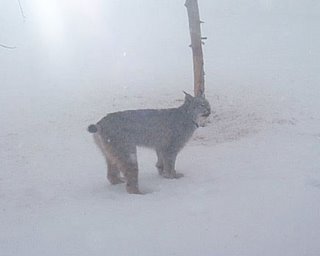
In my front yard yesterday afternoon. The post is part of bird-feeder. This is one reason I really like living here.



Of Fonts and Colours
There's some controversy brewing in the comments about whether white-on-black or black-on-white is better. I thought of putting up a poll, and may do so yet if I can find a free service that doesn't use pop-ups. Anyway, thanks for the input.
My own feeling is that some colour other than white is a better background. White screens are by definition putting out maximum light and are hard on the eyes. In the end I may go with black text on some pale coloured background.
On the use of fonts; serif fonts were invented as a practical way to extend the life of block print in the old days of moveable lead type. If, for instance, the cross-arms of a lower case t started to wear out, a sans-serif t would look like an l. The serifs on the end, being relatively bulky, would wear out last and the vertical stroke would at least have two little dots on either side which the eye would fill in. So they're kind of redundant with computers.
Also, serif fonts always remind me of school books and newspapers. They seem somehow more academic and serious. Sans-serif can sometimes seem light and even trivial. It's all a matter of taste I guess.
My own feeling is that some colour other than white is a better background. White screens are by definition putting out maximum light and are hard on the eyes. In the end I may go with black text on some pale coloured background.
On the use of fonts; serif fonts were invented as a practical way to extend the life of block print in the old days of moveable lead type. If, for instance, the cross-arms of a lower case t started to wear out, a sans-serif t would look like an l. The serifs on the end, being relatively bulky, would wear out last and the vertical stroke would at least have two little dots on either side which the eye would fill in. So they're kind of redundant with computers.
Also, serif fonts always remind me of school books and newspapers. They seem somehow more academic and serious. Sans-serif can sometimes seem light and even trivial. It's all a matter of taste I guess.
Hockey Night in Kandahar
Canadian troops are starting to take casualties in Afghanistan. We have to ask if it is worth it. The new Conservative gov't is refusing a debate in parliament, saying it would be "bad for the troop's morale." The foreign minister also said "Canadians don't cut and run." The rhetoric could have been written by a Bush staffer. (The last gov't wasn't perfect, but one thing I miss is the ability to feel smug about how at least we weren't as bad as the Americans.)
The Buddha said something very interesting about war; he said "men strap on armour and wield swords against each other for sensual desire's sake." In the case of all these new colonialist wars in the Middle East; that holds very true. The sensual desire is energy to run our autos and heat our homes.
Bringing democracy? Give me a break. The western powers are getting less democratic by the day with their Patriot Acts and secret trials. (And we have made in Canada versions here.)
In Iraq of course, it's about the oil stupid. The Afghan war has been out of the spotlight until recently and the polite cover story seems to have held up with the public better. But what you see on CNN ain't neccessarily the whole picture. The stark fact is that this territory needs to be held because it is the only viable route to bring Caspian gas to market.
There are also some specific questions that Canadians need to hear answers to. Are we turning over prisoners of war to the American military, which does not respect the Geneva Convention? If we must have troops there at all, why aren't we working with the United Nations instead of putting them under the banner of the US Operation Enduring Freedom? (Don't you love the Orwellian panache of those guys?)
Anyway interested in some background can read a pdf file published by the Canadian Peace Alliance.
The Buddha said something very interesting about war; he said "men strap on armour and wield swords against each other for sensual desire's sake." In the case of all these new colonialist wars in the Middle East; that holds very true. The sensual desire is energy to run our autos and heat our homes.
Bringing democracy? Give me a break. The western powers are getting less democratic by the day with their Patriot Acts and secret trials. (And we have made in Canada versions here.)
In Iraq of course, it's about the oil stupid. The Afghan war has been out of the spotlight until recently and the polite cover story seems to have held up with the public better. But what you see on CNN ain't neccessarily the whole picture. The stark fact is that this territory needs to be held because it is the only viable route to bring Caspian gas to market.
There are also some specific questions that Canadians need to hear answers to. Are we turning over prisoners of war to the American military, which does not respect the Geneva Convention? If we must have troops there at all, why aren't we working with the United Nations instead of putting them under the banner of the US Operation Enduring Freedom? (Don't you love the Orwellian panache of those guys?)
Anyway interested in some background can read a pdf file published by the Canadian Peace Alliance.
Mea Culpa
From my inbox
I think I can safely say I have never used this blog to talk about garlands and scents. More seriously, I have two things to say in my defence;
First, as the emailer goes on to say;
I believe that politics can be a proper subject of comment for a bhikkhu provided his effort is directed towards Buddhist virtues such as peace, compassion and contentment with little.
Secondly, mea culpa, mea maxima culpa. I am only human and sometimes I'm in a mood and edge over the line. In general, I don't think it helps one's spiritual life to be overly rigid and narrow. It's all a question of finding the balance (Middle Way.)
And let me add a third; there is a vinaya rule against looking into another monk's bowl to find fault.
Venerable Ajahn Punnadhammo:
I was hoping to have you answer some questions for me, which are unrelated themselves but have both demanded answering in my mind. I do thoroughly enjoy reading your blog, and check it frequently for updates, but find myself naggingly questioning the appropriateness of a Theravada monk to be commenting on those things which you do. No doubt this has been addressed to you before, and you may have even spoken of the question on your blog in the past, but I am a new reader as of the published Tricycle article on Buddhist Blogs, and am curious to read your response to the issue. I did a few minutes of quick research into the patimokkha, and was quite astonished to see that there are indeed no rules at all which specifically restrict the speech of a Bhikku, but I might point out that in the Nikayas certain topics seem to be looked down upon, though no formal transgression or punishment is detailed.
"Whereas some priests and contemplatives, living off food given in faith, are addicted to talking about lowly topics such as these — talking about kings, robbers, ministers of state; armies, alarms, and battles; food and drink; clothing, furniture, garlands, and scents; relatives; vehicles; villages, towns, cities, the countryside; women and heroes; the gossip of the street and the well; tales of the dead; tales of diversity [philosophical discussions of the past and future], the creation of the world and of the sea, and talk of whether things exist or not — he abstains from talking about lowly topics such as these. This, too, is part of his virtue." DN 2
I think I can safely say I have never used this blog to talk about garlands and scents. More seriously, I have two things to say in my defence;
First, as the emailer goes on to say;
Accesstoinsight.org also provides this useful commentary on the matter - "Conversation that does not deal with the Dhamma, though, is termed "animal talk" (tiracchana-katha) in the Canon, and there are several passages (e.g., Pc. XXI.1; LXXXV.1; Mv.V.6.3-4) that criticize members of the group of six for engaging in animal talk: worldly talk about "kings, robbers, and ministers of state (politics); armies, alarms, and battles; food and drink; clothing, furniture, garlands, and scents; relatives; vehicles; villages, towns, cities, the countryside; women and heroes; the gossip of the street and the well; tales of the dead; also philosophical discussions of the past and future (this is how the Sub-commentary to Pacittiya 85 explains 'tales of diversity'), the creation of the world and of the sea, and talk of whether things exist or not." The Sub-commentary notes, though, that to discuss any of these topics in a way to foster an understanding of the Dhamma — e.g., discussing the impermanence of worldly power — is not considered improper.
I believe that politics can be a proper subject of comment for a bhikkhu provided his effort is directed towards Buddhist virtues such as peace, compassion and contentment with little.
Secondly, mea culpa, mea maxima culpa. I am only human and sometimes I'm in a mood and edge over the line. In general, I don't think it helps one's spiritual life to be overly rigid and narrow. It's all a question of finding the balance (Middle Way.)
And let me add a third; there is a vinaya rule against looking into another monk's bowl to find fault.
Subscribe to:
Posts (Atom)

![[alsmbowl]](https://lh3.googleusercontent.com/blogger_img_proxy/AEn0k_shlfbA28mRrEYWEbGoUUA-mru6hyWGZ4Anbd4LVLOrb7SRtX9gorem0Mwf4l1hPvL31v06F2Fo0MCDSd9s6cIMWJ1Tpu0S5IR_5lwejZG_h-EOrw=s0-d "donations always welcome")