Showing posts with label environment. Show all posts

Nov 20, 2008

The Rights of Nature

Ecuador has just adopted a new constitution with some very radical new ideas. One in particular represents a totally new way of relating on the legal plane to the natural environment. The new Ecuadorean constitution recognizes that natural eco-systems have an inherent right to exist.

The text states;


"Natural communities and ecosystems possess the unalienable right to exist, flourish and evolve within Ecuador. Those rights shall be self-executing, and it shall be the duty and right of all Ecuadorian governments, communities, and individuals to enforce those rights."

This is ground-breaking because it is a non-anthropocentric view of the environment. As the International Law Observer points out, many states have environmental clauses in their constitutions, but hitherto these have always been couched in terms of the people's right to enjoy a clean environment or to specific environmental rights. No one before now has legally recognized an inherent right of nature itself.

The only historical parallel that occurs to me is King Asoka, and even he didn't go this far;

Beloved-of-the-Gods, King Piyadasi, speaks thus: Dhamma is good, but what constitutes Dhamma? (It includes) little evil, much good, kindness, generosity, truthfulness and purity. I have given the gift of sight in various ways. To two-footed and four-footed beings, to birds and aquatic animals, I have given various things including the gift of life. And many other good deeds have been done by me.

Too often, even environmentalists couch their arguments in anthropocentric terms - how often have we heard that it is important to conserve the rain-forest because it might contain undiscovered medicinal plants? This kind of argument might be thought good p.r. but it still encourages a narrow, selfish view that overlooks the existential reality of countless sentient beings. It still assumes that only humans count.

Two arguments against this law might be raised. First, there is the practical issue of how much good it will actually do. Ecuador is on its fortieth constitution since independence, and even long stable constitutions are not always followed very well. (I'm looking at you, Bush.) Furthermore, like the rest of us, Ecuador is under considerable economic pressure and the pressing need of foreign exchange will always be a temptation for resource exploitation.

All this is true, but even if the clause is substantially ignored in the immediate term, it is still a paradigm shift and if more countries adopted similar laws, the legal framework would inevitably evolve in a more earth-friendly direction. I do not think we should slight the boldness of the Ecuadoreans in adopting this law by popular referendum.

The second argument is a philosophical and legalistic one about the meaning of "rights." Some hold that only thinking rational beings like humans can be meaningfully said to possess rights. This argument depends on an arbitrary definition of "right." It is probably true that only humans can understand and make use of rights. The turtles of the Galapogos certainly remain unaware of their new legal status! And if the rights of nature and its inhabitants are to be protected in Ecuador, it will still require sympathetic humans to use the courts. Legal or constitutional rights are an arbitrary conventional concept, and we can certainly define them however we like. It seems to me the new Ecuadorean concept is a very progressive one.

In a very insightful post at Daily Kos, a good point about this last issue is made;


But Ecuador is not the first country to propose granting rights to nonhuman entities: Many countries, including the United States, have long held that corporations possess many of the same rights – such as the rights to free expression and to due process – that human beings have. And in June, Spain’s parliament approved a measure to extend some human rights to nonhuman apes.

So, if corporations are already legal entities with rights, why not rain-forests and jaguars? It could be seen as a simple leveling of the playing field, giving environmental activists a whole new set of legal options to protect endangered habitats.

This is the new kind of thinking we need. It is clear that the old paradigms have become obsolete and are leading us to disaster.

--------------------------

LINKS
- An excellent write-up in the UK Guardian, written before the constitution was approved.
- Legal background from the International Law Observer, includes comparison to other countries.
- Political analysis, (leftist) goes into some of the larger issues involved in Ecuador
- the Daily Kos article cited above, much interesting analysis and background.







Jun 6, 2008

World-View and World-Saving


My last post on the inter-monastic environmental conference has already sparked some thoughtful comments. Thanks to those who have posted.

A theme in all the comments is that what I am suggesting is a tall order.

I also suggest that it may be too difficult to require thinking of the Earth as sacred. Not many people are capable of thinking in this way. Hence again I suggest to look for intermediate perspectives between "sacred" and "not sacred" that are more easily acceptable to the mass public. Words like "duty" and "responsibility" come to mind.
I personally don't think nature has to be sacred though as brahma-vihara should cover all beings and doing what's beneficial for ourselves and all beings. It doesn't seem to me like sacred ideas about nature or even a belief in tree devas are necessary since humans and animals will be harmed by environmental damage and everyone agrees that these beings exist.

I agree with Robert regarding the "sacredness" of the earth. In today's spiritual black hole, the idea of the earth being sacred would do little but invite ridicule and laughter from people who look at all of that sacred stuff as being outmoded and impractical with the materialist worldview.
(Paragraphs taken from three different posts)

I take your point, but my problem is that I don't see a real alternative to a major change of world-view. Read Lovelock and other cutting edge hard-science types and you'll see that the problem is way beyond the reach of any tinkering around the edges with new technologies. The whole search for a comfortable techno-fix that would leave our life-styles intact is a major part of the problem at this late date. Read the essay Eco-Junk by George Monbiot for a scathing analysis of green consumerism. I stand by the statement that sustainable development is an oxymoron, a phrase I adopted from Lovelock.

I think that the need to re-sacralize nature is critical. At first glance, this might seem a poor fit with Buddhism. Samsara is the broken place we are trying to escape from. But that way of seeing things is a mis-application of the Dhamma in this case. We Buddhists do see all living things as sentient beings, possessed of conscious awareness and equal to us in the sense that we are all travellers on the wheel of rebirth.

And yes, the recognition of non-human entities like tree-devas and nagas is important too. It can easily be forgotten how rare in the sweep of human history our own culture is in being blind to that level of being. Old Celtic Europe had it's fairy folk and dragons, Native Americans had (and still have!) their little people and thunder-birds. Medieval Europe had angels, and Islam had it's jinn. In rural Thailand, the existence of devas and ghosts is taken for granted. Even the hyper-rational Hellenes had their fauns and satyrs, and let's not forget Socrates' genii.

What happened to the culture of Europe (because that's what the modern world is heir to) that it took a different road? Some major psychic shift seemed to occur at the turn of the 15th-16th century; the Renaissance, the Reformation, later the Scientific Revolution and the so-called Enlightenment. We (and I say we because whatever our nationality we are all of us heirs to that) took a hard turn into investigation of the coarse material level. It gained us mastery, but it cost us our spirit.

There is a theory I encountered once in a Christian book about angels. It suggested that the invention of perspective in Renaissance painting was not the invention of a new technique, but a faithful record of a new way of seeing. By seeing this material plane more acutely, we lost the ability to see other planes at all. Be that as it may, it is only the modern world which seems to have depopulated the spirit realms.

This wouldn't matter, perhaps, if only a belief in fairies or devas was at stake. But the loss of this realm is a symptom of a much deeper malaise. Everything is reduced to a dead mechanism. In the economic application, it is world as commodity. In the spiritual world, it is man as meat-machine; the "selfish gene" and the "computional model of mind." This world-view is spiritual death, and it may bear fruit in physical death, if not of the entire bio-sphere, at least of our civilization.

Having said all this, I don't know how we can open people's eyes to the wonder and miracle of nature if they are blinded by materialism and greed. But I don't see anything else that could turn the current trend around.

Jun 5, 2008

Monaticism and the Environment

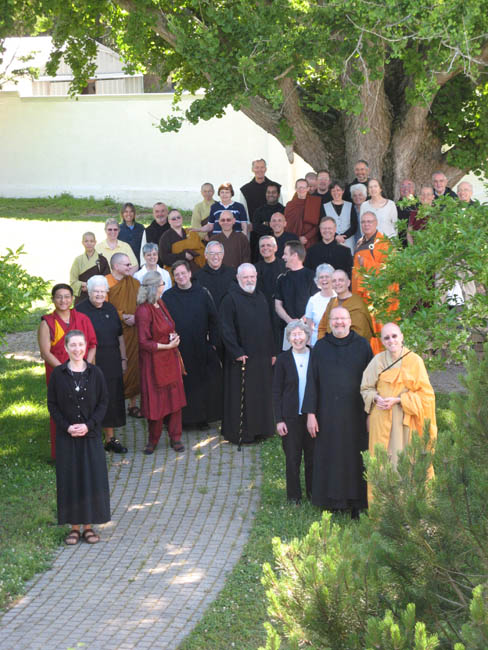
I recently attended the third Buddhist-Catholic monastic inter-faith conference at Gethsemani Abbey in Kentucky, famous as the home of Thomas Merton. There were forty participants, monks and nuns, Catholic and Buddhist from various orders and schools. The theme of the conference was Monasticism and the Environment. A timely topic, to say the least.

The talks and informal conversations were very fruitful and informative. I could sum up the main themes that developed under four headings, two theoretical and two practical;

Greed is the cause. Coming from various angles, everyone agreed that a culture of materialism and consumerism was the underlying motive force behind the environmental crisis. This is, obviously, a specific application of the Buddhist second noble truth. The rich countries today consume extravagant amounts of energy and resources to provide for an extreme life-style. This is completely unsustainable. The problem is really a spiritual crisis. Our modern culture has a warped value system. Here, the monastic communities provide a good example by demonstrating that it is possible to live happily and fully without indulgence in excessive material consumption. The broader culture needs to rediscover ways and means to happiness that do not require shopping.

The need to view nature as sacred. The concluding statement of the conference has the phrase, "we need to view the earth as a community, and not a commodity." The philosophy of materialism has reduced all of nature to a mechanistic process. This is again a spiritual problem, requiring a spiritual solution. Both religious delegations saw the need to re-sacralize the natural world. For the Christians, this means reverence for God's good creation. For the Buddhists, it could mean a recognition of Buddha-nature in all things (Mahayana) or seeing the world as peopled by tree-devas and river-nagas. On a more philosophical level, it means recognizing the primacy and universality of mind. The materialist-reductionist view is spiritual death and may lead to physical death of the planet.

Recognizing our complicity. On a practical note, we examined ways that our various monasteries may be contributing to the problem. One very obvious example is the amount of travel many of us do. This conference alone consumed a lot of fuel to get the participants together from all over North America.

Looking at the positive contributions. On the other hand, many monasteries of both traditions are moving actively into green technologies like wind-power and energy efficient building. We looked at a video presentation of a study done in France which showed that the carbon foot-print of two monasteries, one Catholic and one Tibetan Buddhist, was very much lower than that of the average French community.

The climate crisis is a grave one. I don't see how we can turn it around without a fundamental paradigm shift; a spiritual revolution in the mass value system on a global scale. Tinkering around the edges will no longer suffice. This is a tall order. It very well may not happen deeply enough or soon enough to stop a massive phase shift in the world's climate system which would devastate our civilization. As James Lovelock says, sustainable development is an oxymoron. We are going to experience a retreat. Our only choice is a managed retreat, or a chaotic one.

It occurs to me that if there is a massive societal collapse, monasteries may serve another crucial role. They might become islands of light conserving the knowledge of the old days until the human race gets on it's feet again. The monasteries of Europe, particularly of Ireland, did this after the Roman Civilization collapsed. We live in interesting times.

-----------------------------------------

Text of the Final Statement of the Conference

Spread with garlands of vines,
Places delighting the mind,
Resounding with elephants,
Appealing:
Those rocky crags
Refresh me.
Theragatha 18: Mahakassapa

The wolf and the lamb shall graze alike
And the lion shall eat hay like the ox.
None shall hurt or destroy
On all my holy mountain, says the Lord
Isaiah 65:25

Simple and Sufficient
Gethsemani III: Monasticism and the Environment
A Buddhist/Catholic Monastic Gathering
May 27-31, 2008

We live in a time of environmental crisis and calamity, but also in a time when more and more people are coming together to respond to the suffering of the world. Our monastic interreligious dialogue has brought us to a new awareness of the social and spiritual relevance of ancient monastic traditions that have been sustained for millennia by Buddhist and Catholic communities.

Together we celebrate our common monastic values of reverence for the sacredness of all things, contemplation, humility, simplicity, compassion and generosity. These virtues contribute to a life of nonviolence, balance, and contentment with sufficiency.

We recognize greed and apathy as the poisons at the heart of ecological damage and unbridled materialism. Throughout the centuries, monastic life has inspired generous personal, social and spiritual effort for the good of others. We give and receive in the spirit of gratitude.

We acknowledge our complicity in damaging the environment and will make a sincere and sustained effort to reduce our negative impact on the planet. We are committed to take more mindful, universal responsibility for the way we use and manage the earth’s resources. We resolve to develop our hearts and minds in ways that will contribute to a sustainable and hopeful future for our planet. We renew our commitment to the sacredness of the earth, relating to it as a community, not a commodity.

May our love for all beings and this world sustain our efforts and may our earth be revitalized. This is our prayer and commitment.

------------------------------

LINKS -

Website of the Third Inter-Monastic Dialogue. Includes audio files of all the formal presentations and video of the concluding ceremony.

Text of the paper I presented, Dependent Origination and Climate Change, a Buddhist look at causes and conditions.

----------------------------------

Feb 21, 2008

Monbiot's Heat

I haven't blogged for a couple of months, I've been staying mostly away from the internet for the winter. I may start putting up the odd thing now and again.

Previously I've written about the climate crisis and expressed something close to hopelessness. I've just read something that gives me at least some small hope. This is George Monbiot's "Heat." If you want a very accessible over-view of the technical issues involved, you couldn't do better than that. I heartily recommend it. Monbiot is brutally realistic, very rigourous (he actually crunches the numbers for you) and even writes with a verve and flair that keeps you engaged, no mean feat given the technical nature of the subject matter.

Mr. Monbiot's programme in the book is an ambitious one. He starts by doing the math about just how much we need to cut carbon emissions and how soon if we are going to stabilize the climate. Granted, there is always some guesswork involved in this field where the scientific details, if not the big picture, are still being worked out. But he makes a solid case for some quite startling numbers. We need, says Mr. Monbiot, to cut planetary carbon emissions by 80% before 2030. What's more, this translates into a 90% cut in the industrial countries.

Mr. Monbiot spends the bulk of the book showing how Britain, where he resides, could do this. He covers all major areas of the economy; transport, aviation, housing and so forth. Although he uses the example of Britain, most of what he says could be applied, with some changes, to any industrial country. (Or are we post-industrial already?)

I learnt some surprising things in this book; cement is a huge producer of carbon dioxide in the manufacturing for instance. (Who knew?) Micro-power like home windmills is highly over-rated. (It only looks good if you believe the manufacturer's hype). Monbiot disagrees with my other eco-guru, Lovelock, in a couple of places. Notably, he is not an advocate for nuclear energy.

In the course of the book, Mr. Monbiot surprisingly lays out a plan that could just do it, a plan that is both technically and economically possible. He also does it in a way that incorporates social justice; carbon emissions should be rationed not taxed. Futhermore, he manages to do it without scaling back the lifestyle of the rich nations as much as I would have thought necessary. He tries, whenever possible, to preserve our standard of living. He does this, I am pretty sure, not out of a sympathy with consumerism, but to make the scheme as palatable as possible to the broad masses. Where necessary, though, he can suggest quite severe changes; most notably in aviation. He says long distance jet travel simply cannot be made green. People in the future, if there is to be one, must simply travel less and travel more slowly. I would think we could and should actually cut a lot more out of our lifestyles, but I appreciate Monbiot's realism.

I would like to address the issue of voluntarism. I don't see how we can possibly stop runaway climate change that way. It's the old problem of the "tragedy of the commons." If one person lives in voluntary simplicity, it makes absolutely no difference to the problem. Granted, as one comment to this blog notes, it may set an example. But imagine if fifty percent of the public voluntarily gave up automobile travel. (An impossible number) What would happen? The price of gas would go down due to low demand, and those who didn't care would simply drive more and drive bigger cars.

No, the only action that can work is political (and Monbiot makes the same point.) The problem is way too big for each individual to deal with as they think best. The very least that must happen is a strict system of rationing for all goods that produce carbon emissions.

British Columbia has just introduced a budget said to be the greenest in North America, which includes a gradually escalating carbon tax. This is better than nothing, quite a bit better, but the problem with a tax is that the poor will suffer while the rich will continue to squander. (The budget isn't perfect, it still includes subsidies to the oil and gas industry, an insane policy)

I said earlier that Monbiot's scheme, worked out in meticulous detail, is workable both economically and technically. But is it workable politically? I remain pessimistic on that front. The public may make green mouth noises, but when it comes down to a reduction in their standard of living, such as giving up winter holidays in the Caribbean, the middle classes will not vote for anyone proposing something like Monbiot's plan in Heat. By the time things get so bad that people are willing to face tough decisions, it may be too late. Greed and ignorance strike again.

Jul 27, 2007

Facing Facts

A few more thoughts about the climate crisis;

First, the situation is beyond serious. Check out this article in the New Scientist for some hard science about polar melting.

In the article James Hansen (head of NASA's Goddard Institute) extrapolates our current situation based on geological history;

There is strong evidence that the Earth now is within 1 °C of its highest temperature in the past million years. Oxygen isotopes in the deep-ocean fossil plankton known as foraminifera reveal that the Earth was last 2 °C to 3 °C warmer around 3 million years ago, with carbon dioxide levels of perhaps 350 to 450 parts per million. It was a dramatically different planet then, with no Arctic sea ice in the warm seasons and sea level about 25 metres higher, give or take 10 metres.
And

...the palaeoclimate record contains numerous examples of ice sheets yielding sea level rises of several metres per century when forcings were smaller than that of the business-as-usual scenario. For example, about 14,000 years ago, sea level rose approximately 20 metres in 400 years, or about 1 metre every 20 years.
Second, even now there is a huge amount of denial. I'm not thinking here primarily of the dwindling breed of outright nay-sayers, but of the tendency to imagine things won't get that bad, or the gormless hope that some technological fix will save the day.

Hansen addresses one aspect of this, the strong economic pressure on researchers to downplay the data;

I was dismayed, because in conversations and email exchanges with relevant scientists I sensed a deep concern about the stability of ice sheets in the face of "business as usual" global warming scenarios, which assume that emissions of greenhouse gases will continue to increase. Why might scientists be reticent to express concerns about something so important?

...It seems to me that scientists downplaying the dangers of climate change fare better when it comes to getting funding. Drawing attention to the dangers of global warming may or may not have helped increase funding for the relevant scientific areas, but it surely did not help individuals like Mercer who stuck their heads out.
Of course there are powerful economic interests opposed to any restraint on burning carbon fuels. (Check out this two videos, both produced by public relations arms of the oil industry - Al Gore's Penguin Army and We Call it Life. ) But I suspect there is also something deeper going on. I think that many people who may intellectually accept the concept of anthropic climate change don't really believe in it on a gut level, because they are missing the idea of inevitable change, familiar to Buddhists as anicca. They find it difficult to imagine that things won't always be much the same as they are now.

Obviously, there is no justification for this erroneous assumption. Geology tells us that the earth has had many different climates, many different arrays of flora and fauna. It is only a scant fifteen thousand years since the end of the last ice age. Even on the scale of human affairs, history tells us that nations, races and civilizations rise and fall continually.

What may contribute to the inability to really imagine global change is the long era of peace and prosperity enjoyed by the developed countries since 1945. This is now coming to an end. In reality the only surefire prediction about the future is that it won't be anything like the present.

Third, there is almost no willingness to face up to what needs to be done. George Monbiot says it better than in could in a recent post, Eco-Junk;

Uncomfortable as this is for both the media and its advertisers, giving things up is an essential component of going green. A section on ethical shopping in Goldsmith’s book advises us to buy organic, buy seasonal, buy local, buy sustainable, buy recycled. But it says nothing about buying less.

Green consumerism is becoming a pox on the planet. If it merely swapped the damaging goods we buy for less damaging ones, I would champion it. But two parallel markets are developing: one for unethical products and one for ethical products, and the expansion of the second does little to hinder the growth of the first. I am now drowning in a tide of ecojunk. Over the past six months, our coatpegs have become clogged with organic cotton bags, which – filled with packets of ginseng tea and jojoba oil bath salts – are now the obligatory gift at every environmental event. I have several lifetimes’ supply of ballpoint pens made with recycled paper and about half a dozen miniature solar chargers for gadgets I don’t possess.

... Ethical shopping is in danger of becoming another signifier of social status. I have met people who have bought solar panels and mini-wind turbines before they have insulated their lofts: partly because they love gadgets, but partly, I suspect, because everyone can then see how conscientious (and how rich) they are. We are often told that buying such products encourages us to think more widely about environmental challenges, but it is just as likely to be depoliticising. Green consumerism is another form of atomisation – a substitute for collective action. No political challenge can be met by shopping.

This aspect of the crisis has bothered me for some time now. There is a growing trend to want to do the right thing, the "green" thing. But only if it means no real sacrifices. Let's face the hard truth; switching to flourescent bulbs, putting your tins in the blue-box and buying bags made of hemp is not about saving the planet. It's about making you feel good. (The absurdity of off-setting carbon credits is an extreme example.)

I've said it before, the only thing that will work is a massive roll-back of consumerism. Never mind "green," the catchword should be "less."

And I have to respectfully disagree with fellow Buddhist blogger Cliff of Everyday Zazen who says, regarding the climate crisis;

as in all things,it comes down to individual effort. concern is not enough. it’s what i do that matters.
Given the scale of the problem, this kind of voluntarism is not merely disingenuous, it is actually dangerous. The damage to the environment is too massive to be met by the kind of paltry tinkering that individuals can accomplish. I agree with Monbiot that the only thing that would have a hope in hell of succeeding would be a strict regime of carbon rationing. Politically, there doesn't seem to be much chance of this happening.

However, people were willing to accept quite draconian rationing schemes during World War Two. Odd creatures that we are, we only seem to be willing to make real sacrifices in the interest of beating up on another tribe, not on securing the future for everyone.

Fourthly, The Prognosis is Not Good. Given the last point, it seems unlikely that anything significant enough to make a difference will be done in time. And to make matters worse, there is another consideration. Even if one or even several nations come to their senses and institute a Monbiot carbon rationing scheme, it still won't work. The problem is global and there is no global authority capable of addressing the problem. All the major carbon producing nations would have to get on board, and in the current state of the world, the chance of that happening before it is too late is between slim and nil.

It's just barely possible to imagine that some of the Europeans might be up to the challenge. But the largest single producer is the USA and 'nuff said about that. Also China and India are industrializing at a rapid clip and the middle classes are just beginning to taste the dubious joys of a consumer life-style. And there are an awful lot of them.

I'm sorry I couldn't end this post on a hopeful note. If it makes you feel better, sort the cans from the bottles until the endorphins kick in.


Jul 8, 2007

Saving the Earth with Rock and Roll


Well yesterday was 7/7/07 and the big Live Earth Concert which has saved us all just in the nick of time. By the middle of Madonna's second number, the Greenland Ice Sheet had started to refreeze and what with Al Gore's enormous investment in carbon offsets, we should all be laying in extra firewood for the cold winters ahead. Polar bears are celebrating.

Sarcasm aside, this whole event is quite depressing in the way it typifies our pathetic response to the very real climate crisis. Scientists like Monbiot and Lovelock are painting a very grim picture; according to the latter, we may already have passed the critical "tipping point" where the earth system is going into positive feedback through reduced albedo and released methane from the melting of the Canadian and Siberian permafrost. People at all levels, even the thickest of politicians, are finally facing the facts, about twenty years too late.

But what are we doing about it? Putting in flourescent bulbs mostly. And on the political level, setting ambitious "targets" decades in the future, targets without concrete plans in most cases.

And, oh yeah, holding rock concerts. A really good article from the online Daily Mail has the following snippet;

A Daily Mail investigation has revealed that far from saving the planet, the extravaganza will generate a huge fuel bill, acres of garbage, thousands of tonnes of carbon emissions, and a mileage total equal to the movement of an army.

The most conservative assessment of the flights being taken by its superstars is that they are flying an extraordinary 222,623.63 miles between them to get to the various concerts - nearly nine times the circumference of the world. The true environmental cost, as they transport their technicians, dancers and support staff, is likely to be far higher.

The total carbon footprint of the event, taking into account the artists' and spectators' travel to the concert, and the energy consumption on the day, is likely to be at least 31,500 tonnes of carbon emissions, according to John Buckley of Carbonfootprint.com, who specialises in such calculations.

But take solace in the fact that they've bought all kinds of guilt removing "carbon offsets."


The hard fact is that if we can stop this warming at all (which is doubtful, curly light bulbs or no) it can only be done by massively scaling back our (meaning the rich countries) lifestyles. Use less power, travel less, consume less. In many cases it may not hurt to eat less. Nobody wants to face up to that yet, and probably won't until Mother Nature scales back our lifestyles for us, the hard way.


Jan 22, 2007

Carbon Offsets

Here in Canada we are probably going to have a spring election and the number one issue may very well be the environment. This has a lot to do with the bizarre weather we've been having across the country. (Still no snow to speak of here in North-West Ontario) Finally people are starting to notice. But all we are hearing so far is various tinkerings and feel-good measures. Nobody wants to face up the stark fact that life-styles will have to radically change if we are going to do anything meaningful to reverse the climate catastrophe.

I don't blame the politicians entirely; if they told it like it is they'd never get elected. People are hoping that minor adjustments to their consumer habits will be enough. Actually it may be worse than this. People don't really want to save the ecosystem, they just want to assuage their guilty consciences.

Take one of the commonly hyped "Green" solutions; carbon offsets. The idea is that if you create a lot of carbon dioxide by flying, driving or what have you, you can negate the effect by paying a few bucks into a carbon fund that subsidizes alternate energy projects in the Third World. (See for instance the recent flap about Tony Blair's air travel)

Critics of carbon offsets have compared them to the medieval sale of indulgences. (See this very good essay by environmentalist George Monbiot in the Guardian) Actually the theological basis is almost identical. The church claimed that the saint's had accumulated a surplus of holiness, more than they needed to get into heaven, so they could sell it to you, direct to the sinner, allowing you to offset your adulteries, thievings and what not.

Trouble is, the adultery is still committed, and the carbon is still pumped into the atmosphere. The only tangible benefit is that the sinner feels good about it.

We need to look at radical down-shifting of our production and consumption. I said in this blog before that the Buddhist virtue of contentment with little could be a key; that's something so out of synch with modern values that it won't be easy.

The way people live in the rich countries (Europe, North America, Japan and a few others) is so out of harmony with what the earth can sustain that it is dysfunctional. And huge masses in India and China are scrambling to join the party. Consider how we live compared to our ancestors of only four or five generations ago. Houses are bigger (requiring more material, more energy to heat etc), people have more clothes (a common man in the nineteenth century might have a couple of sets of work clothes and one set of "sunday best"), our food is trucked from remote locations (and grown with massive petro-chemical inputs) and much of our entertainment is energy-intensive (the new plasma TVs, a totally unnecessary item, are huge energy hogs), people dry their clothes in electric dryers instead of on a clothesline etc. etc.

Besides using too much and living too fat, there is another problem. We are all in too much of a hurry. I would like to consider the case of jet travel. It is now possible to get almost anywhere on the globe in a day and a half. Is this necessary? Remember that Jules Verne, little more than a hundred years ago, wrote a novel verging on science-fiction about a man travelling around the world in eighty days.

Jet travel isn't even fun anymore. All the endless paranoid stupidities of taking off your shoes, not being allowed to carry a water bottle, being x-rayed and interrogated are just the start. Unless you are rich enough to avoid flying cattle-class, the cabins are cramped, the air is plastic, the food likewise (if there even is any) and the movies usually awful chick-flicks. The only good thing left about flying is being able to look out the window and see the clouds from above. And worst of all, you don't get the experience of travelling at all, which is to pass gradually from one terrain to another. First you are in some sterile airport where everywhere you look useless crap is being marketed, then you spend a few hours in a horrible aluminum can and then you're in another almost identical airport.

What's the alternative you say? Unfortunately, at present, there often isn't one. Speaking personally, I'd rather take a train when I go on teaching trips but a previous government in it's infinite wisdom pretty much destroyed passenger rail in Canada, and it doesn't even serve Thunder Bay anymore. And of course, you can't cross an ocean in a train.

Here's what I'd like to see; the return of sailing ships. Wind power drove our ancestors across the oceans and it could again. Think of it, the three-masters of the Royal Navy produced zero emissions. I wouldn't mind old-style sailing ships, actually, but there are modern high-tech alternatives, such as this kite-driven experimental freighter. Most of the practical designs which may be coming on line would be hybrids, which use diesel engines whenever there isn't sufficient wind. Or how about bringing back Zeppelins?

I know what some people are thinking, who has two weeks to cross the Atlantic? Maybe you only have a three-week vacation. But this is a symptom of the whole problem. If we didn't consume so much crap, the economy wouldn't have to produce so much, everyone could work less and get longer vacations. We wouldn't need to be in a hurry. A three-month vacation for everyone, leisurely sails across the sea for a standard middle-class vacation. A pristine planet.

But no, you'd rather have sixteen pairs of shoes.

----------

LINKS - Expedia offers carbon offsets for green travel
A look at carbon offsets from David Suzuki's web-site
The New Age of Sail from the New Scientist