Oct 12, 2006

Cambodian Monk Burns Himself to Death

A story based on an Agence France-Press report;

HNOM PENH (AFP) - A Buddhist monk in Cambodia burned himself to death as a sacrifice to Buddha, police have said.

The 20-year-old monk, Yin Keo, was at a pagoda on top of a mountain when he doused himself with five litres of petrol Saturday and set fire to himself, Battambang province deputy police chief So Sam An said.

"The monk completely believed in religion -- he sat cross-legged and poured gas over himself and burned to death in order to sacrifice his body to Buddha," So Sam An told AFP.

Other monks and nuns at the pagoda told police that Yin Keo, who had been in the monastery for three months, had repeatedly said he would die in a religious sacrifice.

"I have never seen anyone use their body as a sacrifice like this monk," the police official said.

I haven't found any more details. Although this site implies a very silly conspiracy theory in the caption under a photo of the 1963 immolation of Thich Quang Doc, this burning does unlike the more famous one in the photo, does not appear politically motivated.

Cambodia is a Theravada country, and Theravada unequivocally condemns suicide (except in the extremely rare case of an arahant with a terminal illness.) The story is maddeningly brief and sketchy, but the monk's name sounds Chinese, not Cambodian, so he may have been Mahayana.

There is a tradition of self-sacrifice by burning in Mahayana that can be traced back to this passage in the Lotus Sutra;

"After making this offering, the bodhisattva Seen-with-Joy-by-All-Living-Beings arose from his samadhi and thought to himself, "Although I have resorted to supernatural powers to make offering to the Buddha, that offering is not of my own body." Whereupon he applied to his body various scents of candana, kunduruka, two kinds of frankincense, trigonella, the scent that sinks in water, and the sent of pine tar. He also drank the fragrant oils of campaka-flowers. When a thousand and two hundred years had past in this way, he then painted his body with fragrant oil and in the presence of the Buddha Pure-and-Bright-Excellence-of-Sun-and-Moon he wrapped his body in a garment adorned with sacred jewels, annointed himself with fragrant oils, and with the force of supernatural insight he took a vow to establish a spiritual foundation.

That done, the bodhisattva Seen-with-Joy-by-All-Living-Beings burned his own body, the glow from which illumined a myriad worlds, as numerous as the sands of 80,000,000 Ganges Rivers. From those worlds, the Buddhas in them together and at once praised this bodhisattva by saying, 'Excellent! Excellent! Good man, you are truly persevering with vigor in the practice known as the true Dharma-offering to the Thus-come-one. If with floral scent, necklaces, burnt incense, powdered scents, paint-scents, divine fabric, banners, parasols, the aroma of the candana of the near seashore, and a variety of such things one were to make offerings, still they could not equal this act which you have fulfilled. Even were one to give kingdoms, fortified cities, wives and children, they would still not equal your deeds. Therefore, Good man, yours is called the Prime Gift. Among the various gifts to Buddhas, this is the most honorable, the highest of all, because it is an offering of Dharma to the Thus-come-ones.' When the buddhas had finished saying this they all became silent.

"The body of the bodhisattva Seen-with-Joy-by-All-Living-Beings burned a full thousand and two-hundred years and in the end was consumed by fire. Because this bodhisattva had made such a Dharma-offering as this, when his life ended he was born once again into the Pure Land of the Buddha Pure-and-Bright-Excellence-of-Sun-and-Moon in which he was born suddenly by transformation in the household of the King Pure Virtue (Vimaladatta), sitting with his legs in lotus position. LINK
There have been cases of such self-immolation from time to time, especially in China. Apparently, this practise was also done by some Taoists. There are also smaller acts of self-burning practised in Mahayana. The ordination ceremony usually includes a ritual burning of spots on the newly shaved head with incense, something not found in Theravada.

While this incense-burning is an established part of the ritual, there is also a fairly wide-spread practise among Korean Zen monks (and perhaps others) of burning off one or more fingers. This is often condemned by the religious authorities, but happens nonetheless. (See R.E. Busswell, The Zen Monastic Experience)

There is a story traditional in Theravada that Ananda when he came to the end of his life, levitated out over a river and burned himself up by entering the fire-kasina jhana. It may be of some significance that the oldest documentary source of this story seems to the Chinese traveller Fa Hsien.

Be that as it may, the Theravada position remains, don't try this at home.

Oct 9, 2006

Thailand Coup

I was in Thailand as a junior monk in 1992 at the time of the last coup. That was a very different affair from the present one. There was a major uprising against the military followed by a bloody repression. The King intervened and settled things down, leading to early elections. I remember a symbolic photograph in the papers that showed the King seated on his throne wagging his finger at the coup leader and the leader of the democratic faction, who were kneeling at his feet, hands in anjali.

The King is a remarkable man. He was actually raised in quite humble circumstances and was not considered to be in line for the throne. He has consistently been a force for stability and democratic progress in the country. He is certainly not a figurehead.

That's why it is significant that he has endorsed this current coup. He didn't have to do that. This coup also seems to have a strong measure of popular support, at least in Bangkok.

The Thaksin government was notoriously corrupt, and the elections almost as sketchy as Ohio's.

Another interesting angle; the coup leader is a Muslim and he wants to try and settle the Muslim insurrection in the south with negotiations. Thaksin was eager to make points with the Americans and was hopping on the War on Terra bandwagon, taking a hard line in the south. This aspect bears watching.

In short, not all coups are created equal.

Doing Firewood - A Haiku

Before enlightenment;
chopping wood, carrying water.
After enlightenment;
chopping wood, carrying water.
Bummer.

(It's that time of year, which is why I'm lazy about blogging)

Sep 28, 2006

China and Organ Harvesting

There have been allegations for some time now that China systematically harvests and sells the organs of executed prisoners. Thousands of Falun Gong practioneers have been "disappeared" and this may have been their fate.

The BBC has done an undercover investigation that adds a lot of credibility to these rumours;
See the clip on Raw Story. Also check out these telephone transcripts from an earlier independent investigation. In the interests of even-handedness, here's the Chinese Embassy's weasel-worded denial.

Sep 27, 2006

Changing Seasons


Some recent pictures around Arrow River, the fall colours are very good this year. Soon enough the trees will be bare.

Speculative Physics

Here's some delicious mind candy for you. Is the Universe a Hologram?

Hua-Yen Buddhism teaches much the same; the whole contained in the parts and so forth. Not that I really know what I'm talking about concerning Hua-Yen, but I just happened to read the above piece immediately after reading a piece about Hua-Yen Buddhism in Buddhadhamma Magazine. Coincidence? Is that even a meaningful concept?

One detail from the Buddhadhamma piece; one Hua-Yen master built a shrine room with all six sides mirrored and a Buddha image suspended dead-centre. Damn, I want one of those!

Sep 19, 2006

Pope Benedict's Remarks

There is once again a tremendous spasm of outrage over a perceived offence to Islam. Religious zealots seem innocent of irony; they have burned several churches and killed an elderly nun because of the insult of being called violent. This is a very different circumstance than the Danish cartoons. In that incident, while deploring the over-reaction, I sympathized with the Muslims feelings of insult. There was no reason to print those cartoons except as a deliberate provocation.

In this case, however, the Pope's remarks were taken completely out of context. He was quoting Manuel II Palaelogus, a late Byzantine emperor and it is evident the quote was used to make a point, and no endorsement of the sentiments were implied. The point being made concerned the danger of religion without reason. If the Pope made any error of judgement, it was in choosing an example from Islamic-Christian confrontation; with a little thought he could have used a purely Christian example to make the same point. In this times, one must be very careful in what one says.

Mostly though, I blame the media in both the west and the Muslim world for cherry-picking two lines in a long complex talk. Nor do I think Pope Benedict has anything to apologize for.

While this whole controversy is too ridiculous to waste any more of your (and my) time over; it did have the fortuitous side-effect of bringing attention to what otherwise would have been an obscure speech to the faculty of a German university. This Pope is an interesting thinker, no doubt about it. The speech itself is well worth a look; it's on the topic of Faith and Reason.

I find myself somewhat in sympathy with many of Pope Benedict's views. Like him, I am uncomfortable with some aspects of modernity such as moral relativism and the materialist world-view. (We're the last two great medieval thinkers.) The Pope has an interesting take on this; he sees the Reformation beginning a process of "de-hellenization," a movement away from the western heritage derived from Greece.

He sees the western Christian, Catholic, view as based on rationality. This makes, for him, theology a rational discipline. It is possible to know the mind of God, at least in part, by analogy from our own minds. This he opposes to both Islam and Protestantism, which are purely vehicles of Revelation; the only things we know about God are what he chooses to tell us. He could (but didn't) have brought in a contrast with eastern Christianity as well, which rejects the positive theology of Rome for what they call an "apophatic" approach, i.e. God is essentially unknowable.

How does all of this relate to Buddhism, which after all postulates no God, apophatic or otherwise? In one particular Buddhism is closer to Catholicism than the other theistic religions in that it is a core axiom that the universe is orderly or rational. This is the principle of the General Dependent Origination; things arise from causes and not otherwise. In other words, Buddhist thought rejects arbitrariness or random arising. In fact, we take this a step further than the Catholics because we also reject the supreme arbitrariness of a Creator. (Balls in your court now Benny.)

But while Buddhism is not theistic, nor is it atheistic in the sense that word is usually understood. There is a transcendental (lokutarra = "above the world") element in Buddhist metaphysics; the Nibbana element or the Unconditioned. For the unawakened putthujana ("many folk") this must perforce be a matter of faith (saddha.) So the tension between reason and faith is present in our religion also. And we see it played out in different ways. There are those westernized Buddhists who want to reject faith and the transcendental altogether. These thinkers are more a product of the European Enlightenment than the Buddha's.

There is one other way in which we would differ from the Pope. He deplores at one point in his talk the reduction of religion to a purely personal and subjective experience. The Catholic Church, as the holder of the keys, has always been uncomfortable with mysticism; persecuting its great mystics while alive and then often as not sanctifying them when dead. While I sympathize with the Pope on the one hand when he criticizes the modern tendency to deny that there is any objective truth, I have to differ with him as well. I think the Buddhist position would be that there is indeed an objective unalterable truth, but that it can only be realized subjectively and personally.

In any case, I encourage you to read the Pope's comments for yourself and draw your own conclusions. Like I said, this man is a subtle and intriguing thinker. Out of step with the times, perhaps, but that's a good thing in times like these.

LINKS

Full Speech of Pope Benedict.
A more political take on it by Justin Raimondo
Who was Manuel II Palaeologus anyway?

Sep 11, 2006

The Fall of the Towers


If you're as old as I am, you'll remember when the 21st century was expected to be a wonderful time of domed cities, flying cars and colonies on the moon. Instead, nine months into the new millenium we got that most terrible and sinister piece of performance art, now known universally by its date, written in, appropriately enough I suppose, American style as 9/11.

It's become trite to say that 9/11 changed everything. Of course, in the big picture it changed nothing. Business as usual in samsara. Beings die, often horrifically, sometimes suddenly. Life is precarious, unpredictable, uncertain. So what else is new?

But in a lot of ways, we do perceive a pre- and a post- 9/11 era, making it one of a very few such events of world historical importance. Any sense of optimism about the world scene, and we had some of that in the 'nineties, naive perhaps but palpable, is gone. We are now in a period of dark international anarchy; war, terrorism, torture, the rise of the omnipresent security state. We are becoming divided along ethnic and principally sectarian grounds. White passengers are made "uncomfortable" by the presence of brown passengers and flights are delayed as those whose skin tone clashes with the zeitgeist are removed for questioning.

Most horribly, the psychic cataclysm of the event was used by those in power in America and Britain to unleash a greater cataclysm in the Middle East; wars, wars and rumours of wars. Mesopotamia, the cradle of civilization, poisoned and laid waste. More than a hundred thousand dead and how many lives ruined?

And we now live in a world of shadows and deceit. There are three or four versions of every event in the news and the scenarios are hotly debated. With 9/11 in particular, to this date, five years on, we still don't really know what happened. The official version is so full of inconsistencies and odd lacunae that it cannot any longer be taken seriously. But no problem, there are plenty of alternate theories to choose from. As I said about faith, it may be mostly a matter of aesthetics which one you believe in.

The power of propaganda to stupefy and delude is impressive. The official scenario, nineteen arabs with box-cutters led by a mad fanatic hooked up to a dialysis machine in a cave in Central Asia, is something out of a bad James Bond movie. This has been accepted as the real deal only by dint of repetition. The really amazing thing is the thread-bare nature of the evidence for this scenario in the public domain. There was Mohammed Atta's passport, miraculously found in the rubble, and a grainy video of some guy who looked vaguely like Osama Bin Laden if you squinted a bit. And not much else.

And, like in the case of the JFK assassination, whether there was any high-level conspiracy or not, there definitely was a cover-up. Why was so much evidence destroyed or hidden? Where are the black boxes? We know what happened to the air-traffic control tapes, they were "accidentally destroyed." Even the rubble was hauled away and melted down with reckless haste. It is normally a felony to destroy evidence from a crime scene, but apparently not in the case of the crime of the century.

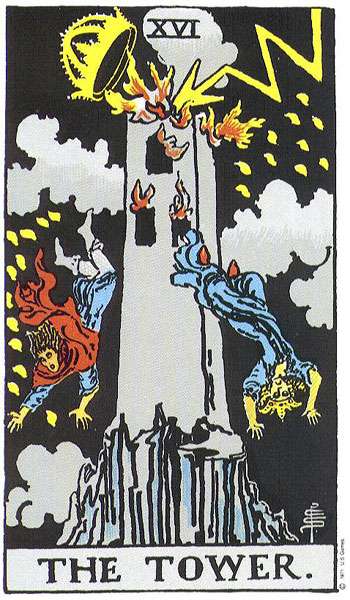
I called 9/11 a terrible piece of performance art. On a psychological level it was more than that, it was an act of Black Magic; a ritual act of great power which shook and re-arranged the collective psyche. It struck me almost immediately that the scene had sinister mythic or occult undertones. The two towers; Joachim and Boaz (or Isengard and Barad-Dur?) cross-referenced with the sixteenth trump of the Tarot. Did somebody know precisely what they were doing?

In the sequence of the Tarot, the fifteenth arcana is the Devil, and the culmination of his works is the Destruction of the Tower. But after the smoke clears, the next arcana is the Star. If we can shake off our media induced stupefaction, and rediscover our common humanity, disown nightmare dreams of empire and terror, can we find our way back to simplicity?


Sep 5, 2006

Snakey on a Plane

[T-shirt reads "I am not a terrorist" in Arabic." Source.]


Recently I posted a link to the insane story of the iPod toilet bomb. There's more. Already in 2004 we had this madness;

A Midwest Airlines flight from Milwaukee to San Francisco was canceled Sunday night after a passenger discovered Arabic-type handwriting inside an in-flight magazine.
The 7:25 p.m. flight carrying 118 passengers and five crew members had already pulled away from the gate at Mitchell International Airport when a passenger flipping through the Midwest Airlines magazine tucked in the seat pocket saw the writing and told a flight crew member. The writing, which was scribbled on a page of the magazine, turned out to be Farsi, the Iranian language, said Midwest spokeswoman Carol Skornicka. Before the plane took off, the flight crew decided to take a closer look at the writing. The plane returned to the gate, and passengers were taken off the plane. Security authorities were notified; all of the luggage was checked and the aircraft was inspected. Nothing was found.
A plane evacuated, passengers delayed and luggage searched because some rube found a marginal scribble in what he thought was Arabic? Marginal scribbles are now weapons of mass destruction?

Now, after the (omigod!) exploding shampoo incident, things have ratcheted up more than a notch. Recently, mostly British passengers leaving the holiday spot of Malaga Spain staged a revolt and refused to fly until two young Muslim men were ejected, at gunpoint no less. Their crime? The increasingly common offence of FWB, Flying While Brown. Oh, and speaking Urdu which the vigilant flying public took for (horrors!) Arabic.

"We might be Asian, but we're two ordinary lads who wanted a bit of fun."

"Just because we're Muslim, does not mean we are suicide bombers."

Khurram added: "I don't blame anyone for what happened. Actually I feel sorry for the people who thought we were terrorists."

The fun-loving pair visited the Spanish resort for a quick recce ahead of a proper holiday later in the year.

They are so far removed from extremism that they even spent the day boozing and tucking into a McDonald's burger.

Khurram admitted: "As Muslims we are not supposed to drink alcohol, but we did have a few."

Now, just today, we have the story of an Hasidic Jew being ejected from an Air Canada flight for praying. Yes, praying. Best be on the safe side, I guess. We don't know what he was praying for. The air crew actually said, "I'm sorry sir, we know you're not a Muslim, but you're making some of the passengers uncomfortable." Probably wasn't even brown, but may have been a bit on the swarthy side. Better not take chances.

I have a suggestion. Next time a bunch of ignorant bigots complain, let them get off and wait for the next flight. More leg room for the Muslim lads and the Hasidim.

People are being manipulated into fear and prejudice with all this terrorism hype. And hype is the operative word. The exploding baby milk plot or whatever the hell it was supposed to be was supposed to be the scariest thing since Saddam Hussein got that yellow-cake (wait, bad example. No, on second thought, good example). But;

None of the alleged terrorists had made a bomb. None had bought a plane ticket. Many did not even have passports, which given the efficiency of the UK Passport Agency would mean they couldn't be a plane bomber for quite some time.

In the absence of bombs and airline tickets, and in many cases passports, it could be pretty difficult to convince a jury beyond reasonable doubt that individuals intended to go through with suicide bombings, whatever rash stuff they may have bragged in internet chat rooms.

What is more, many of those arrested had been under surveillance for over a year - like thousands of other British Muslims. And not just Muslims. Like me. Nothing from that surveillance had indicated the need for early arrests.

Then an interrogation in Pakistan revealed the details of this amazing plot to blow up multiple planes - which, rather extraordinarily, had not turned up in a year of surveillance. Of course, the interrogators of the Pakistani dictator have their ways of making people sing like canaries. As I witnessed in Uzbekistan, you can get the most extraordinary information this way. Trouble is it always tends to give the interrogators all they might want, and more, in a desperate effort to stop or avert torture. What it doesn't give is the truth.
What's more, it wouldn't have worked anyway. Technically impossible.

If anyone doubts that we are descending into a dark age, consider this; one of the quantitative measures of civilizational level is travel time. Point-to-point travel times declined steadily since the early eighteenth century to nearly the end of the twentieth. Now, with time added to take off our shoes, have some underpaid security guy riffle through our luggage, get our i.d. checked four or five times, we've added at least an hour and a half to most journeys. More, if you average in the delays because some dufus found a grocery list in Urdu tucked into the seat flap.

It's way past time to chill out. I wish the passenger train still ran to Thunder Bay.

Aug 29, 2006

How Far We've Fallen

Then and now.

A comment on the Eisenhower speech; notice at the end he says that only an "alert and informed citizenry" can save the republic from the military-industrial complex. If he was right, we are really screwed.

Of course, Eisenhower also said; "Things are more like they are now than they ever were before."

Aug 28, 2006

Sri Lankan Civil War

While the world is focussed on the middle east, the on again off again civil war in Sri Lanka is very much on again. Like all of these wretched modern wars, most of the suffering is borne by innocent civilians.

It's painful for me to try and write about the Sri Lankan crisis; it's painful to see Buddhists acting badly, and even using Buddhism as an excuse.

The parallels to the Israel/Palestine dispute are uncanny. Like the Palestinians, the Tamils have legitimate grievances and have suffered historical injustice. Like the Palestinians, the Tamils have been burdened with fanatical and blood-thirsty leadership. Like the Israelis, the Sinhalese have a legitimate concern for their national survival, like the Israelis the Sinhalese have a sense of religiously sanctioned specialness, and a religiously based claim to the land. And like the Israeli leaders, the Sinhalese nationalists now in control, refuse to make the historic compromises demanded by simple human justice. Like the Israelis, they insist that the other party must first abandon violence and then we'll talk. Any discussion of legitimate Tamil grievances is cut short by reminding the listener of all the evil deeds done by the Tigers. Sound familiar?

Let's be clear, the Tamil Tigers are undoubtedly a terrorist organization of the worst sort. They have carried out more suicide bombings than any Arab group, maybe more than all of them put together. They target civilians. They even bombed the Temple of the Tooth. Their leader, Velupillal Prabharakan, is a charimatic fanatic in the mold of Pol Pot. They systematically brain-wash and use child soldiers. One of their most recent tricks was to close off and mine a canal, causing an artificial drought that left fifteen thousand farmers without a crop. They also systematically assassinate moderate Tamil politicians who work for peace.

But the Tigers (or Hamas) didn't spring up in a vaccuum, or just for fun. The roots of the Tamil-Sinhalese conflict go back a long, long way. Battles against the Tamils in ancient times make up the bulk of Sri Lanka's national epic, the Mahavamsa. British colonial perfidy helped to stir the pot and set the stage for the modern round. (Again, the resemblance to Palestine is inescapable.) The British liked to play divide and rule, and favoured the Tamil minority with a role in the administration, at the same time importing unskilled Tamils by the thousand from India to work their tea plantations, squeezing the Sinhalese majority from above and below.

The first decade after independence it looked like a sensible and fair arrangement was in the works; both Sinhalese and Tamil were recognized as national languages for purposes of law, education, record-keeping and the like. But then in 1956 a Sinhalese Nationalist party came to power and with laws like the Sinhala-Only Act tried to enforce an artificial national unity. The resulting Tamil riots are usually considered the prelude to the civil war.

The nationalist faction among the Sinhalese, currently in power, insist tenaciously on a unitary uni-lingual state, when it is obvious that only a federal arrangement and protected status for minority rights will work as a basis for a peaceful solution. This leads them to insist on a "military solution." This has not worked at all in twenty years of fighting. Conventional wars waged against guerillas only kill a lot of civilians and increase bitterness, breeding more terrorists, more fanatics. (Again, the obvious parallels not only to the West Bank and Lebanon, but to Vietnam, Iraq and Afghanistan)

Consider this essay, posted on buddhistchannel.tv to get an idea of the mind-set of the Sinhalese nationalists; War and Buddhism. The author's thesis is quite outrageous; he is finding a Buddhist justification for war.

Therefore, it is wrong to bring in Buddha or his teachings, to draw parallels to the terrorism we are witnessing in Sri Lanka, in the world. When King Dutugamunu waged a war against King Elara, the Buddhist priests are said to have given their blessings and some of them is said to have accompanied the army.

King Elara was reigning in Anuradhapura. Anuradhapura was then a city, sacred to the Buddhists, as there were many monasteries, temples and shrines, precious to the Buddhists. No body wanted the place to be desecrated by building places of other religions, and conduct ceremonies and rituals not in keeping with the purity of Buddhism. Therefore the war conducted by the King Dutugamuna had the support and blessings of the Maha Sangha

There you have it; don't let anyone say there isn't a Buddhist fundamentalism. War waged to prevent the "desecration" of other faiths being practised.

Another reason why Buddhists would like to stop terrorism in the North at any cost is that Sri Lanka is where the true words of the Buddha, as recited by the monks exist. This land has been sanctified five times by the visit of the Buddha. He had been in the North, the South, East and the West of this Island. Therefore, they believe that this Island should continue to exist as a whole undivided, with the Sinhala, Tamil, Muslim, Malays and others, united as one Nation.

The unitary Buddhist state sanctioned by an ancient myth. Never mind that the Buddha almost certainly never left Northern India. Myths have power. Quick - can you think of some other polity that makes it's claims based on ancient religious claims? I thought you could. But ancient religious stories are not a sound basis for making policy in the face of modern realities. Insistence on a unitary state (as opposed to a federal one) is a recipe for endless warfare and the continued ruin of that lovely island.

Certainly not all Sri Lankans think like this; just this month a big peace rally was broken up by nationalist thugs, including some who disgraced the robe by joining in. There are many both Sinhalese and Tamil who are working for a real peace.

Consider this very sensible essay by a Tamil writer; The Unwise Intent to Keep Tamil Grievances Unresolved. The author makes the sound point that the ball is in the governments court as far as resolving a sensible solution. He says they should begin a process of devolution now, not waiting for an agreement that is not to be had with the Tigers.
If the government is going to wait for the LTTE to shun violence and join the democratic mainstream even to deal with the Tamil grievances let alone a political settlement, it will be a very long costly wait. Even one life lost in the conflict in Sri Lanka is too many to ignore.
The way to end terrorism is to end injustice; and that is for those in positions of power to do. This should not be seen as a counsel of weakness, but of real courage and strength. It also takes personal courage as many men of peace have met their end at an assassin's bullet, usually some fanatic who saw them as a traitor to their own people. (Gandhi killed by a Hindu fanatic, Anwar Sadat by a Muslim one, Yitzhak Rabin by a Jewish one, and several Tamil leaders by the Tigers.)

The author of the above piece goes on to quote from another article, articulating a just settlement;

The author has said two principles are important for a political solution to the ethnic problem. These are: “(1) to allow autonomy as much as it is necessary; (2) to ensure safeguards against any type of disintegration, break away or secession. We also believe that given current international developments and the challenges that our country is facing we need to have a rather strong system at the centre as well. Therefore, we propose considerable power sharing at the centre in addition to devolution of power to the regions or the periphery.
What is really striking is that in so many of these seemingly intractable conflicts, there is a plain, simple, fair solution staring all reasonable people in the face. Only the hard-hearted extremists of both sides seem unable to accept. More's the pity when they find their way to power, and feed off each other's hatred.

(One more link - a good neutral overview translated from the German Der Spiegel; Old Animosity, New Pain. )


Never, Ever lose your iPod in an airplane toilet

The unbelievable paranoid stupidity of this has to be read to be believed; some young kid loses his iPod in the toilet and all hell breaks lose.

I won't try and do a synopsis, the whole thing is incredible. Have we really come to this?

(thanks to Idleworm for the link; a great site btw)

Aug 25, 2006

Solar System Downsized

In a move said to be due to rising costs and increased competition, the solar system has been reduced from nine planets to eight. Officially, the system has said it regrets having to let Pluto go after billions of years of "exemplary service," but privately industry insiders have complained about Pluto's eccentric orbit, retrograde rotation and other anomalies. "Pluto doesn't even travel in the same plane as the rest of us, and sometimes he even slips inside Neptune's orbit. Let's face it, Pluto is just not a team player."

The same insiders are quick to refute rumours that the re-organization is not complete. "Contrary to what you might have heard, we are not considering out-sourcing any of the inner planets to Tau Ceti."

Pluto, together with his long-time partner Charon, will continue to free-lance as a dwarf planet.

Aug 23, 2006

One More on Lebanon

Hopefully this will be my last post on the topic (unless they start fighting again then all bets are off.) But I would be remiss if I didn't steer readers toward this really fine piece of analysis;

Israel's Water Wars by Jason Godesky

The writer makes a very convincing case for what I've stated here before; it had nothing to do with the ostensible pretext of two soldiers captured; it was all about water. I'll say it again; all wars are about resources; land, oil, water etc. etc. There is always a much-hyped casus belli which is nothing but a propagandistic smoke-screen. Don't pay any attention to the little man behind the curtain.

Read the article if you still think this was a war of self-defence.

Aug 22, 2006

Why Do We Believe Anything?

There is a very good essay on pharmaceuticals as a faith-based initiative (my phrase but I guess the author would concur) at the Dust blog. I pretty much agree with the Dust's perspective here, but that's not what I want to blog about. Instead, I'm intrigued by a question he asks in passing;
it would be nice if we all came to deeper understanding of just how we “came to believe” the things we believe.
Everyone believes something. Some of us can manage, like Alice, to believe five impossible things before breakfast. Others like to imagine they are "without beliefs" (even "Buddhists without beliefs") but that's a dodge, a fancy card-trick. Agnostics and skeptics are as much rooted in belief as Southern Baptists or Wahabbis. Just different beliefs; in particular the materialist world-view, or at the very least the reality of the external world.

Most of what you think you know, you probably just believe. Most everybody these days believes, for example, in the heliocentric model of the solar system. But very few could come up with cogent arguments as to why the earth moving around the sun and not vice-versa is the real model.

People believe all kinds of things less rational than this, and with less reason. Creationism, materialism, grey aliens, perpetual motion, the Rapture, the benefits of Free Trade; heck, I'm told some people still believe the official version of 9-11.

People who believe any of these things, or their equally faith-based opposites, or anything else at all, can come up with all kinds of rational arguments, and snippets of evidence, to back up their beliefs. Cruise around the internet and you won't take long to find heated debates on stuff like creationism vs. evolution, with carefully constructed arguments on both sides. But here's the really intriguing thing; almost no-one seems to ever change their position based on these arguments. The best constructed arguments on the other side just force a true believer to refine his or her own counter-arguments in an endless dance.

I would like to suggest that evidence and logical reasoning are only called in after the fact, to justify and bolster a belief. In most cases, they really have nothing at all to do with why we believe what we do.

So why do we believe what we believe? I would like to suggest that the real unspoken criterion of all beliefs is aesthetic. We believe what we believe because it is more beautiful, or more elegant than the available alternatives. We feel intuitively that if x is true then the universe is a more satisfying place. This makes belief a matter of taste. Some people revel in the cold, stark vision of materialism. Others go for the warm fuzzies of eternalism.

To go back to the example of the heliocentric solar system; it would be theoretically possible to construct a completely geo-centric model that fits all the observable data equally well. The only problem is that it would be horrifically complicated. This was in fact the reason the geo-centric model was abandoned in the first place. As more data came in, the astronomers had to keep adding epicycles upon epicycles. What really makes my case is that at the time when Copernicus's theory started to gain general acceptance, the geo-centric model, with all it's centuries of accumulated tinkering, actually fitted the known data better (mostly because Copernicus still assumed circular orbits.) The helio-centric model was adopted not because it fit the evidence better, it didn't. It was adopted because it was more elegant.

So it's all a matter of taste. At least, that's what I believe.

Aug 21, 2006

Fundamentalism and Triumphalism

We hear a lot about religious fundamentalism these days. I suppose we are stuck with the term, but it is actually used imprecisely. Fundamentalism, according to one dictionary definition is "strict maintenance of ancient or fundamental doctrines of any religion or ideology." This in itself may not necessarily be a negative thing. Fidelity to a tradition and it's teachings is one legitimate approach to religion. It may be thought by some to be narrow, by others to demonstrate an integrity and clarity of thought.

However, what is often called "fundamentalism" these days is probably better called "triumphalism." This is the view that one's religion is absolutely right, all others are wrong, and usually leads to the conclusion that force is justified to promote one's beliefs. The Buddha condemned this kind of thinking; "this is right, all else is wrong" as leading to disputation and conflict. We can certainly see that today.

The triumphalist imperative pollutes any religion it touches. While it seems more natural to arise in mono-theistic religions ("my god is bigger than your god") sadly even Buddhism doesn't escape. We had the sorry story this week of fundamentalist monks in Sri Lanka breaking up a peace rally with fist-fighting. How anyone can defend this behaviour as consistent with the Buddha's teaching is beyond me.

There is also a Hindu fundamentalism, whose deeds included the assassination of Mahatma Gandhi and the wrecking of the historic Babri mosque in 1992 (which sparked bloody communal riots.) These type of actions are hardly compatible with the Hindu ideal of ahimsa. (harmlessness)

We hear a lot about Islamic fundamentalism (or Islamo-fascism in the fanciful neo-con lexicon.) Often the discussion simplifies complex and contradictory movements within modern Islam, which seems to be in a period of ferment and renewal not unlike the Protestant Reformation of 16th Europe. That period too, had it's "mad mullahs," it's iconclasm and it's struggle to come to terms with a changing world.

Certainly groups like the Taliban, with their ultra-strict moral codes violently enforced, and their wanton destruction of imagery like the Bamiyan Buddhas, and their valorization of war and conflict, qualify as "triumphalist." Some among the Shiites also have a dangerous fascination with apocalyptic thinking; awaiting the end of this world and the coming of the twelfth imam.

The Christians also have a powerful fundamentalist (or triumphalist) wing, especially in the United States. Like their Muslim shadow-selves, they have a very strong belief in the imminent "end of days." It's kind of scary when people who think the end of the world is a good thing are close to the policy making apparatus of major powers.

There is also a Jewish fundamentalism that complicate the Middle-East problem by seeing a religious sanction for occupation of the whole of Palestine to the Jordan. Some of them even want to re-construct the Temple of Solomon, which would involve destroying the Al-Aqsa mosque. To them, a minor detail. To the rest of the world, a major conflagration.

(I'm not aware of Taoist or Jain fundamentalism - maybe I'm just not informed)

These fundamentalisms feed off each other; they need each other to thrive. Where would the Christian Right in the US be without the "evil axis" of "Islamo-fascism" to rant against? Where would the Islamic hard-core get their juice without the "Great Satan" or the "Zionist entity?"
The Buddhist fundamentalists in Sri Lanka are largely a response to the very aggressive and unethical proselytizing of Christian fundamentalist missionaries.

Too bad we can't all just get along.

Arrow River Announcement

We are having the Annual General Meeting for the Arrow River Forest Hermitage, all friends and supporters of the hermitage are welcome. Date and time; 1:30 PM Sat. Sept. 9th. There will also be a pot-luck and BBQ at 11:00 AM. Please RSVP if you are intending to participate in the lunch.

Aug 6, 2006

Not Enough Dead Arabs?

A truly frightening glimpse into the neo-conservative mind-set is Norman Podhoretz's piece in the New York Post, featured on Uruknet; Too Nice to Win?

Apparently, Israel's problem is that it is just too darned soft-hearted;

If Lebanon's 300-plus civilian casualties are already rocking the world, what if it would take 10,000 civilian casualties to finish off Hezbollah? Could Israel inflict that kind of damage on Lebanon - not because of world opinion, but because of its own modern sensibilities and its understanding of the value of every human life?

What's more, Norman has a little friendly suggestion for the US in Iraq;

What if the tactical mistake we made in Iraq was that we didn't kill enough Sunnis in the early going to intimidate them and make them so afraid of us they would go along with anything? Wasn't the survival of Sunni men between the ages of 15 and 35 the reason there was an insurgency and the basic cause of the sectarian violence now?
Thanks, Norman, we'll take that under advisement for our next invasion. He also indulges in a little bit of historical perspective;
Could World War II have been won by Britain and the United States if the two countries did not have it in them to firebomb Dresden and nuke Hiroshima and Nagasaki?
Bad examples, Norman, both of them. The war in Europe was pretty much won when Dresden was firebombed, a gratuitous act of carnage probably meant to scare the bejeezus out of the Russians more than anything else. And as for Hiroshima, John Denson makes the case better than I can, in this excellent essay on the Hiroshima Myth.

Why should we care about the murderous ravings of some crank? Who is this Norman Podhoretz anyway? According to his bio in Wikipedia, Podhoretz is a member of the Council on Foreign Relations, the Project for a New American Century, and a 2004 recipient of the Presidential Medal of Freedom. He's one of the leading ideologues of the whole Clash of Civilizations/ World War IV mythology.

Aug 3, 2006

Apologia

My apologies for blogging so much about the Lebanon war. I know there are some who feel that a bhikkhu shouldn't be commenting on "politics." They have a point, but my feeling is that this episode goes beyond politics and is part and parcel of the great moral crisis of our times. Our world seems to be spiralling down into a new barbarism with only the ethic of "might makes right."

Make no mistake, those who engage in this acts of wanton slaughter are making very heavy karma for themselves. And the same goes for all those overseas who give their vocal support to the perpetration of war-crimes. Anyone, and there are many, who makes excuses for the carnage of Qana is morally bankrupt. Their consciousness is filled with unwholesome dhammas of hatred and delusion.

The hypocrisy of the omnipresent Israeli spokespersons who "deeply regret any loss of civilian life" is pathetic. Air-strikes on apartment blocks (and Qana was not the only one by a long shot) are justified by Hizbollah rockets having been launched in the vicinity. Even if true, and that is debated hotly, this does not qualify as an act of self-defence. Let's call it by it's true name; revenge. The launchers used by Hizbollah are truck-mounted, they are mobile, and by the time the Israeli air-force arrives they are long gone.

The primitive, dark ethos of tribalism and an eye-for-an-eye govern this vicious conflict on both sides. If it seems like I've mostly criticized Israel, it's because on the best unbiased look at the evidence, this war was started by Israel, whatever their protestations. And the damage inflicted by Israel is a few orders of magnitude greater than Hizbollah is capable of. But both sides are hitting civilians. Both sides are using banned weapons; Israel has dropped cluster bombs and white phosphorus while Hizbollah packs their rockets with ball-bearings.

America is to blame too, for supplying and bankrolling the Israeli war-machine. And Canada's government is acting as cheer-leader (although most Canadians are appalled.)

What has been accomplished by this nasty little war? A beautiful country wrecked and poisoned with depleted uranium. A further radicalization of the Muslims world-wide. No doubt an upsurge in antisemitism as well. If, as I strongly suspect, the real aim of the Israelis is to seize the water of the Litani, they will likely fail in that objective as well. That would mean an ongoing occupation against a hostile population and another Iraq, another Gaza. The Americans haven't gotten much benefit out of Iraqi oil even yet.

What is needed now is some real statesmanship, but I don't see much hope of that. The world seems to be governed by nasty, bigoted little men.

Jul 28, 2006

What Should Israel Do?

A couple of posters to the comments have asked, basically, what can Israel do?

With an earnest wish that the people of the Middle East, all of them, Israeli, Lebanese, Palestinian, Jew, Arab, Shiite and indifferent find a way to live their lives in peace and harmony; if I were in a position to be able to talk straight to the Israeli leadership and people, here is what I would suggest;

1. First and foremost, stop lying to the world and possibly to yourselves. The number one cause of all the trouble is the occupation of the territories conquered in '67 and all it's attendent evils; walls, apartheid roads, curfews, home-demolitions and most of all the intrusion of settlers. Israel is principally to blame for the situation and is therefore in a unique position to solve it. Stop portraying yourselves as victims, it ill becomes you. Arab terrorism has come about because of Israel's policies; it is a result, not a cause.

2. Start talking to your Arab neighbours instead of bombing them. The Council of Arab States proposed a sensible settlement in 2002, which Israel has so far ignored. Basically it is the old formula of land for peace. It is at least worth talking about, isn't it?

3. Israel should announce it's own goal of achieving a just peace, and hold up the offer of giving back the Occupied Territories. And this should be a genuine offer, to get out of all the West Bank. None of these carping caveats about keeping "major settlement blocs." The settlements are illegal and have no business being there in the first place. (And before anyway says Oslo was such an offer, they should read up on it a bit more.)

4. Israel should demonstrate good faith by immediately announcing a total freeze on new settlements. Further unilateral gestures could include opening all of the West Bank to free internal movement (no checkpoints except at the border with Israel) and withdrawal of the IDF from all areas not absolutely essential to security. Mostly, find ways to make the lives of ordinary Palestinians a little less hellish.

5. Open an international conference to discuss the eventual disposition of Jerusalem as some kind of international zone with protection for all religions.

6. Recognize the democratically elected government of the Palestinians, Hamas or not, and start talking to them.

7. Eventual peace would mean total withdrawal from all occupied territories. All the settlements must go unless the settlers are willing to become Palestinian citizens, and live under Palestinian rule and protection. Israel would still have something like twenty percent more Palestinian land than allowed for by the partition of 1947, but I think the world is willing to wink at that. If any land must be retained for the purposes of secure frontiers, then the Palestinians must be compensated with transfer of other lands; likely from the Galilee which was supposed to be theirs anyway.

With sixty odd years of bitterness behind them, it may be difficult for the parties to easily agree. But the alternative is an endless cycle of violence. The stark fact is that Israel can never in a thousand years fight it's way to lasting security. Negotiation and a willingness to right past wrongs is the only hope for the Jewish state in the long run.