Showing posts with label buddhist philosophy. Show all posts

Sep 8, 2010

Why is There Something Rather than Nothing?


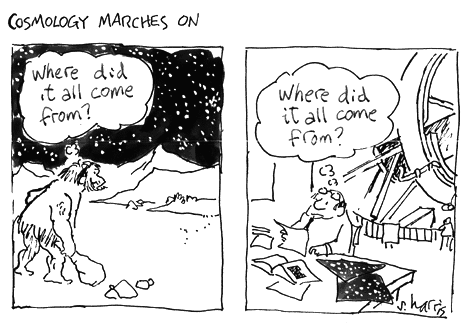
The publication of Stephen Hawking's latest book The Grand Design has stirred some new fire into the old embers of metaphysical speculation. Specifically, the discussion centres on one of the perennial Big Questions; why is there something rather than nothing?

Tough question that, probably impossible for the human mind to definitively answer. I haven't read Hawking's latest book yet, but from reviews I've noted on-line it would seem his answer is that the laws of the universe are such that it didn't require any outside force to initiate the manifestation  of a new universe. Which begs the question, where did these laws come from? Isn't the very concept of a "law" rather anthropomorphic? ("Your Honour, my client violated Planck's Constant by reason of temporary insanity.")

On the other side are the theists whose answer is that a transcendent, pre-existing entity, being or force willed the creation and set out the laws. This answer seems more complete but still doesn't offer a final solution because of course it begs the question, why is there a God anyway? Again, why is there something, even a transcendent something or someone, rather than nothing?

The Buddha's position was that such questions are fundamentally impossible to answer and useless to speculate about. His teaching was meant to be practical; what is our existential dilemma, how did we get ourselves into this mess, is there a way out and how do we manage to get there? Knowledge about the original manifestation or creation of the universe, even if it could be had, would not be useful in answering any of these practical questions.

Instead of a creation theory, the Buddha taught the dependent origination which has the more limited and practical purpose of describing how we find ourselves in this state of cyclic suffering known as samsara. It is a teaching that is entirely oriented toward the immediate human experience and does not attempt to push the question back to ultimate origins.

Without forgetting these original Buddhist principles, it may be interesting to think about how a Buddhist would position himself in the current debate.

For one thing, we should not assume that the universe needed to have a point of origin at all. While the Buddha, as noted above, refused to speculate on the matter, the later Buddhist tradition definitely leaned toward the idea that universe was both beginingless and endless, infinite in both directions and fundamentally cyclical in nature. This was in line with the general trend of Indian thought which is in stark contrast to the linear, eschatological view of Zoroastrian Persia and the monotheistic religions of the west, (whose cosmology may have roots in Zoroastrianism.)

Nowadays, the linear view has found some support in the Big Bang theory. But we should be careful not to take this as definitively proven. There is some contrary evidence that would support a "steady-state" or eternally existing universe. Most probably, the Buddha was right in that this is a question which can never be finally answered.

If we allow for the sake of argument that the universe may not have a single moment of origin, while this doesn't put to rest the question of why there is something rather than nothing, it does shift the emphasis somewhat and would tend against the idea of a creator. Schopenhauer addressed this from a philosophical perspective and said that there is no logical necessity for a first origin and that such an original moment would be a fundamental break in the chain of causality.

Another question raised by this debate is the reality of a transcendent element. Here, the Buddhist shares some ground with the theistic thinker but there are important differences in their understanding of the transcendent. The Unconditioned in Buddhism (the experience of which is called Nibbana or Nirvana) is completely ineffable, which means that it cannot be described in words or grasped in thought. This makes sense because words and thought are products of the conditioned realm. When the Buddha spoke about Nibbana it was always either in poetic similes or in negations; telling us what it is not. However, without forgetting its' ineffable nature we may venture on some approximations; it is outside time-and-space, it is neither physical not mental but sui generis in a category of its' own, it is not subject to change, suffering or cause-and-effect. In Christian theological language, the Nibbana-element is both trascendent (wholly other, "not-this") and immanent (present here-and-now.) Close Pali analogues would be lokuttara (lit. "Beyond the World") and sanditthiko (lit. "Able to be Seen Now").

In line with the practical nature of the Buddha's teaching, the only real argument for the reality of this transcendent element is experiential. "If there were no Unconditioned, there would be no escape from the Conditioned, but since there is an escape, there is an Unconditioned." In colloquial terms, you have to have been there.

This transcendent element seems to have some parallels with the concept of God but is different in that the Unconditioned is never conceived of as a person, being or entity that can through the power of its' will intervene in the Conditioned realm. For it to do so would be a violation of its' fundamental nature as outside of cause-and-effect. The closest approach to the Buddhist idea of the transendental found within theistic thought might be the apophatic view of the God-head held by the Eastern Orthodox or perhaps the Unmanifest in Jewish Kabbalah.

Perhaps a fair summary of the Buddhist position would be that while the question of why there is something rather than nothing is unanswerable (abhyakata) we can refer to the dependent origination to understand how this particular something we are caught up in comes about. Furthermore, we can venture that there are indeed two different modes of Something; samsaric and nibbanic, manifest and non-manifest, conditioned and unconditioned. So, once again, we take a Middle Path sharing some ground with both the theist and the atheist, but not agreeing completely with either pole.

LINKS

The theist argument against Hawking - The Curious Metaphysics of Dr. Stephen Hawking
An argument against the "Big Bang" - Religion Disguised as Science
What all the fuss is about anyway - Hubble Looks at Nothing, finds Something

Dec 16, 2009

Enlightenment vs The Enlightenment

(This post was inspired by a sentence in the statement made by the Insight Meditation teachers of Australia - "This was the original vision of the Buddha 2500 years ago, in far less enlightened times than today." Debatable sentiment that, to say the least. See an old post of mine - The Myth of Progress.)

Many of the English words used to translate Dhamma concepts are problematic; unavoidably so as no two languages are completely isometric. Some rather bad translations have become standard and are hard to avoid. The word "enlightenment" used to describe the state of one who has attained the goal is a particularly unfortunate example. It doesn't really translate any term in the Pali very well. "Awakening" as a translation for bodhi is better, but to my taste "Liberation" from vimutti is perhaps the best choice.

One problem with Enlightenment is that it is easily confused, consciously or not, with The Enlightenment of European intellectual history. We are the children of The Enlightenment whether or not we like it or even know it. Beginning in the eighteenth century with thinkers such as Voltaire and John Locke The Enlightenment has bequeathed us such modern ideals as equality, personal liberty, freedom of conscience and thought, rationalism and indirectly, democracy.

It is far too easy to blithely assume that the legacy of The Enlightenment has been an unadulterated good. We forget that its first practical project was the French Revolution and the guillotine. The history of the world since has been bloody and cruel. The essentially inhumane systems of both capitalism and communism owe their distant origins to Voltaire and the Encyclopedia. A case could be made that even Naziism, a basically anti-enlightenment movement, came into being by way of Romanticism, The Enlightenment's shadow side, and would have been impossible without it.

This should not be surprising. As we should often remember, this is samsara and it's supposed to be broken. The Buddha's "enlightenment" came from a perfectly awakened mind in touch with the transcendental. The European Enlightenment was the product of the fallible minds of putthujana (the unenlightened many-folk.)

The underlying philosophy of The Enlightenment legacy has been called "secular humanism" and this is a way of thought which is at odds with the Dhamma in at least two important ways. First, its secularism means that it denies any spiritual aspect to humanity or the universe. There is no Unconditioned and therefore no escape from the Conditioned. This samsara is all we've got and we had best make the most of it. Second, it is humanist and that means that Man is the supreme value. This leads to the cult of the individual and a strong re-inforcement and validation of the Self principle. The implicit ideas of Enlightenment Humanism is one reason the anatta doctrine is so difficult for educated westerners.

To translate this into the practical issues confronting us right now. We cannot deny that in Theravada Buddhism for at least a thousand years women have not had the opportunities for practice at a deep level that men have. How we frame the problem defines how we will work toward a solution. A possible statement of the issue in Dhammic terms might be; some beings who have the potential for awakening do not have easy access to the ideal form for achieving that. How can we make the Dhamma more accessible to all? The Secular Humanist formulation would be; women should be equal in all things, including the forms for Dhamma practice. How do we attain this equality?

If the question is seen in terms of gender politics we are far away from the Dhamma. Man and Woman are not ultimate realities, they are dependently arisen transient forms born of karma and craving. If we primarily identify with these forms, we are taking refuge in the conditioned, the suffering and the impermanent. This works both ways; the patriarch and the feminist are both operating at a level of samsaric reality.

It may be appropriate, and even necessary, to work at this level within the realms of worldly politics. But the importation of this cognitive framework into Dhammavinaya moves us away from what should be the central concern; how best to disengage from samsaric identification and realize the Unconditioned.

Another way that secular thinking corrupts the discussion is in the call for "reform." The Dhamma, and the Vinaya, cannot be reformed. They are the product of a sammasambuddha (a perfectly awakened one) and cannot be changed until the next one comes. The Dhamma is not even invented by the Buddha, simply discovered and proclaimed, as the expression of a timeless truth. The Vinaya was invented by the Buddha, on a case by case basis, to deal with community issues as they arose. But is nonetheless a product of a perfectly awakened mind and any change made by an unawakened mind could only be for the worse.

On a practical level, there is no body within Buddhism that is competent to make changes in Vinaya. All that is possible is that some individual monks or nuns, or some communities, may choose to disregard some of the rules. They are still "apatti" (in offence) but may feel justified in doing so in this degenerate age.

This raises a whole range of problems regarding the bhikkhuni vinaya, which is not the same as the bhikkhu vinaya and is more restrictive in many ways. If there were to be bhikkhunis in the Wat Pa Pong tradition would they, like the bhikkhus of that tradition, attempt to follow the vinaya whole? Besides the practical issues arising from that, how would that satisfy the secular feminists who are so loudly advocating full ordination for women?

A final thought; there are three kinds of the "I Am Conceit." I am superior to you, I am inferior to you and I am your equal. All three are equally delusions.

Sep 5, 2007

Freedom

What is freedom? The common view in the world is probably something like "the lack of restraint in doing what you want." Buddhism takes a higher view and sees the best freedom as the freedom from wants. The goal of the path is often referred to as vimutti, commonly translated as liberation and literally meaning "the breaking of chains." The arahant is one who is perfectly free, and the "master of the pathways of the mind, thinking only what he wants to think and not thinking what he doesn't want to think." This freedom from desire has the result of contentment in the here-and-now, and liberation from the painful process of repeated rebirth. It is, in the last analysis, freedom from the conditioned realm.

Moving down several notches, what if anything does Buddhism have to say about the practicalities of freedom within the conditioned realm, that is to say, political freedom? The Buddha was not primarily concerned with social and political questions, but he does address them here and there. The issue of political freedom does not appear directly. He probably was not a major concern, ancient states did not have the wherewithal to become truly absolute.

Unfortunately, this is no longer the case. The erosion of civil liberty has become a major concern of our time. Especially, but not only, as part of the ubiquitous "war on terror." Even before 9-11 there had long been a drift in western democracies toward a more regulated, surveilled and restricted interpretation of individual rights. This drift has now become a cascade. The United States has pretty much abandoned the fourth amendment as well as habeas corpus, and Canada is not far behind. The UK is probably ahead of the curve with CCTV tracking the citizens every move.

We can't find a definite statement about this in the Buddhist teachings, but we can approach the problem sideways by examining the Buddhist attitude toward the state. We can, I think, determine two separate strands in the scripture.

First, there is a sensible and practical view of the state as a necessary evil. This is evident in the Agganna Sutta and here and there elsewhere. The Agganna presents what modern theorists would call a "social contract" theory of government.

‘Then those beings came together and lamented the arising of these evil things among them: taking what was not given, censuring, lying, and punishment. And they thought: "Suppose we were to appoint a certain being who would show anger where anger was due, censure those who deserved it, and banish those who deserved banishment! And in return we would grant him a share of the rice." So they went to the one among them who was the handsomest, the best-looking, most pleasant and capable, and asked him to do this for them in return for a share of the rice, and he agreed.


This was a conscious retort to the brahminical view of government as divinely instituted. Not so, according to the Buddha, it was in the first instance a human contrivance to deal with human problems, specifically the lack of ethical restraint of some individuals. If everyone keep good morality, we wouldn't need a government at all. A nation of sotapannas would naturally adopt anarchism. It can't work for the rest of us, alas.

So consider what is happening here, exactly what the social contract entails. The populace surrenders some of it's liberty in return for a measure of security. Sound familiar? The practical question for our time is just this; where do we set the boundary between freedom and security?

To think about this clearly, it is important to understand one principle; the state never gave anyone, anywhere any liberty. By its nature, its origin and its very essence all it can ever do is take liberty away. The people give some of their inherent natural freedom away in exchange for an arrangement of peace and safety. This is a rational trade. For example, no sensible person would object to giving up their natural freedom to drive through a red light.

The problem is that if the state was instituted to protect and limit the nastiness of human nature, the rulers of the state are themselves flawed humans. If the state is instituted to protect us, the meta-question is, how can we be protected from the state?

There are two possible answers to this question. The first, which is the second strand of Buddhist political thought mentioned above, is that the rulers must be restrained by Dhamma. This is the central political myth of the Wheel-Turning Monarch, who rules by righteousness not force. It is, in a sense, a transcendence of ordinary politics to a new level. This was the ideal of Buddhist monarchs, often emulated, never achieved. The closest anyone anywhere ever came was probably Asoka, and his Dhamma regime passed away with him.

Other times and cultures have also had their myth of the "Good King;" from Arthur to Aragorn the "Return of the King" is a persistent motif.

The second answer is one of the really valuable contributions of European civilization to the world; the idea of restraining the King by laws. (A caveat here, this is not entirely European, the Buddhist texts mention how rulers should govern according to the ancient laws - but it was formalized and developed methodically in Greece, Rome and Europe) Thus, for an important example, we have the Magna Carta imposed on King John in 1215 (and blown away by Alberto Gonzales in 2006) whereby the King agreed to certain specified limits to his rule.

How does this apply to the social contract? The king (or the republican rulers) are not giving anyone freedom, they are simply agreeing not to take certain freedoms away. The American constitution seems to be cognizant of this distinction in it's wording; "...congress shall make no law etc." (Thus Gonzales assertion that the constitution gives "no grant" of habeas corpus is meaningless and deceitful. Either he doesn't understand the point, or he was being deliberately misleading. )

The bottom line is that if the people are to enjoy civil freedom, the rulers must be restrained somehow or they will naturally limit it more and more. If a way cannot be found to limit the rulers by having them behave morally, then they must be restrained by law and reminded that their authority comes from us, and is a limited exchange. No government can be trusted for long to set the limits of freedom.

Jun 17, 2007

Three Lifetimes or One Moment?

Picking up on a theme in several of the comments, I'd like to jump into the very hot water of the perennial debate about dependent origination. I like to say that when I was in Thailand, I saw only two topics that would be sure to generate heated debate among the monks; the correct interpretation of the dependent origination and the allowability of cheese in the afternoon.

(Not wanting to get lost in the legalistic minutiae of vinaya, we'll leave the latter aside for now.)

The twelve-fold dependent origination is a cornerstone of the Buddhist teaching, essentially a detailed elaboration of first and second noble truth, or in the scriptural phrase, "an explanation of how this whole mass of suffering comes to be."

The teaching itself is a subtle and difficult one, and as so often, the original texts are quite terse and formulaic. These factors have led to various attempts at detailed elaboration. Two of these have gained prominence in the Theravada world.

The traditional model, sometimes called the "three lifetime model," is the one established in the orthodox tradition by Buddhaghosa in the 5th century A.D. (The explanation of dependent origination on my web-site is based on this model.) The term "three lifetimes" is a bit of a misnomer, it should really be "many lifetimes." The model supposes that some of the factors refer to events from previous lifetimes, some to this lifetime, and others to future lifetimes. For example, the crucial link sankhara -> vinnana (formations to consciousness) is interpreted as past karmic formations causing rebirth-linking consciousness.

The other popular model is sometimes called the "momentary" model. Although some version of this interpretation was known to Buddhaghosa, as he mentions it in passing, it has only come into prominence in recent decades through the work of the great Thai teacher Ajahn Buddhadasa. This model prefers to see the dependent origination as occurring in it's full cycle in every single moment of consciousness. Thus, the links of birth and death are interpreted metaphorically, rather than literally. (Here is a site dealing with Buddhadasa's interpretation.)

Without coming to any definite conclusion (although in the interests of full disclosure I'll say that I lean toward the traditional model) I'll make the following observations;

1. I don't think the two models are mutually exclusive, despite what some partisans on both sides would have us believe. The process of cause-and-effect detailed by the dependent origination can, and probably do, occur on several time scales. We are coming into birth every moment as we take new objects of consciousness and run the gamut of feeling, craving and clinging. But we also go through the processes of actual physical death followed by rebirth periodically. The dependent origination serves as an explanation for both inter-related processes.

2. While some of Ajahn Buddhadasa's disciples have gone so far as to actually deny that there is any rebirth in the traditional sense, this does not appear to have been the Ajahn's view. I don't believe there is any place in his writings where he categorically denied the reality of physical rebirth. He did say something like "rebirth has nothing to do with Buddhism" but what he may have meant is that Buddhism should be about attaining nibbana (and thereby ending rebirth) rather than seeking a fortunate rebirth. This may have had a lot to do with the milieu of Thai Buddhism at the time, which in his view was neglecting the higher teachings.

I have also heard that when he was asked point-blank about this, he would say "What do the suttas say?" When the reply came back that the suttas clearly teach the actuality of rebirth (as they indisputably do) he would say, "Well, we musn't go against what the Buddha said." Make of this what you will.

3. From my reading of Ajahn Buddhadasa's writing (not comprehensive) it seems that the main reason he taught the momentary view was it's utility for practice. It is no simple matter to practice with factors spanning several lifetimes, but we can all watch the mind go through it's changes in the here and now. There is a lot to be said for this way of looking at it. In particular, watching the mind go through the sequence contact to feeling to craving to clinging to becoming is a very important aspect of developing insight.

4. Finally, whatever the merit of the two models practically or theoretically, it is quite clear which one is closer to the original texts. Whenever the Buddha gave detailed descriptions of the twelve factors, he always described birth and death in literal, not metaphorical language. Birth is coming into existence in one of the six realms, through one of the four modes of generation etc. and death is the failing of the faculties, the destruction of the body, the passing out of this realm of being etc.

------------

POSTSCRIPT on Rebirth;

A correspondent alerted me to another web-site dedicated to promulgating Buddhism without Rebirth. Without getting into a detailed critique, it should be enough that this character quotes "the Buddha" using Paul Carus' Buddhist Gospel as a source. I've dealt with the dubious influence of this book before.

Jun 11, 2007

The Importance of Rebirth

Barry writes;

could you post on 'rebirth' re your comments agreeing with 'onemind' at 'thebuddhawaswrong.com' I would be interested to read more of your view on this matter since you place a particular emphasis on it and it is a seeming point of agreement between you and the owner of the anti-Buddhist website.
To recap; OneMind had said that without rebirth, the whole structure of Buddhist teaching falls apart. Phrased a little strongly, but essentially he is correct. (The only correct statement on the web-site perhaps)

There have been many attempts to cobble together some kind of Buddhism that leaves rebirth out of the picture. I can't really understand why anyone would try. The result is either stoicism or existentialism with an optional dash of vegetarianism perhaps, but it sure isn't any Buddhism that the old teachers would recognize. I guess the motivation comes from a misguided impulse to make the Dhamma more palatable to modern people by pandering to their delusions.

Actually, and I've said this before, rebirth per se isn't the most important issue. Denial of rebirth means a total misunderstanding of the First Noble Truth. But the real damage in these bastardized materialist/agnostic/existential "Buddhisms" is to the Third Noble Truth. I'll go into this in a little detail, bear with me here.

The First Noble Truth is the statement of the problem. It implies dukkha, annica, anatta in every moment of consciousness. But it implies something much more profound than this; it teaches that there is no way out within the confines of samsaric existence. At each moment there is just mind vainly seeking satisfaction from the ten thousand objects. This is repeated ad infinitum. The only way out is to stop doing that.

Now, it is vitally important for the full grasping of this situation to realize that this process has been going on for an indefinitely long period in the past, and has the potential to go on for an indefinitely long period in the future. The true hollowness of samsaric satisfaction can only be fully understood in the context of manifold lifetimes.

This makes a crucial difference in the depth of meditation. If one is to realize the unconditioned, then there has to be a complete and radical relinquishment of the conditioned. No half measures will do. Every arising object, and every potential object, must be seen as completely empty, vain and undesirable. This is possible if one has really internalized the reality of multiple lifetimes. Whatever fantastic desirable thing may be out there is essentially just more of the same. Been there, done that, billions of times.

If however, one is working from the concept of one life-time only, this level of relinquishment is not possible. The experiences of the senses take on a different flavour, a greater importance or perhaps one should say, piquancy, if this is the only shot at the can. In fact, it would be fair to ask if relinquishment is even a worthwhile goal in this context.

So awakening is simply not possible if one adheres to miccha-ditthi (erroneous views.) Sorry to all the "agnostic Buddhist" but the Unconditioned is one place that particular eel is unable to wriggle to.

This brings us to the Third Noble Truth. Nibbana has to be written out of materialist or agnostic reworkings of the Dhamma. This is for both philosophic and experential reasons. Philosophically, there is no possible place for a transcendental reality in a materialist world. Experentially, Nibbana cannot be realized by adherents of false view, so none of them deal with it their writings. Or they redefine it into something that "fits" onto the flat-land of their impoverished world-view. And if one of them ever did attain the path and fruit, he would immediately and forever cease to be a materialist thereby.

Feb 2, 2007

Buddhism and God

There were some great comments discussing my post on Buddhism and the charge of negativity. In the post, I said I might later say something about Buddhism and the idea of God. Here goes a first attempt.

People who don't know much about Buddhism are often surprised to learn that Buddhism is a religion without a God. Sometimes you hear that Buddhism is actually agnostic on the question and that the existence or otherwise of God is irrelevant to Buddhism. I do not think this is really true. For one thing, the Buddha actually listed belief in a supreme creator as one of the wrong views in the Brahmajala Sutta, Digha 1.

But more essentially, there are several ways the whole concept of a creator God is antethical to Buddhist thought.

1. It would contradict the anatta doctrine. (no-self) God is a kind of supreme being, a big self. One quite logical extension of the monotheist idea is found in the Upanishads where it is taught that Brahma equals Atman. That means, not only is God a self, but he is the one and only self. Buddhism taught that even this universal self is empty; all is sunya, void and nothing exists from it's own side. This Buddhism idea of voidness cannot be sustained if one postulates a God who is an essential reality.

2. It would contradict the anicca doctrine (impermanence) Just as God is a big self, he is also neccessarily conceived as everlasting (in most versions, in both directions "before Abraham was I am") If anything or anyone can exist eternally, then impermanence is false.

3. It contradicts the core axiom of the dependent origination; everything arises according to causes and conditions and not otherwise. In other words, no arbitrariness in the universe. God, as the First Cause and the Prime Mover is essentially arbitrary. There is no cause for God, nor does he have antecedents, nor need there be reasons for his actions.

The whole philosophical reason for wanting a God is to explain origins, but it is not really an explanation at all. The child's question, "Well then where did God come from?" cannot be answered. It is true that Buddhism has no explanation for ultimate origination. In fact, the Buddha said this was an "unanswerable" or meaningless question. While I don't think that the Buddha himself ever said so explicitly, later Buddhist thought has generally assumed that the universe is beginingless.

This is not such an impossible concept. Why must there have been a beginning? It is only to satisfy the limits of human imagination, and has nothing to do with the real world "out there." If we imagine any moment, arbitrarily far back into the past, can we not imagine a preceding moment? Indeed, musn't we?

Nor is Buddhist, strictly speaking, polytheistic. There are gods aplenty in Buddhist cosmology, but they are always explained as beings like us, impermanent forms in a shifting samsaric existence. They are not "gods" in the sense of ultimate beings at all.

However, Buddhism is not really atheistic either, if by that we assume as is usual, the implication of a materialist world-view. Buddhism does have a concept of the Transcendental (Lokuttara) or Supramundane. An absolute, if you will. That is the Nibbana-Dhatu (nirvana element) which is outside time and space, has nothing to do with being or non-being, causation or conditionality and is quite incomprehensible by the ordinary rational mind.

The idea of Nibbana separates Buddhism from materialist philosophies of all kinds, but it would hardly satisfy a theist looking for some equivalent to a personal, intervening God. There may be some approaches to this idea of the absolute in some versions of theistic thinking. I am thinking of the apophatic theology of Eastern Orthodoxy or the Veils of the Unmanifest in Qabbalah. But one thing that has always attracted me to Buddhism, and to Theravada in particular, is the purity and rigour of it's conception of the ultimate.

Jan 19, 2007

Is Buddhism Negative?

I've just had a look at a couple of pages that critique Buddhism from a Catholic perspective.

Why Buddhism Gets up the Pope's Nose (serious article with a funny name)
and Catholic Encyclopedia article on Buddhism (surprisingly rude, really)

The major criticism seems to be on two points; Buddhism lacks a concept of God and Buddhism is essentially negative about the world, the body etc. The former point we can readily concede, although seeing it as a virtue rather than a defect of Buddhist thought (perhaps the topic of another post.) The latter, Buddhism's supposed negativity, deserves some rebuttal.

This is not a criticism limited to the Catholics, either. Many who are in partial sympathy with Buddhist ideas voice similar objections. For instance, on a web-site called "A Call for a New Buddhism" we find the following;

1) Life is suffering. Is human life essentially painful from the moment of birth to the moment of death? Even ordinary life can be full of fun, adventure, friends, romance, good food, music and art. In many ways Buddhism has become an anti-life religion that appeals to those who always see the glass half empty rather than half full. Why should we deny the fact that life can be an enjoyable adventure and not just a pitiful veil of tears?
I've also encountered variants of this objection phrased as a question many times when giving talks. (On one occassion someone asks why Buddhists only talk about suffering and I couldn't resist replying that that isn't true, we also talk about grief, pain, lamentation, misery and despair)

The objection comes primarily from a reading of the First Noble Truth (in translation) as "Life is suffering." Part of the problem is that old bug-bear, translation. I've said it before, and I'll no doubt say it again, languages are not perfectly isomorphic. Pali does not completely map into English on a word for word basis. The Pali word translated as "suffering" is "dukkha" which is much broader than the English word. In some contexts, suffering works well enough but the problem comes when we encounter the teaching that all conditioned experience is dukkha and translate that as suffering. A poke in the eye with a sharp stick is both suffering and dukkha. A delicious slice of rhubarb pie is dukkha but it certainly isn't suffering.

So what exactly is dukkha then? It is a universal characteristic of all conditioned phenomena experienced with the physical senses or the mind. It points to that aspect shared by all such experience as being imperfect, unsatisfactory, in some way incomplete or provisional. Some experiences can give us joy, but no experience can be completely sufficient. There is never enough rhubarb pie.

From the subjective side, this is the root of desire. The mind always seeks to fulfill itself, to complete itself, through objects. These objects can never give total satisfaction, so the mind always moves on to another desire. This is the endless, and ultimately fruitless, project of samsaric existence.

Far from seeing the world as an endless veil of misery, Buddhism teaches that this human existence is a balance of pleasure and pain. Actually, most of our mind-moments are neither, they fall in the neutral range of equanimity. Buddhism also teaches that other realms of existence, devas and brahmas, experience much more pleasure than pain, but are still included within samsara. So samsaric existence is not necessarily suffering, but is always incomplete and in a deep sense futile.

Furthermore, Buddhism has the Third Truth, there is an end to dukkha. This is where Buddhism, far from being pessimistic, is radically more optimistic than other religions. For a Buddhist, the Christian heaven is still bound within samsara. Buddhism teaches that there is an Unconditioned, the Nibbana element, which is an alternative to conditioned existence. Nibbana (or Nirvana) has been grossly misunderstood by critics of Buddhism. This is understandable, because the Buddha refused to define it very clearly. Indeed, the implication of Majjhima 72 is that is essentially indefinable (words and logic being conditioned cannot contain the unconditioned). The implication of this sutta is to reject the view of Nibbana as either a super-sensuous heaven or a state of annihilation (the two erroneous views often encountered)

Finally, it should be noted that far from rejecting this human existence and body, Buddhism teaches the "preciousness of human rebirth" since a human existence is rare in the world and is the optimum position from which to attain awakening. (Humans may not seem rare, but consider that there are more beings in a bucketful of garden earth than there are human beings on earth.)

So we have to conclude that Buddhism is not pessimistic. In it's appraisal of this life it is simply realistic, and in it's soteriological aspect is in fact extraordinarily optimistic.