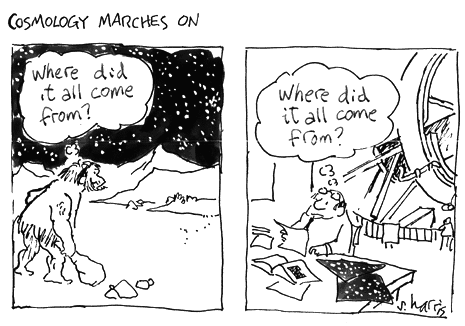
The publication of Stephen Hawking's latest book The Grand Design has stirred some new fire into the old embers of metaphysical speculation. Specifically, the discussion centres on one of the perennial Big Questions; why is there something rather than nothing?
Tough question that, probably impossible for the human mind to definitively answer. I haven't read Hawking's latest book yet, but from reviews I've noted on-line it would seem his answer is that the laws of the universe are such that it didn't require any outside force to initiate the manifestation of a new universe. Which begs the question, where did these laws come from? Isn't the very concept of a "law" rather anthropomorphic? ("Your Honour, my client violated Planck's Constant by reason of temporary insanity.")
On the other side are the theists whose answer is that a transcendent, pre-existing entity, being or force willed the creation and set out the laws. This answer seems more complete but still doesn't offer a final solution because of course it begs the question, why is there a God anyway? Again, why is there something, even a transcendent something or someone, rather than nothing?
The Buddha's position was that such questions are fundamentally impossible to answer and useless to speculate about. His teaching was meant to be practical; what is our existential dilemma, how did we get ourselves into this mess, is there a way out and how do we manage to get there? Knowledge about the original manifestation or creation of the universe, even if it could be had, would not be useful in answering any of these practical questions.
Instead of a creation theory, the Buddha taught the dependent origination which has the more limited and practical purpose of describing how we find ourselves in this state of cyclic suffering known as samsara. It is a teaching that is entirely oriented toward the immediate human experience and does not attempt to push the question back to ultimate origins.
Without forgetting these original Buddhist principles, it may be interesting to think about how a Buddhist would position himself in the current debate.
For one thing, we should not assume that the universe needed to have a point of origin at all. While the Buddha, as noted above, refused to speculate on the matter, the later Buddhist tradition definitely leaned toward the idea that universe was both beginingless and endless, infinite in both directions and fundamentally cyclical in nature. This was in line with the general trend of Indian thought which is in stark contrast to the linear, eschatological view of Zoroastrian Persia and the monotheistic religions of the west, (whose cosmology may have roots in Zoroastrianism.)
Nowadays, the linear view has found some support in the Big Bang theory. But we should be careful not to take this as definitively proven. There is some contrary evidence that would support a "steady-state" or eternally existing universe. Most probably, the Buddha was right in that this is a question which can never be finally answered.
If we allow for the sake of argument that the universe may not have a single moment of origin, while this doesn't put to rest the question of why there is something rather than nothing, it does shift the emphasis somewhat and would tend against the idea of a creator. Schopenhauer addressed this from a philosophical perspective and said that there is no logical necessity for a first origin and that such an original moment would be a fundamental break in the chain of causality.
Another question raised by this debate is the reality of a transcendent element. Here, the Buddhist shares some ground with the theistic thinker but there are important differences in their understanding of the transcendent. The Unconditioned in Buddhism (the experience of which is called Nibbana or Nirvana) is completely ineffable, which means that it cannot be described in words or grasped in thought. This makes sense because words and thought are products of the conditioned realm. When the Buddha spoke about Nibbana it was always either in poetic similes or in negations; telling us what it is not. However, without forgetting its' ineffable nature we may venture on some approximations; it is outside time-and-space, it is neither physical not mental but sui generis in a category of its' own, it is not subject to change, suffering or cause-and-effect. In Christian theological language, the Nibbana-element is both trascendent (wholly other, "not-this") and immanent (present here-and-now.) Close Pali analogues would be lokuttara (lit. "Beyond the World") and sanditthiko (lit. "Able to be Seen Now").
In line with the practical nature of the Buddha's teaching, the only real argument for the reality of this transcendent element is experiential. "If there were no Unconditioned, there would be no escape from the Conditioned, but since there is an escape, there is an Unconditioned." In colloquial terms, you have to have been there.
This transcendent element seems to have some parallels with the concept of God but is different in that the Unconditioned is never conceived of as a person, being or entity that can through the power of its' will intervene in the Conditioned realm. For it to do so would be a violation of its' fundamental nature as outside of cause-and-effect. The closest approach to the Buddhist idea of the transendental found within theistic thought might be the apophatic view of the God-head held by the Eastern Orthodox or perhaps the Unmanifest in Jewish Kabbalah.
Perhaps a fair summary of the Buddhist position would be that while the question of why there is something rather than nothing is unanswerable (abhyakata) we can refer to the dependent origination to understand how this particular something we are caught up in comes about. Furthermore, we can venture that there are indeed two different modes of Something; samsaric and nibbanic, manifest and non-manifest, conditioned and unconditioned. So, once again, we take a Middle Path sharing some ground with both the theist and the atheist, but not agreeing completely with either pole.
LINKS
The theist argument against Hawking - The Curious Metaphysics of Dr. Stephen Hawking
An argument against the "Big Bang" - Religion Disguised as Science
What all the fuss is about anyway - Hubble Looks at Nothing, finds Something



![[alsmbowl]](https://lh3.googleusercontent.com/blogger_img_proxy/AEn0k_vTGMIj_hQoMSdCVvss4Z8ifoPRNQcBXC0MHxyRN4rnl_HRmJ-MNPH3Bu7xlSRrJx_3qku9YwLaCNGZtxnrY9Qn2qdp_03Smdi1QMdIagPchfJidQ=s0-d "donations always welcome")