Nov 5, 2006

We Get Mail

From the Comments;

Could you please elaborate on the terms "the Unconditioned" and "the Conditioned"? I'm pretty informed about Buddhism, but I'm not familiar with such terminology. Thanks.

The Conditioned is this ordinary day-to-day realm of conscious experience. Phenomena here are subject to cause and effect, hence conditioned. This is the realm governed by the Dependent Origination; otherwise known as samsara. The world of birth, suffering and death.

The Unconditioned (asankhata) is another name for Nibbana or Nirvana. This is the ultimate goal of Buddhist practise. It is a plane of reality where cause and effect have no bearing, hence the unconditioned. It should not be thought of as a place, or an experience, or a mode of being. It actually cannot be described or classified in words because words and logic belong to the Conditioned level.

Hope this helps more than it confuses.

We Get Political Mail

From the comments to American Elections
No, no, no. You're going to be wrong. It'll be a thumpin', jumpin' Demo splendorama.
I sincerely hope so. Actually I think that the Democratic surge is so strong that they will take the House of Representatives, but I still think the Republicans will steal the Senate. They have to. If the Dems control both houses and start serious investigations, some of those guys will be looking at prison time. They won't let that happen.

As a side note, Canadians tend to be very tuned into American political trends whereas most Americans probably couldn't tell you who the Prime Minister of Canada is. Pierre Trudeau once compared our relationship to an elephant sleeping with a mouse. The elephant doesn't really care what the mouse does, but the mouse is keenly interested in every twitch of his bed-mate.

Anyway, I think most of us up here on the tundra are rooting for the Dems.

We Get Snarky Mail Too

From the comments to Monks in the West;
Bhante, I would really like to challenge you to justify why you think it is appropriate to your role (as a monk, or simply as a "full-time Buddhist" generally) to show up and smear the (none-too-fine) distinctions between the religions, and roll out the whitewash and red carpet for one of the most infamous, brutal, corrupt organisations in the world (leaving aside the fact that it is a "false" religion), viz., Catholicism.
Posted by E.M. in a snarky mood.

Smearing over the differences between religions is certainly not my idea of valid inter-faith dialogue. There are many important doctrinal differences between Buddhism and Catholicism and I didn't have the impression at this conference that anyone was trying to avoid that. I am very critical of writers who take the line that all religions are the same underneath. (Perennial philosophy)

However, I also think it is healthy and useful for religions to meet and discuss together in an attitude of harmony. What's the alternative? Sectarian bigotry and narrow dogmatism.

I also don't fully subscribe to the characterization of Catholicism or Christianity in general as a "false religion." Even in narrow Buddhist exegesis it would be called a "partial" religion; any belief system which promotes moral behaviour and teaches that there are consequences of good and evil deeds falls within the elephant's footprint.

Whatever the history of the Catholic Church, and we all know about that, the brothers of the Benedictine Order that I met are good, spiritually minded men who are have aspirations beyond the worldly realm. That is rare enough in these degenerate days that it ill behooves us to strain at gnats because we have metaphysical differences. The real problem these days is not the Church, but the overwhelmingly materialist zeitgeist. And I would say that the Catholics have not bought into this like most of the Protestants.

Religious tolerance is something the world needs more of. I think the Church is to be commended for overcoming their past history of triumphalism and reaching out to talk to other religions. By doing so, we don't jeopardize the integrity of our own faiths. On the contrary, the contrast sharpens our mutual understanding.

Nov 3, 2006

American Election

Let me risk a prediction;

The Republicans will win narrow victories in both houses after some amazing (one might almost say unbelievable) turnarounds. The talking heads will blather for a week or so on various theories about how all the polls could be just so damn wrong. Go figger.

Then some celebrity will get involved in some weird sex thing and everybody will forget about it.

(Hope I'm wrong)

Monks in the West Conference

I've just gotten back from attending an inter-faith conference at St. John's Abbey, a Benedictine Abbey in Minnesota. Monks from various Buddhist schools and Catholic orders met to discuss the role of celibacy in religious life. I must say I enjoyed it very much and learnt a lot.

Two things I picked up that I'd like to note briefly;

1. Although the metaphysics of the two systems are almost as different as could be, the experience of contemplatives is very similar. My feeling is that we are all straining to find words to express the inexpressible. As the Buddha put it, the Third Noble Truth (the Unconditioned, the Absolute) can be experienced (or penetrated, patisamvedhi) but cannot be understood.

2. I had thought previously that the biggest doctrinal differences between Buddhism and Christianity revolved around the Transcendent (God vs. the Unconditioned) but it seems that the real practical differences concern the attitude toward the Conditioned (or in Christian terms, the Created.) In Buddhism, the world is samsara, something that is suffering and delusion. In Christianity, the world is sacred, if flawed after the fall. This has repercussions on attitudes towards the body, sexuality and celibacy as well.

But most important, it was good to meet all the brothers from various traditions and places. Monasticism may seem like an anachronism, but like I always say, in times like these if you're not an anachronism you're part of the problem.

LINKS-

Press Release for the Monks in the West 2006 conference (click on the link at the bottom)
Home Page of St. John's Abbey.

Oct 25, 2006

Going Off-Line for a Bit

I'm going to a conference and will be off-line until Nov. 1 at the earliest, so there won't be any blog entries until then.

We Had Snow


And this guy didn't seem to like it very much. (It's all melted now; hopefully we won't have to deal with the durable kind for a few more weeks)

Evolution Considered

Richard Dawkins has come out with a new book, "The God Delusion" and he's popping up everywhere in interviews; for instance here, here and here. While a Buddhist wouldn't feel any particular need to defend the God Idea (see Nyanaponika's essay "Buddhism and the God Idea"), nor do we find ourselves in agreement with the mechanistic views espoused by Mr. Dawkins.

One of Dawkin's principle interests is evolution. I'd like to rehash some of the arguments against an overly mechanistic view of that process that I first aired on the old blog site. Forgive me if you've heard any or all of this before.

Buddhism doesn't subscribe to creationism. That is a philosophy that precludes the dependent origination; if we suppose the arbitrary will of an original first cause we are violating the deep principle of causality. (This is the old "then who made God?" argument)

However, mechanistic evolution as understood by Dawkins is also essentially arbitrary because it contains a random element. Randomness is as much an intellectual dodge as saying "God did it." In the end, it explains nothing. In the end it is a fall back on arbitrariness. Things happened that way "just because" without a reason or a cause.

The standard model of Darwinian evolution postulates that there is a constant competition between randomly arisen variations, and the fittest survive to leave offspring. The mechanism of selection through competition may explain some things, but other things are not very well accounted for.

I want to mention just two, both in the domain of mind (which modern science can't properly account for anyway)

1. Consciousness - by which I mean the simple fact of awareness; citta or vinnana to use the technical Pali terms. If organisms are simply lumbering robots "designed" by selection for the replication of their genes (as in Dawkins' "The Selfish Gene") then why and how did they ever become aware? Surely a simple stimulus-response mechanism would be far more efficient for the purposes of finding food and mates, and avoiding predators, without the totally superfluous extra layer of processing that consciousness implies. Robots would have a competitive edge of speed over the dithering of conscious entities every time. Hence, consciousness could never arise through natural selection.

2. Human Intelligence - This is quite another problem for the mechanists. The human brain is a grossly hypertrophied organ. It consumes an inordinate amount of the body's calories. The size of the human head creates additional dangers and difficulties for the female giving birth. What is more, the human baby remains helpless much longer than those of our primate cousins. If there is any selective advantage to high intelligence, it must be at least sufficient to overcome these grievous disadvantages.

It would seem to me that only so much intelligence is required to be able to catch a rabbit for dinner, and when that level had been reached, there was no strong selective edge to be had by future increase of the brain. As beautiful as the Cro-Magnon cave art is, it has no Darwinian advantage.

(One objection to this argument I have heard is that perhaps there was a sexual selection at work, as in the hypertrophied antlers of some ungulates. Maybe, but think back to high-school. Who got the dates, the jocks or the nerds?)

I would also suggest a somewhat more speculative third case; the arising of life itself in the still mysterious Cambrian explosion. Life seemed to blossom everywhere at once on the planet, in very rapid geologic time. The arising of complex life forms by random chance seems remote at best, unlikely in the extreme at the time scale it appeared to have done so.

Mechanists like Dawkins want to leave Mind out of the equation, but quantum mechanics makes it look less and less viable to do so. I would suggest that it is a gross error to assume that mind arises from matter at all. Rather, I think it is far more likely that form arises from mind (as in the sequence of the Dependent Origination) and that evolution is a process of consciousness seeking through trial and error to find an ever more refined vehicle for manifestation in the physical world.

Oct 19, 2006

The Eye of Mordor?

Frodo Failed


The Republican Senator for Pennsylvania, Rick Santorum, has compared the War on Iraq to the War of the Ring.
As the hobbits are going up Mount Doom, the Eye of Mordor is being drawn somewhere else.... It's being drawn to Iraq and it's not being drawn to the U.S. You know what? I want to keep it on Iraq. I don't want the Eye to come back here to the United States.
I guess the historical analogies from WW2 are wearing thin, so they're lifting them from fantasy books now. But really, Mr. Santorum, if we must make a strained analogy to Lord of the Rings, who would really best qualify as the Dark Lord? Who has got the devastating air-power? Whose hapless prisoners endure torment in Cirith Ungol?

If you want LOTR analogies, this one is a classic; New York to Build Barad-Dur on the site of WTC. An oldie but a goodie.

"I can understand the need for domestic security – and the attractiveness of the design," said Noah Jacobson, Secretary of the New York Civil Liberties Union. "The sheer, soul-annihilating power of this black monolith should serve to reduce all manner of crime and anti-social activity within 100 miles," Jacobson predicted, "reducing a once-free city to a necropolis of cringing slaves. We have no problem with that. But a Lidless Eye that interrogates the souls of every person who slinks or crawls through the five boroughs – this could raise some serious Fourth Amendment issues."
But enough of that. For some comic relief check out this brilliant "early version" of the Lord of the Rings, a never-released epic starring Humphrey Bogart as the indominatible Frodo and featuring Orson Welles as the Grey Wizard.

PS - thought I'd add this quote from J.R.R. himself;
"It is not unlikely that they [the Orcs] invented some of the machines that have since troubled the world, especially the ingenious devices for killing large numbers of people at once, for wheels and engines and explosions always delighted them"


Oct 12, 2006

Cambodian Monk Burns Himself to Death

A story based on an Agence France-Press report;

HNOM PENH (AFP) - A Buddhist monk in Cambodia burned himself to death as a sacrifice to Buddha, police have said.

The 20-year-old monk, Yin Keo, was at a pagoda on top of a mountain when he doused himself with five litres of petrol Saturday and set fire to himself, Battambang province deputy police chief So Sam An said.

"The monk completely believed in religion -- he sat cross-legged and poured gas over himself and burned to death in order to sacrifice his body to Buddha," So Sam An told AFP.

Other monks and nuns at the pagoda told police that Yin Keo, who had been in the monastery for three months, had repeatedly said he would die in a religious sacrifice.

"I have never seen anyone use their body as a sacrifice like this monk," the police official said.

I haven't found any more details. Although this site implies a very silly conspiracy theory in the caption under a photo of the 1963 immolation of Thich Quang Doc, this burning does unlike the more famous one in the photo, does not appear politically motivated.

Cambodia is a Theravada country, and Theravada unequivocally condemns suicide (except in the extremely rare case of an arahant with a terminal illness.) The story is maddeningly brief and sketchy, but the monk's name sounds Chinese, not Cambodian, so he may have been Mahayana.

There is a tradition of self-sacrifice by burning in Mahayana that can be traced back to this passage in the Lotus Sutra;

"After making this offering, the bodhisattva Seen-with-Joy-by-All-Living-Beings arose from his samadhi and thought to himself, "Although I have resorted to supernatural powers to make offering to the Buddha, that offering is not of my own body." Whereupon he applied to his body various scents of candana, kunduruka, two kinds of frankincense, trigonella, the scent that sinks in water, and the sent of pine tar. He also drank the fragrant oils of campaka-flowers. When a thousand and two hundred years had past in this way, he then painted his body with fragrant oil and in the presence of the Buddha Pure-and-Bright-Excellence-of-Sun-and-Moon he wrapped his body in a garment adorned with sacred jewels, annointed himself with fragrant oils, and with the force of supernatural insight he took a vow to establish a spiritual foundation.

That done, the bodhisattva Seen-with-Joy-by-All-Living-Beings burned his own body, the glow from which illumined a myriad worlds, as numerous as the sands of 80,000,000 Ganges Rivers. From those worlds, the Buddhas in them together and at once praised this bodhisattva by saying, 'Excellent! Excellent! Good man, you are truly persevering with vigor in the practice known as the true Dharma-offering to the Thus-come-one. If with floral scent, necklaces, burnt incense, powdered scents, paint-scents, divine fabric, banners, parasols, the aroma of the candana of the near seashore, and a variety of such things one were to make offerings, still they could not equal this act which you have fulfilled. Even were one to give kingdoms, fortified cities, wives and children, they would still not equal your deeds. Therefore, Good man, yours is called the Prime Gift. Among the various gifts to Buddhas, this is the most honorable, the highest of all, because it is an offering of Dharma to the Thus-come-ones.' When the buddhas had finished saying this they all became silent.

"The body of the bodhisattva Seen-with-Joy-by-All-Living-Beings burned a full thousand and two-hundred years and in the end was consumed by fire. Because this bodhisattva had made such a Dharma-offering as this, when his life ended he was born once again into the Pure Land of the Buddha Pure-and-Bright-Excellence-of-Sun-and-Moon in which he was born suddenly by transformation in the household of the King Pure Virtue (Vimaladatta), sitting with his legs in lotus position. LINK
There have been cases of such self-immolation from time to time, especially in China. Apparently, this practise was also done by some Taoists. There are also smaller acts of self-burning practised in Mahayana. The ordination ceremony usually includes a ritual burning of spots on the newly shaved head with incense, something not found in Theravada.

While this incense-burning is an established part of the ritual, there is also a fairly wide-spread practise among Korean Zen monks (and perhaps others) of burning off one or more fingers. This is often condemned by the religious authorities, but happens nonetheless. (See R.E. Busswell, The Zen Monastic Experience)

There is a story traditional in Theravada that Ananda when he came to the end of his life, levitated out over a river and burned himself up by entering the fire-kasina jhana. It may be of some significance that the oldest documentary source of this story seems to the Chinese traveller Fa Hsien.

Be that as it may, the Theravada position remains, don't try this at home.

Oct 9, 2006

Thailand Coup

I was in Thailand as a junior monk in 1992 at the time of the last coup. That was a very different affair from the present one. There was a major uprising against the military followed by a bloody repression. The King intervened and settled things down, leading to early elections. I remember a symbolic photograph in the papers that showed the King seated on his throne wagging his finger at the coup leader and the leader of the democratic faction, who were kneeling at his feet, hands in anjali.

The King is a remarkable man. He was actually raised in quite humble circumstances and was not considered to be in line for the throne. He has consistently been a force for stability and democratic progress in the country. He is certainly not a figurehead.

That's why it is significant that he has endorsed this current coup. He didn't have to do that. This coup also seems to have a strong measure of popular support, at least in Bangkok.

The Thaksin government was notoriously corrupt, and the elections almost as sketchy as Ohio's.

Another interesting angle; the coup leader is a Muslim and he wants to try and settle the Muslim insurrection in the south with negotiations. Thaksin was eager to make points with the Americans and was hopping on the War on Terra bandwagon, taking a hard line in the south. This aspect bears watching.

In short, not all coups are created equal.

Doing Firewood - A Haiku

Before enlightenment;
chopping wood, carrying water.
After enlightenment;
chopping wood, carrying water.
Bummer.

(It's that time of year, which is why I'm lazy about blogging)

Sep 28, 2006

China and Organ Harvesting

There have been allegations for some time now that China systematically harvests and sells the organs of executed prisoners. Thousands of Falun Gong practioneers have been "disappeared" and this may have been their fate.

The BBC has done an undercover investigation that adds a lot of credibility to these rumours;
See the clip on Raw Story. Also check out these telephone transcripts from an earlier independent investigation. In the interests of even-handedness, here's the Chinese Embassy's weasel-worded denial.

Sep 27, 2006

Changing Seasons


Some recent pictures around Arrow River, the fall colours are very good this year. Soon enough the trees will be bare.

Speculative Physics

Here's some delicious mind candy for you. Is the Universe a Hologram?

Hua-Yen Buddhism teaches much the same; the whole contained in the parts and so forth. Not that I really know what I'm talking about concerning Hua-Yen, but I just happened to read the above piece immediately after reading a piece about Hua-Yen Buddhism in Buddhadhamma Magazine. Coincidence? Is that even a meaningful concept?

One detail from the Buddhadhamma piece; one Hua-Yen master built a shrine room with all six sides mirrored and a Buddha image suspended dead-centre. Damn, I want one of those!

Sep 19, 2006

Pope Benedict's Remarks

There is once again a tremendous spasm of outrage over a perceived offence to Islam. Religious zealots seem innocent of irony; they have burned several churches and killed an elderly nun because of the insult of being called violent. This is a very different circumstance than the Danish cartoons. In that incident, while deploring the over-reaction, I sympathized with the Muslims feelings of insult. There was no reason to print those cartoons except as a deliberate provocation.

In this case, however, the Pope's remarks were taken completely out of context. He was quoting Manuel II Palaelogus, a late Byzantine emperor and it is evident the quote was used to make a point, and no endorsement of the sentiments were implied. The point being made concerned the danger of religion without reason. If the Pope made any error of judgement, it was in choosing an example from Islamic-Christian confrontation; with a little thought he could have used a purely Christian example to make the same point. In this times, one must be very careful in what one says.

Mostly though, I blame the media in both the west and the Muslim world for cherry-picking two lines in a long complex talk. Nor do I think Pope Benedict has anything to apologize for.

While this whole controversy is too ridiculous to waste any more of your (and my) time over; it did have the fortuitous side-effect of bringing attention to what otherwise would have been an obscure speech to the faculty of a German university. This Pope is an interesting thinker, no doubt about it. The speech itself is well worth a look; it's on the topic of Faith and Reason.

I find myself somewhat in sympathy with many of Pope Benedict's views. Like him, I am uncomfortable with some aspects of modernity such as moral relativism and the materialist world-view. (We're the last two great medieval thinkers.) The Pope has an interesting take on this; he sees the Reformation beginning a process of "de-hellenization," a movement away from the western heritage derived from Greece.

He sees the western Christian, Catholic, view as based on rationality. This makes, for him, theology a rational discipline. It is possible to know the mind of God, at least in part, by analogy from our own minds. This he opposes to both Islam and Protestantism, which are purely vehicles of Revelation; the only things we know about God are what he chooses to tell us. He could (but didn't) have brought in a contrast with eastern Christianity as well, which rejects the positive theology of Rome for what they call an "apophatic" approach, i.e. God is essentially unknowable.

How does all of this relate to Buddhism, which after all postulates no God, apophatic or otherwise? In one particular Buddhism is closer to Catholicism than the other theistic religions in that it is a core axiom that the universe is orderly or rational. This is the principle of the General Dependent Origination; things arise from causes and not otherwise. In other words, Buddhist thought rejects arbitrariness or random arising. In fact, we take this a step further than the Catholics because we also reject the supreme arbitrariness of a Creator. (Balls in your court now Benny.)

But while Buddhism is not theistic, nor is it atheistic in the sense that word is usually understood. There is a transcendental (lokutarra = "above the world") element in Buddhist metaphysics; the Nibbana element or the Unconditioned. For the unawakened putthujana ("many folk") this must perforce be a matter of faith (saddha.) So the tension between reason and faith is present in our religion also. And we see it played out in different ways. There are those westernized Buddhists who want to reject faith and the transcendental altogether. These thinkers are more a product of the European Enlightenment than the Buddha's.

There is one other way in which we would differ from the Pope. He deplores at one point in his talk the reduction of religion to a purely personal and subjective experience. The Catholic Church, as the holder of the keys, has always been uncomfortable with mysticism; persecuting its great mystics while alive and then often as not sanctifying them when dead. While I sympathize with the Pope on the one hand when he criticizes the modern tendency to deny that there is any objective truth, I have to differ with him as well. I think the Buddhist position would be that there is indeed an objective unalterable truth, but that it can only be realized subjectively and personally.

In any case, I encourage you to read the Pope's comments for yourself and draw your own conclusions. Like I said, this man is a subtle and intriguing thinker. Out of step with the times, perhaps, but that's a good thing in times like these.

LINKS

Full Speech of Pope Benedict.
A more political take on it by Justin Raimondo
Who was Manuel II Palaeologus anyway?

Sep 11, 2006

The Fall of the Towers


If you're as old as I am, you'll remember when the 21st century was expected to be a wonderful time of domed cities, flying cars and colonies on the moon. Instead, nine months into the new millenium we got that most terrible and sinister piece of performance art, now known universally by its date, written in, appropriately enough I suppose, American style as 9/11.

It's become trite to say that 9/11 changed everything. Of course, in the big picture it changed nothing. Business as usual in samsara. Beings die, often horrifically, sometimes suddenly. Life is precarious, unpredictable, uncertain. So what else is new?

But in a lot of ways, we do perceive a pre- and a post- 9/11 era, making it one of a very few such events of world historical importance. Any sense of optimism about the world scene, and we had some of that in the 'nineties, naive perhaps but palpable, is gone. We are now in a period of dark international anarchy; war, terrorism, torture, the rise of the omnipresent security state. We are becoming divided along ethnic and principally sectarian grounds. White passengers are made "uncomfortable" by the presence of brown passengers and flights are delayed as those whose skin tone clashes with the zeitgeist are removed for questioning.

Most horribly, the psychic cataclysm of the event was used by those in power in America and Britain to unleash a greater cataclysm in the Middle East; wars, wars and rumours of wars. Mesopotamia, the cradle of civilization, poisoned and laid waste. More than a hundred thousand dead and how many lives ruined?

And we now live in a world of shadows and deceit. There are three or four versions of every event in the news and the scenarios are hotly debated. With 9/11 in particular, to this date, five years on, we still don't really know what happened. The official version is so full of inconsistencies and odd lacunae that it cannot any longer be taken seriously. But no problem, there are plenty of alternate theories to choose from. As I said about faith, it may be mostly a matter of aesthetics which one you believe in.

The power of propaganda to stupefy and delude is impressive. The official scenario, nineteen arabs with box-cutters led by a mad fanatic hooked up to a dialysis machine in a cave in Central Asia, is something out of a bad James Bond movie. This has been accepted as the real deal only by dint of repetition. The really amazing thing is the thread-bare nature of the evidence for this scenario in the public domain. There was Mohammed Atta's passport, miraculously found in the rubble, and a grainy video of some guy who looked vaguely like Osama Bin Laden if you squinted a bit. And not much else.

And, like in the case of the JFK assassination, whether there was any high-level conspiracy or not, there definitely was a cover-up. Why was so much evidence destroyed or hidden? Where are the black boxes? We know what happened to the air-traffic control tapes, they were "accidentally destroyed." Even the rubble was hauled away and melted down with reckless haste. It is normally a felony to destroy evidence from a crime scene, but apparently not in the case of the crime of the century.

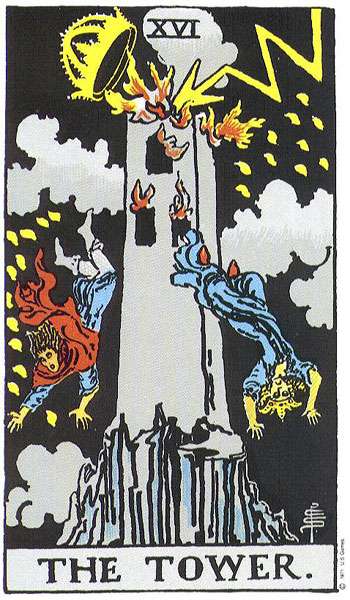
I called 9/11 a terrible piece of performance art. On a psychological level it was more than that, it was an act of Black Magic; a ritual act of great power which shook and re-arranged the collective psyche. It struck me almost immediately that the scene had sinister mythic or occult undertones. The two towers; Joachim and Boaz (or Isengard and Barad-Dur?) cross-referenced with the sixteenth trump of the Tarot. Did somebody know precisely what they were doing?

In the sequence of the Tarot, the fifteenth arcana is the Devil, and the culmination of his works is the Destruction of the Tower. But after the smoke clears, the next arcana is the Star. If we can shake off our media induced stupefaction, and rediscover our common humanity, disown nightmare dreams of empire and terror, can we find our way back to simplicity?


Sep 5, 2006

Snakey on a Plane

[T-shirt reads "I am not a terrorist" in Arabic." Source.]


Recently I posted a link to the insane story of the iPod toilet bomb. There's more. Already in 2004 we had this madness;

A Midwest Airlines flight from Milwaukee to San Francisco was canceled Sunday night after a passenger discovered Arabic-type handwriting inside an in-flight magazine.
The 7:25 p.m. flight carrying 118 passengers and five crew members had already pulled away from the gate at Mitchell International Airport when a passenger flipping through the Midwest Airlines magazine tucked in the seat pocket saw the writing and told a flight crew member. The writing, which was scribbled on a page of the magazine, turned out to be Farsi, the Iranian language, said Midwest spokeswoman Carol Skornicka. Before the plane took off, the flight crew decided to take a closer look at the writing. The plane returned to the gate, and passengers were taken off the plane. Security authorities were notified; all of the luggage was checked and the aircraft was inspected. Nothing was found.
A plane evacuated, passengers delayed and luggage searched because some rube found a marginal scribble in what he thought was Arabic? Marginal scribbles are now weapons of mass destruction?

Now, after the (omigod!) exploding shampoo incident, things have ratcheted up more than a notch. Recently, mostly British passengers leaving the holiday spot of Malaga Spain staged a revolt and refused to fly until two young Muslim men were ejected, at gunpoint no less. Their crime? The increasingly common offence of FWB, Flying While Brown. Oh, and speaking Urdu which the vigilant flying public took for (horrors!) Arabic.

"We might be Asian, but we're two ordinary lads who wanted a bit of fun."

"Just because we're Muslim, does not mean we are suicide bombers."

Khurram added: "I don't blame anyone for what happened. Actually I feel sorry for the people who thought we were terrorists."

The fun-loving pair visited the Spanish resort for a quick recce ahead of a proper holiday later in the year.

They are so far removed from extremism that they even spent the day boozing and tucking into a McDonald's burger.

Khurram admitted: "As Muslims we are not supposed to drink alcohol, but we did have a few."

Now, just today, we have the story of an Hasidic Jew being ejected from an Air Canada flight for praying. Yes, praying. Best be on the safe side, I guess. We don't know what he was praying for. The air crew actually said, "I'm sorry sir, we know you're not a Muslim, but you're making some of the passengers uncomfortable." Probably wasn't even brown, but may have been a bit on the swarthy side. Better not take chances.

I have a suggestion. Next time a bunch of ignorant bigots complain, let them get off and wait for the next flight. More leg room for the Muslim lads and the Hasidim.

People are being manipulated into fear and prejudice with all this terrorism hype. And hype is the operative word. The exploding baby milk plot or whatever the hell it was supposed to be was supposed to be the scariest thing since Saddam Hussein got that yellow-cake (wait, bad example. No, on second thought, good example). But;

None of the alleged terrorists had made a bomb. None had bought a plane ticket. Many did not even have passports, which given the efficiency of the UK Passport Agency would mean they couldn't be a plane bomber for quite some time.

In the absence of bombs and airline tickets, and in many cases passports, it could be pretty difficult to convince a jury beyond reasonable doubt that individuals intended to go through with suicide bombings, whatever rash stuff they may have bragged in internet chat rooms.

What is more, many of those arrested had been under surveillance for over a year - like thousands of other British Muslims. And not just Muslims. Like me. Nothing from that surveillance had indicated the need for early arrests.

Then an interrogation in Pakistan revealed the details of this amazing plot to blow up multiple planes - which, rather extraordinarily, had not turned up in a year of surveillance. Of course, the interrogators of the Pakistani dictator have their ways of making people sing like canaries. As I witnessed in Uzbekistan, you can get the most extraordinary information this way. Trouble is it always tends to give the interrogators all they might want, and more, in a desperate effort to stop or avert torture. What it doesn't give is the truth.
What's more, it wouldn't have worked anyway. Technically impossible.

If anyone doubts that we are descending into a dark age, consider this; one of the quantitative measures of civilizational level is travel time. Point-to-point travel times declined steadily since the early eighteenth century to nearly the end of the twentieth. Now, with time added to take off our shoes, have some underpaid security guy riffle through our luggage, get our i.d. checked four or five times, we've added at least an hour and a half to most journeys. More, if you average in the delays because some dufus found a grocery list in Urdu tucked into the seat flap.

It's way past time to chill out. I wish the passenger train still ran to Thunder Bay.

Aug 29, 2006

How Far We've Fallen

Then and now.

A comment on the Eisenhower speech; notice at the end he says that only an "alert and informed citizenry" can save the republic from the military-industrial complex. If he was right, we are really screwed.

Of course, Eisenhower also said; "Things are more like they are now than they ever were before."

Aug 28, 2006

Sri Lankan Civil War

While the world is focussed on the middle east, the on again off again civil war in Sri Lanka is very much on again. Like all of these wretched modern wars, most of the suffering is borne by innocent civilians.

It's painful for me to try and write about the Sri Lankan crisis; it's painful to see Buddhists acting badly, and even using Buddhism as an excuse.

The parallels to the Israel/Palestine dispute are uncanny. Like the Palestinians, the Tamils have legitimate grievances and have suffered historical injustice. Like the Palestinians, the Tamils have been burdened with fanatical and blood-thirsty leadership. Like the Israelis, the Sinhalese have a legitimate concern for their national survival, like the Israelis the Sinhalese have a sense of religiously sanctioned specialness, and a religiously based claim to the land. And like the Israeli leaders, the Sinhalese nationalists now in control, refuse to make the historic compromises demanded by simple human justice. Like the Israelis, they insist that the other party must first abandon violence and then we'll talk. Any discussion of legitimate Tamil grievances is cut short by reminding the listener of all the evil deeds done by the Tigers. Sound familiar?

Let's be clear, the Tamil Tigers are undoubtedly a terrorist organization of the worst sort. They have carried out more suicide bombings than any Arab group, maybe more than all of them put together. They target civilians. They even bombed the Temple of the Tooth. Their leader, Velupillal Prabharakan, is a charimatic fanatic in the mold of Pol Pot. They systematically brain-wash and use child soldiers. One of their most recent tricks was to close off and mine a canal, causing an artificial drought that left fifteen thousand farmers without a crop. They also systematically assassinate moderate Tamil politicians who work for peace.

But the Tigers (or Hamas) didn't spring up in a vaccuum, or just for fun. The roots of the Tamil-Sinhalese conflict go back a long, long way. Battles against the Tamils in ancient times make up the bulk of Sri Lanka's national epic, the Mahavamsa. British colonial perfidy helped to stir the pot and set the stage for the modern round. (Again, the resemblance to Palestine is inescapable.) The British liked to play divide and rule, and favoured the Tamil minority with a role in the administration, at the same time importing unskilled Tamils by the thousand from India to work their tea plantations, squeezing the Sinhalese majority from above and below.

The first decade after independence it looked like a sensible and fair arrangement was in the works; both Sinhalese and Tamil were recognized as national languages for purposes of law, education, record-keeping and the like. But then in 1956 a Sinhalese Nationalist party came to power and with laws like the Sinhala-Only Act tried to enforce an artificial national unity. The resulting Tamil riots are usually considered the prelude to the civil war.

The nationalist faction among the Sinhalese, currently in power, insist tenaciously on a unitary uni-lingual state, when it is obvious that only a federal arrangement and protected status for minority rights will work as a basis for a peaceful solution. This leads them to insist on a "military solution." This has not worked at all in twenty years of fighting. Conventional wars waged against guerillas only kill a lot of civilians and increase bitterness, breeding more terrorists, more fanatics. (Again, the obvious parallels not only to the West Bank and Lebanon, but to Vietnam, Iraq and Afghanistan)

Consider this essay, posted on buddhistchannel.tv to get an idea of the mind-set of the Sinhalese nationalists; War and Buddhism. The author's thesis is quite outrageous; he is finding a Buddhist justification for war.

Therefore, it is wrong to bring in Buddha or his teachings, to draw parallels to the terrorism we are witnessing in Sri Lanka, in the world. When King Dutugamunu waged a war against King Elara, the Buddhist priests are said to have given their blessings and some of them is said to have accompanied the army.

King Elara was reigning in Anuradhapura. Anuradhapura was then a city, sacred to the Buddhists, as there were many monasteries, temples and shrines, precious to the Buddhists. No body wanted the place to be desecrated by building places of other religions, and conduct ceremonies and rituals not in keeping with the purity of Buddhism. Therefore the war conducted by the King Dutugamuna had the support and blessings of the Maha Sangha

There you have it; don't let anyone say there isn't a Buddhist fundamentalism. War waged to prevent the "desecration" of other faiths being practised.

Another reason why Buddhists would like to stop terrorism in the North at any cost is that Sri Lanka is where the true words of the Buddha, as recited by the monks exist. This land has been sanctified five times by the visit of the Buddha. He had been in the North, the South, East and the West of this Island. Therefore, they believe that this Island should continue to exist as a whole undivided, with the Sinhala, Tamil, Muslim, Malays and others, united as one Nation.

The unitary Buddhist state sanctioned by an ancient myth. Never mind that the Buddha almost certainly never left Northern India. Myths have power. Quick - can you think of some other polity that makes it's claims based on ancient religious claims? I thought you could. But ancient religious stories are not a sound basis for making policy in the face of modern realities. Insistence on a unitary state (as opposed to a federal one) is a recipe for endless warfare and the continued ruin of that lovely island.

Certainly not all Sri Lankans think like this; just this month a big peace rally was broken up by nationalist thugs, including some who disgraced the robe by joining in. There are many both Sinhalese and Tamil who are working for a real peace.

Consider this very sensible essay by a Tamil writer; The Unwise Intent to Keep Tamil Grievances Unresolved. The author makes the sound point that the ball is in the governments court as far as resolving a sensible solution. He says they should begin a process of devolution now, not waiting for an agreement that is not to be had with the Tigers.
If the government is going to wait for the LTTE to shun violence and join the democratic mainstream even to deal with the Tamil grievances let alone a political settlement, it will be a very long costly wait. Even one life lost in the conflict in Sri Lanka is too many to ignore.
The way to end terrorism is to end injustice; and that is for those in positions of power to do. This should not be seen as a counsel of weakness, but of real courage and strength. It also takes personal courage as many men of peace have met their end at an assassin's bullet, usually some fanatic who saw them as a traitor to their own people. (Gandhi killed by a Hindu fanatic, Anwar Sadat by a Muslim one, Yitzhak Rabin by a Jewish one, and several Tamil leaders by the Tigers.)

The author of the above piece goes on to quote from another article, articulating a just settlement;

The author has said two principles are important for a political solution to the ethnic problem. These are: “(1) to allow autonomy as much as it is necessary; (2) to ensure safeguards against any type of disintegration, break away or secession. We also believe that given current international developments and the challenges that our country is facing we need to have a rather strong system at the centre as well. Therefore, we propose considerable power sharing at the centre in addition to devolution of power to the regions or the periphery.
What is really striking is that in so many of these seemingly intractable conflicts, there is a plain, simple, fair solution staring all reasonable people in the face. Only the hard-hearted extremists of both sides seem unable to accept. More's the pity when they find their way to power, and feed off each other's hatred.

(One more link - a good neutral overview translated from the German Der Spiegel; Old Animosity, New Pain. )


Never, Ever lose your iPod in an airplane toilet

The unbelievable paranoid stupidity of this has to be read to be believed; some young kid loses his iPod in the toilet and all hell breaks lose.

I won't try and do a synopsis, the whole thing is incredible. Have we really come to this?

(thanks to Idleworm for the link; a great site btw)

Aug 25, 2006

Solar System Downsized

In a move said to be due to rising costs and increased competition, the solar system has been reduced from nine planets to eight. Officially, the system has said it regrets having to let Pluto go after billions of years of "exemplary service," but privately industry insiders have complained about Pluto's eccentric orbit, retrograde rotation and other anomalies. "Pluto doesn't even travel in the same plane as the rest of us, and sometimes he even slips inside Neptune's orbit. Let's face it, Pluto is just not a team player."

The same insiders are quick to refute rumours that the re-organization is not complete. "Contrary to what you might have heard, we are not considering out-sourcing any of the inner planets to Tau Ceti."

Pluto, together with his long-time partner Charon, will continue to free-lance as a dwarf planet.

Aug 23, 2006

One More on Lebanon

Hopefully this will be my last post on the topic (unless they start fighting again then all bets are off.) But I would be remiss if I didn't steer readers toward this really fine piece of analysis;

Israel's Water Wars by Jason Godesky

The writer makes a very convincing case for what I've stated here before; it had nothing to do with the ostensible pretext of two soldiers captured; it was all about water. I'll say it again; all wars are about resources; land, oil, water etc. etc. There is always a much-hyped casus belli which is nothing but a propagandistic smoke-screen. Don't pay any attention to the little man behind the curtain.

Read the article if you still think this was a war of self-defence.

Aug 22, 2006

Why Do We Believe Anything?

There is a very good essay on pharmaceuticals as a faith-based initiative (my phrase but I guess the author would concur) at the Dust blog. I pretty much agree with the Dust's perspective here, but that's not what I want to blog about. Instead, I'm intrigued by a question he asks in passing;
it would be nice if we all came to deeper understanding of just how we “came to believe” the things we believe.
Everyone believes something. Some of us can manage, like Alice, to believe five impossible things before breakfast. Others like to imagine they are "without beliefs" (even "Buddhists without beliefs") but that's a dodge, a fancy card-trick. Agnostics and skeptics are as much rooted in belief as Southern Baptists or Wahabbis. Just different beliefs; in particular the materialist world-view, or at the very least the reality of the external world.

Most of what you think you know, you probably just believe. Most everybody these days believes, for example, in the heliocentric model of the solar system. But very few could come up with cogent arguments as to why the earth moving around the sun and not vice-versa is the real model.

People believe all kinds of things less rational than this, and with less reason. Creationism, materialism, grey aliens, perpetual motion, the Rapture, the benefits of Free Trade; heck, I'm told some people still believe the official version of 9-11.

People who believe any of these things, or their equally faith-based opposites, or anything else at all, can come up with all kinds of rational arguments, and snippets of evidence, to back up their beliefs. Cruise around the internet and you won't take long to find heated debates on stuff like creationism vs. evolution, with carefully constructed arguments on both sides. But here's the really intriguing thing; almost no-one seems to ever change their position based on these arguments. The best constructed arguments on the other side just force a true believer to refine his or her own counter-arguments in an endless dance.

I would like to suggest that evidence and logical reasoning are only called in after the fact, to justify and bolster a belief. In most cases, they really have nothing at all to do with why we believe what we do.

So why do we believe what we believe? I would like to suggest that the real unspoken criterion of all beliefs is aesthetic. We believe what we believe because it is more beautiful, or more elegant than the available alternatives. We feel intuitively that if x is true then the universe is a more satisfying place. This makes belief a matter of taste. Some people revel in the cold, stark vision of materialism. Others go for the warm fuzzies of eternalism.

To go back to the example of the heliocentric solar system; it would be theoretically possible to construct a completely geo-centric model that fits all the observable data equally well. The only problem is that it would be horrifically complicated. This was in fact the reason the geo-centric model was abandoned in the first place. As more data came in, the astronomers had to keep adding epicycles upon epicycles. What really makes my case is that at the time when Copernicus's theory started to gain general acceptance, the geo-centric model, with all it's centuries of accumulated tinkering, actually fitted the known data better (mostly because Copernicus still assumed circular orbits.) The helio-centric model was adopted not because it fit the evidence better, it didn't. It was adopted because it was more elegant.

So it's all a matter of taste. At least, that's what I believe.

Aug 21, 2006

Fundamentalism and Triumphalism

We hear a lot about religious fundamentalism these days. I suppose we are stuck with the term, but it is actually used imprecisely. Fundamentalism, according to one dictionary definition is "strict maintenance of ancient or fundamental doctrines of any religion or ideology." This in itself may not necessarily be a negative thing. Fidelity to a tradition and it's teachings is one legitimate approach to religion. It may be thought by some to be narrow, by others to demonstrate an integrity and clarity of thought.

However, what is often called "fundamentalism" these days is probably better called "triumphalism." This is the view that one's religion is absolutely right, all others are wrong, and usually leads to the conclusion that force is justified to promote one's beliefs. The Buddha condemned this kind of thinking; "this is right, all else is wrong" as leading to disputation and conflict. We can certainly see that today.

The triumphalist imperative pollutes any religion it touches. While it seems more natural to arise in mono-theistic religions ("my god is bigger than your god") sadly even Buddhism doesn't escape. We had the sorry story this week of fundamentalist monks in Sri Lanka breaking up a peace rally with fist-fighting. How anyone can defend this behaviour as consistent with the Buddha's teaching is beyond me.

There is also a Hindu fundamentalism, whose deeds included the assassination of Mahatma Gandhi and the wrecking of the historic Babri mosque in 1992 (which sparked bloody communal riots.) These type of actions are hardly compatible with the Hindu ideal of ahimsa. (harmlessness)

We hear a lot about Islamic fundamentalism (or Islamo-fascism in the fanciful neo-con lexicon.) Often the discussion simplifies complex and contradictory movements within modern Islam, which seems to be in a period of ferment and renewal not unlike the Protestant Reformation of 16th Europe. That period too, had it's "mad mullahs," it's iconclasm and it's struggle to come to terms with a changing world.

Certainly groups like the Taliban, with their ultra-strict moral codes violently enforced, and their wanton destruction of imagery like the Bamiyan Buddhas, and their valorization of war and conflict, qualify as "triumphalist." Some among the Shiites also have a dangerous fascination with apocalyptic thinking; awaiting the end of this world and the coming of the twelfth imam.

The Christians also have a powerful fundamentalist (or triumphalist) wing, especially in the United States. Like their Muslim shadow-selves, they have a very strong belief in the imminent "end of days." It's kind of scary when people who think the end of the world is a good thing are close to the policy making apparatus of major powers.

There is also a Jewish fundamentalism that complicate the Middle-East problem by seeing a religious sanction for occupation of the whole of Palestine to the Jordan. Some of them even want to re-construct the Temple of Solomon, which would involve destroying the Al-Aqsa mosque. To them, a minor detail. To the rest of the world, a major conflagration.

(I'm not aware of Taoist or Jain fundamentalism - maybe I'm just not informed)

These fundamentalisms feed off each other; they need each other to thrive. Where would the Christian Right in the US be without the "evil axis" of "Islamo-fascism" to rant against? Where would the Islamic hard-core get their juice without the "Great Satan" or the "Zionist entity?"
The Buddhist fundamentalists in Sri Lanka are largely a response to the very aggressive and unethical proselytizing of Christian fundamentalist missionaries.

Too bad we can't all just get along.

Arrow River Announcement

We are having the Annual General Meeting for the Arrow River Forest Hermitage, all friends and supporters of the hermitage are welcome. Date and time; 1:30 PM Sat. Sept. 9th. There will also be a pot-luck and BBQ at 11:00 AM. Please RSVP if you are intending to participate in the lunch.

Aug 6, 2006

Not Enough Dead Arabs?

A truly frightening glimpse into the neo-conservative mind-set is Norman Podhoretz's piece in the New York Post, featured on Uruknet; Too Nice to Win?

Apparently, Israel's problem is that it is just too darned soft-hearted;

If Lebanon's 300-plus civilian casualties are already rocking the world, what if it would take 10,000 civilian casualties to finish off Hezbollah? Could Israel inflict that kind of damage on Lebanon - not because of world opinion, but because of its own modern sensibilities and its understanding of the value of every human life?

What's more, Norman has a little friendly suggestion for the US in Iraq;

What if the tactical mistake we made in Iraq was that we didn't kill enough Sunnis in the early going to intimidate them and make them so afraid of us they would go along with anything? Wasn't the survival of Sunni men between the ages of 15 and 35 the reason there was an insurgency and the basic cause of the sectarian violence now?
Thanks, Norman, we'll take that under advisement for our next invasion. He also indulges in a little bit of historical perspective;
Could World War II have been won by Britain and the United States if the two countries did not have it in them to firebomb Dresden and nuke Hiroshima and Nagasaki?
Bad examples, Norman, both of them. The war in Europe was pretty much won when Dresden was firebombed, a gratuitous act of carnage probably meant to scare the bejeezus out of the Russians more than anything else. And as for Hiroshima, John Denson makes the case better than I can, in this excellent essay on the Hiroshima Myth.

Why should we care about the murderous ravings of some crank? Who is this Norman Podhoretz anyway? According to his bio in Wikipedia, Podhoretz is a member of the Council on Foreign Relations, the Project for a New American Century, and a 2004 recipient of the Presidential Medal of Freedom. He's one of the leading ideologues of the whole Clash of Civilizations/ World War IV mythology.

Aug 3, 2006

Apologia

My apologies for blogging so much about the Lebanon war. I know there are some who feel that a bhikkhu shouldn't be commenting on "politics." They have a point, but my feeling is that this episode goes beyond politics and is part and parcel of the great moral crisis of our times. Our world seems to be spiralling down into a new barbarism with only the ethic of "might makes right."

Make no mistake, those who engage in this acts of wanton slaughter are making very heavy karma for themselves. And the same goes for all those overseas who give their vocal support to the perpetration of war-crimes. Anyone, and there are many, who makes excuses for the carnage of Qana is morally bankrupt. Their consciousness is filled with unwholesome dhammas of hatred and delusion.

The hypocrisy of the omnipresent Israeli spokespersons who "deeply regret any loss of civilian life" is pathetic. Air-strikes on apartment blocks (and Qana was not the only one by a long shot) are justified by Hizbollah rockets having been launched in the vicinity. Even if true, and that is debated hotly, this does not qualify as an act of self-defence. Let's call it by it's true name; revenge. The launchers used by Hizbollah are truck-mounted, they are mobile, and by the time the Israeli air-force arrives they are long gone.

The primitive, dark ethos of tribalism and an eye-for-an-eye govern this vicious conflict on both sides. If it seems like I've mostly criticized Israel, it's because on the best unbiased look at the evidence, this war was started by Israel, whatever their protestations. And the damage inflicted by Israel is a few orders of magnitude greater than Hizbollah is capable of. But both sides are hitting civilians. Both sides are using banned weapons; Israel has dropped cluster bombs and white phosphorus while Hizbollah packs their rockets with ball-bearings.

America is to blame too, for supplying and bankrolling the Israeli war-machine. And Canada's government is acting as cheer-leader (although most Canadians are appalled.)

What has been accomplished by this nasty little war? A beautiful country wrecked and poisoned with depleted uranium. A further radicalization of the Muslims world-wide. No doubt an upsurge in antisemitism as well. If, as I strongly suspect, the real aim of the Israelis is to seize the water of the Litani, they will likely fail in that objective as well. That would mean an ongoing occupation against a hostile population and another Iraq, another Gaza. The Americans haven't gotten much benefit out of Iraqi oil even yet.

What is needed now is some real statesmanship, but I don't see much hope of that. The world seems to be governed by nasty, bigoted little men.

Jul 28, 2006

What Should Israel Do?

A couple of posters to the comments have asked, basically, what can Israel do?

With an earnest wish that the people of the Middle East, all of them, Israeli, Lebanese, Palestinian, Jew, Arab, Shiite and indifferent find a way to live their lives in peace and harmony; if I were in a position to be able to talk straight to the Israeli leadership and people, here is what I would suggest;

1. First and foremost, stop lying to the world and possibly to yourselves. The number one cause of all the trouble is the occupation of the territories conquered in '67 and all it's attendent evils; walls, apartheid roads, curfews, home-demolitions and most of all the intrusion of settlers. Israel is principally to blame for the situation and is therefore in a unique position to solve it. Stop portraying yourselves as victims, it ill becomes you. Arab terrorism has come about because of Israel's policies; it is a result, not a cause.

2. Start talking to your Arab neighbours instead of bombing them. The Council of Arab States proposed a sensible settlement in 2002, which Israel has so far ignored. Basically it is the old formula of land for peace. It is at least worth talking about, isn't it?

3. Israel should announce it's own goal of achieving a just peace, and hold up the offer of giving back the Occupied Territories. And this should be a genuine offer, to get out of all the West Bank. None of these carping caveats about keeping "major settlement blocs." The settlements are illegal and have no business being there in the first place. (And before anyway says Oslo was such an offer, they should read up on it a bit more.)

4. Israel should demonstrate good faith by immediately announcing a total freeze on new settlements. Further unilateral gestures could include opening all of the West Bank to free internal movement (no checkpoints except at the border with Israel) and withdrawal of the IDF from all areas not absolutely essential to security. Mostly, find ways to make the lives of ordinary Palestinians a little less hellish.

5. Open an international conference to discuss the eventual disposition of Jerusalem as some kind of international zone with protection for all religions.

6. Recognize the democratically elected government of the Palestinians, Hamas or not, and start talking to them.

7. Eventual peace would mean total withdrawal from all occupied territories. All the settlements must go unless the settlers are willing to become Palestinian citizens, and live under Palestinian rule and protection. Israel would still have something like twenty percent more Palestinian land than allowed for by the partition of 1947, but I think the world is willing to wink at that. If any land must be retained for the purposes of secure frontiers, then the Palestinians must be compensated with transfer of other lands; likely from the Galilee which was supposed to be theirs anyway.

With sixty odd years of bitterness behind them, it may be difficult for the parties to easily agree. But the alternative is an endless cycle of violence. The stark fact is that Israel can never in a thousand years fight it's way to lasting security. Negotiation and a willingness to right past wrongs is the only hope for the Jewish state in the long run.

Jul 26, 2006

Welcome Aboard, eh!

It's nice to be able to congratulate the Parliament of Canada for doing the right thing for once.

HH the Dalai Lama is being invested with the honour of becoming an honorary Canadian citizen.


(PS, no disrespect meant by the graphic, but I couldn't help myself!)

Karma and Right View

I often get asked questions about karma. It is instructive to consider where the questioner is coming from. In particular, a common type of question revolves around the mechanism of karma. Some people assume that there must be some conscious agent that judges and metes out karma. This line of thought belongs to the Eternalist view. Others reject the idea altogether, because they just can't imagine a mechanism; the whole thing seems superstitious. This line of thought belongs to the Annhilationist view.

Dealing with the Eternalist first; part of the problem comes from the sloppy use of language when we refer to "good" and "bad" karma. This is not in accord with the Pali which classifies volitional action as "kusala" and "akusala", skilful or unskilful. That puts a whole different slant on things. There is no one to judge your actions as good or bad; they are just inherently skilful or not. It is a mistake to think of karma as some kind of cosmic or divine law-code. It is a law, of a sort, but more akin to the Law of Gravity than the Criminal Code. It is best to think of karma as an unfolding of natural law.

This then raises the objection from the Annihilationist; where is the mechanism for this law? He cannot accept that an action done today may have effects years hence, evcn in a subsequent life-time. This objection comes from a deep-seated materialist bias. Given the assumptions of materialism, then it is insurmountable. But abandon those assumptions and it melts away like dew.

Materialism has been the dominant paradigm of science for at least two centuries. It assumes that matter is the only ontological Real. Mind is considered nothing more than a process of physical interactions.

This is a strange hypothesis, one held by many with dogmatic fervour. It is strange because if you consider the case, it is obvious that the only thing we ever really know or experience directly is our own minds. The material world we access only through our sense doors and the light of consciousness. Materialism denies what is immediately known, and gives exclusive reality only to that which is inferred.

The Buddha was certainly not a materialist, a view which he specifically denounced. He also said that Mind is the forerunner; i.e. Mind is the primary Real.

Given that assumption it is not hard to see how karma works. In the abhidhamma, karma is explained in terms of balancing voltional and resultant mind-moments. For every skilful moment of volition there will be a profitable resultant experienced as sense-impression at some later time.

Given that Mind is primary, if the material universe needs to adjust itself to accomodate these mind-moments, then it does so. We make the world with our minds.

This is not an issue peripheral to the Buddhist Path either. The most common formulation of Right View is as follows;

There is what is given, what is offered, what is sacrificed. There are fruits & results of good & bad actions. There is this world & the next world. There is mother & father. There are spontaneously reborn beings; there are priests & contemplatives who, faring rightly & practicing rightly, proclaim this world & the next after having directly known & realized it for themselves.
Right View, remember, is the first of the Path Factors. I think the Buddha gave this doctrine such central importance precisely because the proper understanding of karma (and rebirth) is essential to find the Middle Ground of the Dependent Origination and to gain freedom from the shackles of the Wrong Views. If one is stuck in either Eternalism or Materialism (Annihilationism) one simply cannot correctly apprehend the void nature of the dhammas and escape from suffering.

Israel hits UN post

Anyone concerned about human values and peace should speak up clearly against what Israel is doing to Lebanon and Gaza. As if things weren't bad enough already, Israel has crossed yet another moral and legal boundary by bombing a UN observer post, killing four unarmed observers, including one Canadian.

Kofi Annan has stated that the attack was deliberate, and it sure looks that way. This was not one stray bomb. Israeli artillery shelled the post for six hours, despite ten telephone calls from the UN team to the Israeli military telling them to cease and desist. The observers were holed up in a hardened bunker, and in the end the Israelis took them out with a precision guided bunker-buster missile. This would require deliberate targetting. Nor is it credible that Israeli intelligence would not know, from the outset, where all the UN posts were located.

The response of our stirling leader, PM Harper, was to defend the Israeli military;

We’re going to want to get all the information before making a judgment,I can tell you that I certainly doubt that [Kofi Annan's allegation] to be the case given that the government of Israel has been co-operating with us in our evacuation efforts and our attempts to move Canadian citizens out of Lebanon and also trying to keep our own troops that are on the ground involved in the evacuation out of harm’s way.

He also pledged to work with the Israeli authorities to get to the bottom of it. Yes, Steve, I'm sure they'll be very helpful. And he had the temerity to put some blame on the UN for leaving the soldiers in "harm's way." In their hardened bunker, with a direct line to the Israeli command, doing the job they were sent there to do.

An Israeli army spokesman was interviewed on CBC radio and when asked specifically about the phone calls, he didn't answer at all but launched into a lengthy rant about the "war on global terror" including the fantastic allegation that Hizbollah, unless stopped now, would soon be lobbing missiles into Europe.

He also stated that this war was forced on Israel. What's that about the first casualty of war? The fact is that the two Israelis captured by Hizbollah were on the Lebanese side of the border.
Entering another country, in uniform and under arms, is an act of war. The incident merely provided a convenient pretext for a campaign which had been in the planning stage for at least a year.

By 2004, the military campaign scheduled to last about three weeks that we're seeing now had already been blocked out and, in the last year or two, it's been simulated and rehearsed across the board."

More than a year ago, a senior Israeli army officer began giving PowerPoint presentations, on an off-the-record basis, to U.S. and other diplomats, journalists and think tanks, setting out the plan for the current operation in revealing detail. Under the ground rules of the briefings, the officer could not be identified.

It is just common sense that a campaign of this magnitude couldn't be launched at a moment's notice.

Getting back to the UN post; if the attack was indeed deliberate (and it is very hard to escape that conclusion) then that raises the obvious question; why would Israel want to get the observers out of South Lebanon?

Could it be that they have something to hide?

According to Human Rights Watch, Israel is now dropping cluster bombs on Lebanese villages, and have already killed and wounded men, women and children. Meanwhile, the Lebanese Minister of Health says wounded children are suffering from the impact of white phosphorus. The Lebanese president repeated the claim yesterday. As Israel pushes further into Lebanon, it continues to target civilians, in one incident blowing up a house and killing the family inside. A Times reporter has told ABC news that he has witnessed the deliberate targeting of civilians
This is beginning to look a lot like ethnic cleansing.


Jul 23, 2006

But an F-15 is so much shinier than a car-bomb

A related thought I've had about this conflict and the tepid response from the international community and western media to Israel's aggression and the destruction of Lebanon. In a recent post I suggested imagining any other state had done this to it's neighbour. Let's take this one step further; imagine a very well organized and funded terrorist organization had carried out a campaign of bombings delivered by trucks or suicide operatives which, over a period of two weeks, had destroyed power-plants, roads, bridges, petrol stations, factories, private homes and apartments, airports and docks right across some state or country.

Imagine further that the announced reason for this campaign of atrocity was to secure the release of some of their members jailed by the state in question.

The US State Department defines terrorism as follows;

The term "terrorism" means premeditated, politically motivated violence perpetrated against noncombatant/*/ targets by subnational groups or clandestine agents, usually intended to influence an audience.

(The asterik after "non-combatant" is explained in a foot-note of some length to stretch the term to include soldiers not currently involved in combat operations. )

Invasion of another country, and bombing of it's facilities is surely "politically motivated violence." Why isn't the IDF branded a terrorist organization by the US State Department? (Other then sheer hypocrisy of course)

The key is in the phrase "by sub-national groups." The horror and outrage over terrorism is generally so much greater than the horror over war, not because it is any worse. On the contrary, states tend to have much greater resources for inflicting carnage and suffering than any terrorist cell.

No, the reason goes back to what I've blogged about the nature of the state before. The horror of terrorism comes not from the violence alone, but from the fact that some group has dared to breach the state's sacred monopoly of the use of force.

I used the word "sacred" advisedly. The state is, according to the social contract theory of Hobbes and of the Agganna Sutta, nothing more than a big bully which the people have appointed to keep the other bullies in line. This way of thinking is not congenial to kings and presidents though, and there has been a steady effort over the centuries to sacralize the institution. This is done in various ways; many ancient and even medieval monarchies claimed descent from a god or a god-like human. (cf. the Holy Blood and Holy Grail and it's pop-culture clone, the Da Vinci Code - other examples would be Romulus and Remus and the mythologized George Washington)

At the real human level, there is no ethical difference between a suicide-bomb and a rocket launched from an F-15. Attempts by war apologists to obfuscate the difference fail miserably, and come across as obscene. The families who have lost members to an Israeli air-strike and those who have lost them to a Hizbollah Katyusha feel the same pain.

It's high time we held all parties to the same standards.

-----------------------------

Afterthoughts (and links)

It's important to realize that not all Israelis support this aggression. See the web-site of Gush Shalom, an Israeli Peace Movement.

A good article on the Semantics of War; death delivered by euphemism.

The news may be depressing, but some people find a silver-lining.

Statement of the Buddhist Peace Fellowship on the crisis.


What is More Priceless?

When the Sakyans and the Koliyans were on the brink of war over water rights to the Rohini River, the Buddha stepped between the rival armies and asked them, "What is more priceless, water or blood?" and averted the conflict.

This wise admonition suddenly takes on a new relevance. Some bloggers have made a very good case that the real reason for the Israeli aggression against Lebanon is water. (thanks to Cannonfire and Rigorous Intuition for pointing this out)

Israel is in desperate need of fresh water, a commodity in short supply in the region, and has a history of disputes with Lebanon, relatively well supplied, over water rights.

Now the whole thing makes sense. Governments, as a general rule, never state the real casus belli out loud. The ostensible provocations from Hizbollah never accounted for Israel's systematic destruction of Lebanon's infrastructure. The goal of crippling the Lebanese state so that Israel can make a de facto annexation of the south, including the Litani does.

Watch Lebanon collapse back into a chaotic failed state, a fate from which it appeared to be emerging, and Israel announcing the need to retain the south, at least to the Litani, and possibly including a buffer zone on the north, for "security reasons." (the 21st century port-manteau excuse for any atrocity.)


Jul 21, 2006

Israel's Destruction of Lebanon

Israel is systematically destroying Lebanon's infrastructure, bombing roads, bridges, power stations and even privately owned factories, seemingly in an attempt to cripple the Lebanese economy.

The production facilities of at least five companies in key industrial sectors - including the country's largest dairy farm, Liban Lait; a paper mill; a packaging firm and a pharmaceutical plant - have been disabled or completely destroyed. Industry insiders say the losses will cripple the economy for decades to come.

"I think the picture will be much worse than we can possible imagine when the whole thing ends, but the direct damage from yesterday's attacks to the industrial sector alone will take years to recover from," said Wajid al-Bisri, the vice-president of the Lebanese Association of Industrialists (LAI).


The number of dead civilians is already over threee hundred, including scores of children.
What can one say about this orgy of destruction and death?

UN Commissioner for Human Rights, Louise Arbour has warned that Israeli leaders might be liable to war-crimes prosecution.

By contrast Canadian PM Stephen Harper has called Israeli actions, "a measured response."

Is this a measured response to the capture of three soldiers, or this?

Let's make a little thought experiment; let's imagine any other country was doing to it's neighbour what is Israel is doing to Lebanon? Wouldn't there be immediate calls from all quarters to cease and desist, threats of sanctions or even "regime change?"

Has the world no moral spine, or are we all just so blase about human suffering now?

What criticism there is of Israel from world leaders tends to be muted, calls for "restraint". Please don't kill quite so many of them.

There was an Israeli defence official on the radio making excuses. Hezbollah hides it's weapons in clinics and schools and private homes. And the inevitable "we deeply regret any loss of civilian life." This is the same crap the American military uses every time they kill a bunch of innocent people; they must have the same PR firm.

And what possible excuse is there for the destruction of Lebanon's infrastructure. This is not only clearly a war-crime of major proportions, it is not only totally disproportionate to the supposed offense, it will not only result in even more death in the long run...it is also extraordinarily stupid.

Lebanon was on it's way to becoming a prosperous, stable democracy (anyone else remember the "Cedar Revolution?") Sure, the state was too weak to restrain Hezbollah but what condition will it be in after this? Israel will end up with a disastrously failed state for a northern neighbour and thousands more recruits for the suicide bombers.

And the incident that started it all? The capture of three Israeli soldiers? It now appears that they were on the Lebanese side of the border when it happened.

Jul 17, 2006

Buddhism and Anarchism

E.M. wrote in the comments;

Interesting to see contact between Buddhists and anarchists in this forum; there really isn't much mutual awareness between the two. Perhaps Bhante will, in future, write a column on "Buddhism and/or/as Anarchism"?

Anarchism as a political philosophy has always intrigued me. In large part because the Anarchists seem to be the only ones who think and speak clearly about the nature of the state. Unfortunately, I don't think they always think clearly about the realities of human nature. Kropotkin wrote a great little book "Mutual Aid" where he argued that altruistic behaviour is natural for humans, and even animals. His argument was largely anecdotal, collecting stories of people and animals behaving unselfishly. No doubt he hit on an important truth; compassion and loving-kindness are part of the human make-up.

Sad but true, except for the arahants ( a rare breed), we are also deluded and defiled and one could just as easily collect a book full of anecdotes of human folly, cruelty and treachery.

I see anarchy as an ideal state; not to be attained in reality. It would work if humans were sensible, they wouldn't even need to be perfect I think, just sensible and kind. I'd go futher and say that sensible people would just naturally live in a happy anarchy. Government, as I understand it, is a necessary evil. Because, as a species we are not always sensible or kind.

In the Agganna Sutta (Digha 27) the Buddha laid out a mythological history of the human species to explain such things as the origins of the state and the caste system. In part at least, this was his way of deflating the pretensions of the brahmin caste. This mythical history turns our modern myth of progress and evolution on it's head; this is a story of steady decline; we didn't evolve from lower forms, we devolved from higher ones.

This devolution is described in several phases, each fall triggered by the defilements of the beings. The part of the story of interest here is the establishment of government. Here is the relevant passage (from M. Walshe's translation)

Then, Vasettha, one greedy-natured being, while watching over his own plot, took another plot that was not given to him, and enjoyed the fruits of it. So they seized hold of him and said "You've done a wicked thing, taking another's plot like that! Don't ever do such a thing again!" "I won't," he said, but he did the same thing a second and a third time. Again he was seized and rebuked, and some hit him with their fists, some with stones and some with sticks. And in this way, Vasettha, taking what was not given, and censuring, and lying and punishment too their origin.

Then those beings came together and lamented the arising of these evil things among them: taking what was not given, censuring, lying and punishment. And they thought, "Suppose we were to appoint a certain being who would show anger where anger was due, censure those who deserved it, and banish those who deserved banishment! And in return, we would grant him a share of the rice." So they went to the one among them who was the handsomest, the best-looking, the most pleasant and capable, and asked him to do this for them in return for a share of the rice and he agreed

"The People's Choice" is the meaning of Maha-Sammata which is the first regular title to be introduced. "Lord of the Fields" is the meaning of Khattiya, the second such title. And "He Gladdens Others with Dhamma" is the meaning of Raja the third title to be introduced. This then, Vasettha, is the origin of the class of Khattiyas, in the accordance with the ancient titles that were introduced for them. They originated among these very same beings, like ourselves, no different, and in accordance with the Dhamma, not otherwise.


So the Buddha's theory of government was basically of the social-contract type. In the pristine state of nature, before greediness arose, there was no government and no need for one was felt. Notice one interesting detail; it wasn't just the stealing that the people perceived as a new evil, but the censuring and punishment as well. They didn't want to have to do these evil things, so they appointed one amongst themselves to take on this onerous task for them.

This election by the people was an important part of the Buddha's argument, because it directly criticized the Brahminical theory that the castes were inherently appointed by Brahma from the beginning. (In their creation myth, the brahmins emerged from Brahma's brow, the Khattiyas from his arms, the Vessas from his belly and the Suddas from his feet)
In Western history we had the "Divine Right of Kings." These ways of thinking gave the state or the king a special, inherent status and a sacred right to rule. This the Buddha denied by describing the state as something the people themselves created for their own purposes. And something created specifically to keep the "evils" of censure and punishment contained to a specialist class.

As a side-note, it's somewhat amusing that the very first election was made with such irrelevant factors in mind as who was the "best-looking." Richard Nixon sweating and shifty-eyed vs. JFK with his gorgeous head of hair.

The last paragraph may be a bit obscure. Maha-Samatta, according to a note by Walshe, was the title of the legendary first Solar King who founded the Sakyan race. Khattiyas were the warrior-noble caste in ancient India, and the rulers. Raja came to mean king in the monarchial period, but originally meant any one having sovereignty; i.e. a citizen in a republic. (Not everyone in the early republics were of the citizen class of course) Sovereignty, briefly defined, means the recognized right to use force upon others; legitimate violence.

One last note on the text; when the Buddha says this is "according to Dhamma, not otherwise" I think that Dhamma means according to natural law, as opposed to the brahminical idea that the establishment of government was a metaphysical act, an intervention by deity, outside of and above ordinary nature.

With that as background, I'd like to get back to a statement I made at the beginning; that anarchists are the only ones who speak clearly about the nature of the state. I would like to make one important point here; most political theory tends to assume that it is the state which grants rights to the citizens. Nothing could be further from the truth. No state in history has ever done that, nor is it even theoretically possible. The state exists specifically to limit the individuals rights, which are absolute in a state of nature or anarchy.

The best states have historically propounded "Bills of Rights" and so forth. But these are not gifts to the people. They are simply promises made by the state not to take certain rights away. The first ten amendments to the American constitution (remember that? it's kind of an obsolete 18th c. thing, doesn't much apply now) probably the best of these various Bills of Rights ever written, makes this explicit in the language; "..congress shall pass no law..." or "...the people's right shall not be infringed..." (quoting from memory, may not be exact) I think the founders of the American republic were conscious of this idea when they wrote it. Jefferson once said, "that government is best which governs least."

Of course, government has a natural tendency to accrue power and authority to itself. The power elite has never actually liked the social contract idea. In a monarchy, they sacralize the person of the monarch. In republics, they sacralize the abstract entity known as the State. This is taken to an extreme in Fascist systems. Symbolic emblems of the state take on a quasi-magical resonance; roman eagles, fasces, swastikas, hammers-and-sickles, stars-and-stripes. The idea that the state exists as a convenience for the people is lost and now the people become tax-payers and cannon-fodder to feed the hungry maw of the state.

I guess when they asked that big good-looking guy if he'd like to earn a little extra rice, it seemed like a good idea at the time.