There's been some very heated discussion in the comments section. While it's good to see that the blog is generating some interest and controversy, it's time for everyone to take a deep and mindful breath. Some of the posts have crossed the line into wrong speech. I'm thinking particularly of Rod's nasty characterization of Americans.
While it's always wrong to slander a whole nationality, it's also rather nonsensical to apply such generalizations to a country as diverse as the United States of America. It's perfectly valid to be critical of American foreign policy, or the current administration, but America is more than that.
In my opinion, for what little it's worth, this presidency will surely go down in history as the worst and most destructive ever. And one of the most damaging aspects of Bush's legacy is what it's done to America's reputation around the world. Sadly, Rod's views are pretty widespread.
Something to consider; Bush was not fairly elected, either time. The first time, in 2000, Al Gore plainly got the most votes and almost certainly actually would of taken Florida if the vote count had not been stopped. In 2004, the election was shamelessly rigged with touch-screen voting. It is highly unlikely that at any time the majority of Americans actually supported Bush.
Something else to consider; most Americans are fundamentally decent and compassionate. The only way the war party has been able to sell their imperial projects has been to package them as humanitarian endeavours, "to spread freedom" and topple dictators. Even now, the most often heard excuse for prolonging the agony of the obviously failed colonization of Iraq is that an American withdrawal would lead to a "humanitarian catastrophe." If the Americans were really as mean and nasty as some would have us believe, Bush and his cronies could have just told the truth; "We're going in to steal their oil and we don't care how many of them we have to kill to do it."
Yes, there are ugly parts of America's history; the genocide of the natives and african slavery the most obvious, but the same is true of most countries. We should not forget the good things that America has given the world.
Unfortunately, when Americans of a conservative bent think of the good they've done, too often their mind goes immediately to military interventions. "America saved Europe twice." Not only does this miss the point and encourage the worst side of the collective American character, it's also historically dubious. America's importance in both world wars has been greatly exaggerated. (They were barely involved in the First, and Russia won the Second; the western front was a diversion at best.)
What America gave the world was first and foremost the concept of a free nation based on the consent of the governed and with a people holding inalienable rights. Remember the American Revolution predated the French one, and was pulled off without a reign of terror. This was quite an accomplishment, even if all they were doing was taking good old British liberties to their logical conclusion. It would be a particular tragedy if they let their constitution fail; it is on shaky grounds these days with even habeas corpus practically abandoned. (Gonzales partying like it's 1214)
As a free nation with a free and prosperous population, America has been a cultural powerhouse. Yes, I know ninety percent of American culture is crap, but as Theodore Sturgeon said about science fiction, ninety percent of everything is crap. It's the ten percent that is so impressive. America gave us Mark Twain, Ernest Hemingway, Norman Mailer, Ken Kesey, Walt Whitman. And American cinema, at it's best, has no comparison anywhere. And let's not forget jazz.
And don't forget that when America puts it's technological know-how into something other than killing machines, they can do astonishing things like put a man on the moon. In the sixties. With less electronics on-board than it takes to power up your Nissan.
Most Canadians have mixed feelings about our big neighbour. Best way to summarize it would be to think of a major sporting event, like an international hockey tournament. Nothing makes us happier than whipping the American team, but if the Canadians are elimated we automatically root for the Yanks. Speaking personally, I like America and Americans, I've travelled around the States a fair bit and enjoy their brash self-confident open-hearted cultural persona. (Canadian joke; what's the best thing about Americans? You never have to tell them to speak up.) Which is why I am so troubled by the way the leadership is taking the country.
America is great when it remembers it's a republic, it's horrific when it imagines it is an empire.
Apr 8, 2007


Apr 3, 2007
Dangerous Games
It's kind of amazing to me that high-stakes international politics sometimes looks like a school-yard squabble. Nobody wants to admit they made a mistake and say they're sorry.
In the current stand-off over the British sailors held in Tehran, both sides say the capture was made on their side of the international boundary. And both sides are flat out lying. The simple truth is that there is no agreed international boundary in the Gulf. See the analysis by Craig Murray, former head of the UK Foreign Office's Maritime Section, Blair Faked Map. short version, there is no way either the Brits or the Iranians can state with certainty which side of a line that doesn't exist that boat was on. Another "dodgy dossier" for Mr. Blair?
Which begs a few questions; if this area of water is disputed, why is the Royal Navy going there at all? If they wanted to avoid trouble with the situation so tense, you think they'd allow a de-facto neutral zone. (Leaving aside the bigger question, why are they in the Gulf at all?) On the other hand, why are the Iranians pushing their luck?
Part of the answer may be that the sailors were seized by radical elements of the Revolutionary Guard. The western media likes to portray Iran as a monolith headed by a dictatorial Ahmadinejad. Nothing could be further from the truth, the government there has all kinds of internal power blocs and factions and Ahmadinejad really has very little power. If the sailors had been confronted by Iranian regular navy or army the situation might have been resolved on the spot.
But there may be something else, a reason why more pragmatic elements of the Iranian leadership seem willing to push the issue. There is a piece in the Indepedent that has got a lot of attention; it reports that the Iranians are responding tit-for-tat after the Americans raided their diplomatic liason office in Arbil.
Some of the commentary from the Jingos would almost be amusing if it weren't so pathetic; check out this utterly predictable screed from the Yorkshire Post, Let's Give Iran a Bloody Nose. Terry Jones (of Monty Python fame) has done a good job of puncturing this sort of blather; Call That Humiliation?
Let's hope the children are able to put away their toys and play nicely from now on.
In the current stand-off over the British sailors held in Tehran, both sides say the capture was made on their side of the international boundary. And both sides are flat out lying. The simple truth is that there is no agreed international boundary in the Gulf. See the analysis by Craig Murray, former head of the UK Foreign Office's Maritime Section, Blair Faked Map. short version, there is no way either the Brits or the Iranians can state with certainty which side of a line that doesn't exist that boat was on. Another "dodgy dossier" for Mr. Blair?
Which begs a few questions; if this area of water is disputed, why is the Royal Navy going there at all? If they wanted to avoid trouble with the situation so tense, you think they'd allow a de-facto neutral zone. (Leaving aside the bigger question, why are they in the Gulf at all?) On the other hand, why are the Iranians pushing their luck?
Part of the answer may be that the sailors were seized by radical elements of the Revolutionary Guard. The western media likes to portray Iran as a monolith headed by a dictatorial Ahmadinejad. Nothing could be further from the truth, the government there has all kinds of internal power blocs and factions and Ahmadinejad really has very little power. If the sailors had been confronted by Iranian regular navy or army the situation might have been resolved on the spot.
But there may be something else, a reason why more pragmatic elements of the Iranian leadership seem willing to push the issue. There is a piece in the Indepedent that has got a lot of attention; it reports that the Iranians are responding tit-for-tat after the Americans raided their diplomatic liason office in Arbil.
This nasty little incident greatly antagonized the Iranians, and for good reason. Not only is this kind of thing totally in breach of diplomatic conventions and international law, it is also puts the lie to the claim that the Iraqi authorities have any say about what goes on in their own country. These officials were there on the Iraqi's invitation. And the Americans are still holding five low level Iranians seized in the raid. (The big fish got away.)Early on the morning of 11 January, helicopter-born US forces launched a surprise raid on a long-established Iranian liaison office in the city of Arbil in Iraqi Kurdistan. They captured five relatively junior Iranian officials whom the US accuses of being intelligence agents and still holds.
In reality the US attack had a far more ambitious objective, The Independent has learned. The aim of the raid, launched without informing the Kurdish authorities, was to seize two men at the very heart of the Iranian security establishment....
The two men were in Kurdistan on an official visit during which they met the Iraqi President, Jalal Talabani, and later saw Massoud Barzani, the President of the Kurdistan Regional Government (KRG), at his mountain headquarters overlooking Arbil.
Some of the commentary from the Jingos would almost be amusing if it weren't so pathetic; check out this utterly predictable screed from the Yorkshire Post, Let's Give Iran a Bloody Nose. Terry Jones (of Monty Python fame) has done a good job of puncturing this sort of blather; Call That Humiliation?
Let's hope the children are able to put away their toys and play nicely from now on.
Apr 2, 2007
Did the Buddha have a sense of humour?
"A madman and an arahant both smile, but the arahant knows why while the madman doesn't."
Ajahn Chah
There was a long standing taboo in Thailand against monks being photographed smiling. Ajahn Chah was the first prominent bhikkhu who allowed his image to be recorded while looking cheerful. Certainly many of his teaching stories have a playful or humourous flavour. The same could be said of many other Thai ajahns. Similarly, the Zen tradition is full of quirky anecdotes and Vajrayana has its trickster figure in Milarepa.
But did the founder, Gotama Buddha, have a sense of humour? Some might think the idea irreverant. I would beg to differ, I don't think a healthy sense of humour, a clean enjoyment of ambiguity, paradox and the foibles of human nature, is incompatible with the highest state of liberation.
One obstacle in appreciating the Buddha's wry wit may be the stilted formal language of the suttas; recorded in Pali which was probably not a natural language but a kind of artificial prakrit, an Indic esperanto. The language itself has a structure that lends itself to formality or even gravity in expression, and the use of formulaic passages as a mnemonic device adds to this.
Translations have also been problematic in this way. The newer versions by Bhikkhu Bodhi, Maurice Walshe and some others are written in a more natural English prose, but one sometimes gets the feeling that the early translators of the Pali Text Society were trying to emulate the prose style of the King James Bible to attain the neccessary gravitas.
Nevertheless, some of the Buddha's wit does make it through the layers of transmission. This is especially true of many of his parables. From Digha 23, a parable concerning attachment to views and opinions;
Or, what about the story found in the Kevatta Sutta (Digha 11) where a monk uses psychic powers to travel up through the successive heavens seeking the answer to a Dhamma question. Each level of gods is unable to answer him, and refers him upstairs; "Surely the gods in the next higher realm will know!" He continues until he reaches the realm of the Great Brahma who does a routine reminiscent of the Wizard of Oz;
There are many other examples that could be cited; Moggallana's encounter with Sakka in Majjhima 37, (another one making fun of the gods), or the charlatan Patikuputta in Digha 24 who wants to challenge the Buddha but cannot get up from his seat, ("What is the matter, friend Patikuputta, is your bottom stuck to the seat or is the seat stuck to your bottom?") or so many more.
But my personal favourite, for it's quiet understated humour, is from Majjhima 12, the Greater Discourse of the Lion's Roar. The Buddha is speaking to Sariputta and recounting his early struggle for enlightment. Bear in mind, both are elderly men at this time, roughly the same age'
Or as my teacher Kema Ananda once said, "The universe is a huge joke. If you don't find it funny, that's because you haven't reached the punch-line yet."
Ajahn Chah
There was a long standing taboo in Thailand against monks being photographed smiling. Ajahn Chah was the first prominent bhikkhu who allowed his image to be recorded while looking cheerful. Certainly many of his teaching stories have a playful or humourous flavour. The same could be said of many other Thai ajahns. Similarly, the Zen tradition is full of quirky anecdotes and Vajrayana has its trickster figure in Milarepa.
But did the founder, Gotama Buddha, have a sense of humour? Some might think the idea irreverant. I would beg to differ, I don't think a healthy sense of humour, a clean enjoyment of ambiguity, paradox and the foibles of human nature, is incompatible with the highest state of liberation.
One obstacle in appreciating the Buddha's wry wit may be the stilted formal language of the suttas; recorded in Pali which was probably not a natural language but a kind of artificial prakrit, an Indic esperanto. The language itself has a structure that lends itself to formality or even gravity in expression, and the use of formulaic passages as a mnemonic device adds to this.
Translations have also been problematic in this way. The newer versions by Bhikkhu Bodhi, Maurice Walshe and some others are written in a more natural English prose, but one sometimes gets the feeling that the early translators of the Pali Text Society were trying to emulate the prose style of the King James Bible to attain the neccessary gravitas.
Nevertheless, some of the Buddha's wit does make it through the layers of transmission. This is especially true of many of his parables. From Digha 23, a parable concerning attachment to views and opinions;
Once there was a swineherd...[who] saw a heap of dry dung that had been thrown away, and he thought: 'there's a lot of dry dung someone has thrown away, that would be food for my pigs. I ought to carry it away. And he spread out his cloak, gathered up the dung, and made a bundle and put it on his head...there was a heavy shower of unseasonable rain and he became spattered with oozing, dripping dung to his finger-tips, but still carried his load of dung. Those who saw him said, 'You must be mad! You must be crazy!' [and he answered] 'You're the ones who are mad! You're the ones who are crazy! This stuff is food for my pigs!'This spoken to one Payasi, a stubborn-minded fellow doggedly holding onto his own pile of metaphorical dung, long after the "rain" had made it worthless.
Or, what about the story found in the Kevatta Sutta (Digha 11) where a monk uses psychic powers to travel up through the successive heavens seeking the answer to a Dhamma question. Each level of gods is unable to answer him, and refers him upstairs; "Surely the gods in the next higher realm will know!" He continues until he reaches the realm of the Great Brahma who does a routine reminiscent of the Wizard of Oz;
"So the monk approached the Great Brahma and, on arrival, said, 'Friend, where do these four great elements — the earth property, the liquid property, the fire property, and the wind property — cease without remainder?'On being asked a second and a third time, at last;"When this was said, the Great Brahma said to the monk, 'I, monk, am Brahma, the Great Brahma, the Conqueror, the Unconquered, the All-Seeing, All-Powerful, the Sovereign Lord, the Maker, Creator, Chief, Appointer and Ruler, Father of All That Have Been and Shall Be.'
"Then the Great Brahma, taking the monk by the arm and leading him off to one side, said to him, 'These gods of the retinue of Brahma believe, "There is nothing that the Great Brahma does not know. There is nothing that the Great Brahma does not see. There is nothing of which the Great Brahma is unaware. There is nothing that the Great Brahma has not realized." That is why I did not say in their presence that I, too, don't know where the four great elements... cease without remainder. So you have acted wrongly, acted incorrectly, in bypassing the Blessed One in search of an answer to this question elsewhere. Go right back to the Blessed One and, on arrival, ask him this question. However he answers it, you should take it to heart.'Maybe it's just me, but it seems like this passage was intended to be funny.
There are many other examples that could be cited; Moggallana's encounter with Sakka in Majjhima 37, (another one making fun of the gods), or the charlatan Patikuputta in Digha 24 who wants to challenge the Buddha but cannot get up from his seat, ("What is the matter, friend Patikuputta, is your bottom stuck to the seat or is the seat stuck to your bottom?") or so many more.
But my personal favourite, for it's quiet understated humour, is from Majjhima 12, the Greater Discourse of the Lion's Roar. The Buddha is speaking to Sariputta and recounting his early struggle for enlightment. Bear in mind, both are elderly men at this time, roughly the same age'
Now I recall having eaten a single rice grain a day. Sariputta, you may think that the rice grain was bigger at that time, yet you should not regard it so: the rice grain was then at most the same size as now.I don't know why, it cracks me up.
Or as my teacher Kema Ananda once said, "The universe is a huge joke. If you don't find it funny, that's because you haven't reached the punch-line yet."
Mar 22, 2007
Historicity of the Suttas
I'm surprised that my posts about the sutta pitaka stirred up such a hornet's nest! I naively thought that the value of reading the scriptures wouldn't need defending.
I admit to not being fully conversant with all the modern scholarship; my comment about the consistency of the texts across various cultural lines is based on Warder's "Indian Buddhism" and a few other older books. As far as I can see, the point basically stands. And I am aware that the various recensions in Pali were not wholly independent of each other, but that doesn't negate the idea that they are all even more dependent on an ancient core textual tradition.
And I don't really care what Bronkhurst says, I don't find real inconsistencies in the suttas. Now, admittedly that might mean late careful editing, so doesn't in itself argue for their historicity.
Below I've posted some thoughts on history in general, but what I'd like to say here is to ask how we can be sure of anything in the past? Skepticism has it's uses but can be pushed to absurd lengths, follow the link in the post below to the New Chronologists for an example.
As I see the problem it is twofold; what value do we place on Buddhavacana (word of the Buddha) and how do we know if it is real Buddhavacana? I admit to being a bit of a fundamentalist on the first question. If there is any meaning to the concept of Buddhahood, then all is speech is "flawless in the meaning, flawless in the letter." If someone named Siddhattha Gotama really did destroy the asavas and saw absolute naked reality then it follows his words are inherently meaningful and true.
The latter question, alas, is more problematic. There are undoubtedly some late additions to the suttas. These might perhaps to some degree be discovered by linguistic analysis. What I am more uncomfortable with is any attempt to dismiss some passage based on the content. If someone decides a passage about ghosts must be an addition, isn't that based on the materialist-rationalist mind-set of the critic? To be short, how can someone who is not a Buddha judge what a Buddha might say?
As a point of practise, I think it is much more useful spiritually to err on the side of reverence for the text. This is absolute heresy to modern rationalism, but that's exactly why it's good medicine.
I admit to not being fully conversant with all the modern scholarship; my comment about the consistency of the texts across various cultural lines is based on Warder's "Indian Buddhism" and a few other older books. As far as I can see, the point basically stands. And I am aware that the various recensions in Pali were not wholly independent of each other, but that doesn't negate the idea that they are all even more dependent on an ancient core textual tradition.
And I don't really care what Bronkhurst says, I don't find real inconsistencies in the suttas. Now, admittedly that might mean late careful editing, so doesn't in itself argue for their historicity.
Below I've posted some thoughts on history in general, but what I'd like to say here is to ask how we can be sure of anything in the past? Skepticism has it's uses but can be pushed to absurd lengths, follow the link in the post below to the New Chronologists for an example.
As I see the problem it is twofold; what value do we place on Buddhavacana (word of the Buddha) and how do we know if it is real Buddhavacana? I admit to being a bit of a fundamentalist on the first question. If there is any meaning to the concept of Buddhahood, then all is speech is "flawless in the meaning, flawless in the letter." If someone named Siddhattha Gotama really did destroy the asavas and saw absolute naked reality then it follows his words are inherently meaningful and true.
The latter question, alas, is more problematic. There are undoubtedly some late additions to the suttas. These might perhaps to some degree be discovered by linguistic analysis. What I am more uncomfortable with is any attempt to dismiss some passage based on the content. If someone decides a passage about ghosts must be an addition, isn't that based on the materialist-rationalist mind-set of the critic? To be short, how can someone who is not a Buddha judge what a Buddha might say?
As a point of practise, I think it is much more useful spiritually to err on the side of reverence for the text. This is absolute heresy to modern rationalism, but that's exactly why it's good medicine.
History is Bunk
My university training was in history, and one valuable thing I got out of four years of study was a life-long skepticism about historical writing, including the off-the-cuff contemporary history known as journalism.
History is a selective retelling of events based on very imprecise and incomplete sources. Quite a shocking amount is sheer guess-work. Historians quote each other and thereby enshrine certain memes as "facts."
One obvious bias in all the sources is that history is always written by the victors. Our concept of the Punic Wars would be quite different if the Carthaginians had won. Portrayals of the enemy are always skewed. Usually they are demonized, but occassionally they are given the status of tragic noble savages, as in Tacitus' portrayal of the Germans. This is also for political effect, Tacitus was a conservative who wanted to contrast the noble simplicity of the Germans with the hedonistic decadence of the Romans.
History is very often used and abused to serve contemporary political ends. Every time politicians want to drum up support for a war, they are sure to dredge up the hoary example of the Munich conference of 1938. If anyone took the trouble to really read up on 1938 they'd understand that it should serve as an example of the folly of international acceptance of aggression, it should be a pacifist example. (At least that's how I'd spin it)
Popular presentations of history are especially suitable vehicles for propaganda. Two recent movies (confession; I've not seen either) seem to make the case. Both are very inaccurate representations of the past, both have fairly blatant agendas relevant to contemporary issues.
Mel Gibson's Apocalypto is a statement for aggresive and expansionist Christianity (Mel belongs to a fundamentalist sect more Catholic than the pope). It misrepresents Mayan culture (denies it actually) and portrays the Spanish conquest as the coming of light into the heathen darkness. Link.
The movie about Sparta, 300, sounds like a ridiculous caricture. The political agenda of a movie about heroic good-guys fighting for "freedom" against evil swarthy Persians (no less) is too obvious in the current climate to need explaining. But if you must, go here Link. What troubles me is that contemporary Americans identify more easily with the Spartans than the Athenians.
Then there are those cases in which the interpretation of history becomes a hot political issue in it's own right. The Canadian War Museum is under fire from veteran groups for suggesting in their display on strategic bombing that German civilians were killed by Canadian air-men. Heavens, we can't let facts interfere with the myth. Link.
Finally, if you want to see just how shaky the whole edifice really is, consider the new school of maverick historical researchers, mostly Russian, who claim all history before about 1500 really is bunk. They call themselves the New Chronologists and claim, basically, that the Middle Ages never happened. According to them, about a thousand years of pure fiction got tacked in for political purposes during the Renaissance. Wild stuff, to be sure, but how do we really know?
Link
(I think the numismatic evidence refutes them, but it's fun to play with)
History is a selective retelling of events based on very imprecise and incomplete sources. Quite a shocking amount is sheer guess-work. Historians quote each other and thereby enshrine certain memes as "facts."
One obvious bias in all the sources is that history is always written by the victors. Our concept of the Punic Wars would be quite different if the Carthaginians had won. Portrayals of the enemy are always skewed. Usually they are demonized, but occassionally they are given the status of tragic noble savages, as in Tacitus' portrayal of the Germans. This is also for political effect, Tacitus was a conservative who wanted to contrast the noble simplicity of the Germans with the hedonistic decadence of the Romans.
History is very often used and abused to serve contemporary political ends. Every time politicians want to drum up support for a war, they are sure to dredge up the hoary example of the Munich conference of 1938. If anyone took the trouble to really read up on 1938 they'd understand that it should serve as an example of the folly of international acceptance of aggression, it should be a pacifist example. (At least that's how I'd spin it)
Popular presentations of history are especially suitable vehicles for propaganda. Two recent movies (confession; I've not seen either) seem to make the case. Both are very inaccurate representations of the past, both have fairly blatant agendas relevant to contemporary issues.
Mel Gibson's Apocalypto is a statement for aggresive and expansionist Christianity (Mel belongs to a fundamentalist sect more Catholic than the pope). It misrepresents Mayan culture (denies it actually) and portrays the Spanish conquest as the coming of light into the heathen darkness. Link.
The movie about Sparta, 300, sounds like a ridiculous caricture. The political agenda of a movie about heroic good-guys fighting for "freedom" against evil swarthy Persians (no less) is too obvious in the current climate to need explaining. But if you must, go here Link. What troubles me is that contemporary Americans identify more easily with the Spartans than the Athenians.
Then there are those cases in which the interpretation of history becomes a hot political issue in it's own right. The Canadian War Museum is under fire from veteran groups for suggesting in their display on strategic bombing that German civilians were killed by Canadian air-men. Heavens, we can't let facts interfere with the myth. Link.
Finally, if you want to see just how shaky the whole edifice really is, consider the new school of maverick historical researchers, mostly Russian, who claim all history before about 1500 really is bunk. They call themselves the New Chronologists and claim, basically, that the Middle Ages never happened. According to them, about a thousand years of pure fiction got tacked in for political purposes during the Renaissance. Wild stuff, to be sure, but how do we really know?
Link
(I think the numismatic evidence refutes them, but it's fun to play with)
Mar 17, 2007
Sutta and Abhidhamma
Some discussion has opened up in the comments regarding my post about reading the suttas. It occurred to me that I haven't made the most imortant and salient point; the reason to read the suttas is to hear the most undiluted Dhamma directly from the most qualified source.
Who was the Buddha anyway? If you take a traditional view, as I do, he wasn't just some really smart guy. On the other hand, he wasn't a deity or incarnation of one either. He was an extremely rare historical occurence of a fully awakened human being. By his own effort, he completely purified his psyche and penetrated totally into the Unconditioned. His words are precious, because they are a manifestation into speech directly from the transcendental. In a sense, you could say he was the only fully human person in the last two and a half millenia.
To the traditional Buddhist, the Buddha's words (buddhavacana) are considered flawless. As a Tathagata, all his speech is true, connected with meaning and beneficial. This is quite different from a secular view which might hold that the Buddha taught some things because of cultural conditioning or other mundane causes of error. This is a favourite tack of those who would, for instance, edit rebirth and karma out of the teachings. If the Buddha really was a Buddha, this secular line falls apart. If he could see through the most subtle levels of samsaric delusion, he wouldn't be caught by something as relatively gross as cultural conditioning.
One problem, of course, is to know if we have the real goods. If we accept that the Buddha's Word is inherently flawless, how do we know we have the real Buddha's Word? The answer is that we don't, not completely. On the other hand, scholarship reveals the sutta pitaka of the pali canon as pretty reliable as far as we can ascertain.
We can say this because of both internal and external consistency. The bulk of the suttas agree with the contents of the Chinese agamas, which have a textual tradition going back to the second council or shortly thereafter. The various recensions of the pali, in Sinhalese, Siamese and Burmese editions agree even more. This means the original texts have not been tampered with much since the traditions diverged.
Also the degree of internal consistency of the suttas is very high, much more so than the Bible for instance. We don't find instances of the Buddha saying one thing here and another contradictory thing there.
Finally, the suttas were never subject to the same degree of political manipulation as the biblical texts.
However, we cannot have the same degree of certainty about the abhidhamma. The abhidhammas of various other early schools also survive, in whole or in part, and there is nothing like the degree of agreement as between the various recensions of the sutta material. Instead, they are completely separate. It seems likely to me that the abhidhamma arose somewhat later and served, among other things, as something like a manifesto for each school clearly defining their metaphysical positions and distinguishing themselves from the others.
Nevertheless, abhidhamma can be a rewarding and useful study. It especially complements methodical vipassana meditation, and it is no accident that these are the two branches of Dhamma developed in Burma. The only caveat is that the practioneer must remain careful not to rely on word definitions at the expense of actual phenomenal experience. One of the surest ways to block spiritual progress is to convince yourself that you've already figured it out. Just because you can name something, doesn't mean you know it, even if you can name it in Pali!
Who was the Buddha anyway? If you take a traditional view, as I do, he wasn't just some really smart guy. On the other hand, he wasn't a deity or incarnation of one either. He was an extremely rare historical occurence of a fully awakened human being. By his own effort, he completely purified his psyche and penetrated totally into the Unconditioned. His words are precious, because they are a manifestation into speech directly from the transcendental. In a sense, you could say he was the only fully human person in the last two and a half millenia.
To the traditional Buddhist, the Buddha's words (buddhavacana) are considered flawless. As a Tathagata, all his speech is true, connected with meaning and beneficial. This is quite different from a secular view which might hold that the Buddha taught some things because of cultural conditioning or other mundane causes of error. This is a favourite tack of those who would, for instance, edit rebirth and karma out of the teachings. If the Buddha really was a Buddha, this secular line falls apart. If he could see through the most subtle levels of samsaric delusion, he wouldn't be caught by something as relatively gross as cultural conditioning.
One problem, of course, is to know if we have the real goods. If we accept that the Buddha's Word is inherently flawless, how do we know we have the real Buddha's Word? The answer is that we don't, not completely. On the other hand, scholarship reveals the sutta pitaka of the pali canon as pretty reliable as far as we can ascertain.
We can say this because of both internal and external consistency. The bulk of the suttas agree with the contents of the Chinese agamas, which have a textual tradition going back to the second council or shortly thereafter. The various recensions of the pali, in Sinhalese, Siamese and Burmese editions agree even more. This means the original texts have not been tampered with much since the traditions diverged.
Also the degree of internal consistency of the suttas is very high, much more so than the Bible for instance. We don't find instances of the Buddha saying one thing here and another contradictory thing there.
Finally, the suttas were never subject to the same degree of political manipulation as the biblical texts.
However, we cannot have the same degree of certainty about the abhidhamma. The abhidhammas of various other early schools also survive, in whole or in part, and there is nothing like the degree of agreement as between the various recensions of the sutta material. Instead, they are completely separate. It seems likely to me that the abhidhamma arose somewhat later and served, among other things, as something like a manifesto for each school clearly defining their metaphysical positions and distinguishing themselves from the others.
Nevertheless, abhidhamma can be a rewarding and useful study. It especially complements methodical vipassana meditation, and it is no accident that these are the two branches of Dhamma developed in Burma. The only caveat is that the practioneer must remain careful not to rely on word definitions at the expense of actual phenomenal experience. One of the surest ways to block spiritual progress is to convince yourself that you've already figured it out. Just because you can name something, doesn't mean you know it, even if you can name it in Pali!
Mar 12, 2007
Reading Suttas
I've been leading a book study once a week on the Sutta Nipata. This is a challenging and fascinating exercise. So I'll share a few general thoughts about reading suttas and post links to some helpful resources.
Why read the suttas? There are hundreds of Buddhist books out there; good, bad and middling. Many western Buddhists have read dozens of them without cracking the scriptures. This is a shame; you want to get the straight goods, you should go directly to the source. The whole sutta pitaka has now been translated, parts of it several times. If you want to have a firm grasp of what the actual historical Buddha taught, as opposed to all the various re-castings, spins and speculations, why not check out his own words? This is especially important because so many people have put their own words into his mouth over the centuries, as discussed by my post Check Your Sources.
How to Read the Suttas. First remember that they were originally oral literature. So don't be put off by all the repetetions and numbered lists; these were aids to memorization. They definitely have a deeper resonance by being heard rather than read and some people like to read them out loud. Some of the beauty of the language is lost in translation; large portions like most of the Sutta Nipata are actually verse although the translations tend to be in a rather dry prose. Stylistically, the suttas are a very rich and diverse collection. There are straight technical sections, devotional passages, myths and stories all intermixed.
Problems of Translation. Never forget that languages are not completely isomorphic. Even the best translation is not completely true to the original, it cannot be. Even if you go to the effort of learning some Pali, you can't escape the problem entirely (although it helps.) It is however important not to become overly reliant on the bare English words which often translate Pali words inexactly. This is not sloppy translation; it is an insoluble problem because some words in Pali have no exact English equivalent. Pali has a very precise technical language for mental states and spiritual phenomena, something which English lacks. To give the most obvious example, dukkha is not the same as suffering. One of the best ways to get around this limitation, at least in part, is to acquire a working vocabulary of technical terms in Pali and refer back to them when in doubt. A very good resource here is the Buddhist Dictionary by Nyanatiloka. (Link is to an online version).
Some More on Translations. The best translations available at present are by Bhikkhu Bodhi and his teacher Nyanamoli. Maurice Walshe's edition of the Digha Nikaya is also very good. Many texts are still only available in the Pali Text Society editions dating to the early years of the last century. These works are generally very good from a purely linguistic point-of-view, but often lack the background in the actual living tradition which informs Bh. Bodhi and M. Walshe. Readers should also be aware that some of the PTS translators imposed their own ideas onto the work. A well known example is the way Mrs. Rhys-Davis and to a lesser degree I.B. Horner translated the particle atta. They wanted to "prove" that Buddha never actually taught no-self, so whenever this particle occurs, they take it as a substantive noun. A close analogy would be the use of the suffix -self in English words like myself, yourself, oneself, which does not imply a metaphysical entity. See this article, anatta6, for a discussion.
What to Read. If you are new to the suttas, or even if you're not, the best place to start would be with Bhikkhu Bodhi's In the Buddha's Words, which is a collection of suttas and sections of suttas arranged thematically and progressively together with copious explanatory notes. Another good overall collection is Nyanamoli's Life of the Buddha which arranges all the narrative sections of the suttas into a chronological sequence, together with some sections which relate the most important teachings.
When you are ready to go to the original texts in whole collections, the best place to start is usually with the Digha Nikaya, and then go on to the Majjhima. After that, you can proceed as your interest goes; deeper into the philosophy with the Samyutta for instance, or get the flavour of the myths and stories with the Dhammapada commentary or the Jatakas.
Resources and Aids. Many of the suttas are now available online at accesstoinsight.org. These are mostly in Ajahn Thanisarro's translations. These are quite good, but the novice should be aware that the Ajahn's choice of words is often not standard and this can lead to confusion (example: dukkha is translated as stress)
I've already linked to the indispensible Buddhist Dictionary, another amazing web find is the entire Dictionary of Pali Names, in the hard-cover three fat (and expensive) volumes. This is a real treasure trove of information if you like to dip into the stories behind the names.
Not online, alas, but invaluable nonetheless, is a little booklet from the Buddhist Publication Society called An Analysis of the Pali Canon by Russell Webb which provides handy indices to the various suttas.
Why read the suttas? There are hundreds of Buddhist books out there; good, bad and middling. Many western Buddhists have read dozens of them without cracking the scriptures. This is a shame; you want to get the straight goods, you should go directly to the source. The whole sutta pitaka has now been translated, parts of it several times. If you want to have a firm grasp of what the actual historical Buddha taught, as opposed to all the various re-castings, spins and speculations, why not check out his own words? This is especially important because so many people have put their own words into his mouth over the centuries, as discussed by my post Check Your Sources.
How to Read the Suttas. First remember that they were originally oral literature. So don't be put off by all the repetetions and numbered lists; these were aids to memorization. They definitely have a deeper resonance by being heard rather than read and some people like to read them out loud. Some of the beauty of the language is lost in translation; large portions like most of the Sutta Nipata are actually verse although the translations tend to be in a rather dry prose. Stylistically, the suttas are a very rich and diverse collection. There are straight technical sections, devotional passages, myths and stories all intermixed.
Problems of Translation. Never forget that languages are not completely isomorphic. Even the best translation is not completely true to the original, it cannot be. Even if you go to the effort of learning some Pali, you can't escape the problem entirely (although it helps.) It is however important not to become overly reliant on the bare English words which often translate Pali words inexactly. This is not sloppy translation; it is an insoluble problem because some words in Pali have no exact English equivalent. Pali has a very precise technical language for mental states and spiritual phenomena, something which English lacks. To give the most obvious example, dukkha is not the same as suffering. One of the best ways to get around this limitation, at least in part, is to acquire a working vocabulary of technical terms in Pali and refer back to them when in doubt. A very good resource here is the Buddhist Dictionary by Nyanatiloka. (Link is to an online version).
Some More on Translations. The best translations available at present are by Bhikkhu Bodhi and his teacher Nyanamoli. Maurice Walshe's edition of the Digha Nikaya is also very good. Many texts are still only available in the Pali Text Society editions dating to the early years of the last century. These works are generally very good from a purely linguistic point-of-view, but often lack the background in the actual living tradition which informs Bh. Bodhi and M. Walshe. Readers should also be aware that some of the PTS translators imposed their own ideas onto the work. A well known example is the way Mrs. Rhys-Davis and to a lesser degree I.B. Horner translated the particle atta. They wanted to "prove" that Buddha never actually taught no-self, so whenever this particle occurs, they take it as a substantive noun. A close analogy would be the use of the suffix -self in English words like myself, yourself, oneself, which does not imply a metaphysical entity. See this article, anatta6, for a discussion.
What to Read. If you are new to the suttas, or even if you're not, the best place to start would be with Bhikkhu Bodhi's In the Buddha's Words, which is a collection of suttas and sections of suttas arranged thematically and progressively together with copious explanatory notes. Another good overall collection is Nyanamoli's Life of the Buddha which arranges all the narrative sections of the suttas into a chronological sequence, together with some sections which relate the most important teachings.
When you are ready to go to the original texts in whole collections, the best place to start is usually with the Digha Nikaya, and then go on to the Majjhima. After that, you can proceed as your interest goes; deeper into the philosophy with the Samyutta for instance, or get the flavour of the myths and stories with the Dhammapada commentary or the Jatakas.
Resources and Aids. Many of the suttas are now available online at accesstoinsight.org. These are mostly in Ajahn Thanisarro's translations. These are quite good, but the novice should be aware that the Ajahn's choice of words is often not standard and this can lead to confusion (example: dukkha is translated as stress)
I've already linked to the indispensible Buddhist Dictionary, another amazing web find is the entire Dictionary of Pali Names, in the hard-cover three fat (and expensive) volumes. This is a real treasure trove of information if you like to dip into the stories behind the names.
Not online, alas, but invaluable nonetheless, is a little booklet from the Buddhist Publication Society called An Analysis of the Pali Canon by Russell Webb which provides handy indices to the various suttas.
Long Time No Blog
I just checked the blog and discovered to my embarassment that it's been almost a month since I've written anything here. And I've been deluged by requests to get back to it. (Okay, one guy asked)
Anyway, my only excuse other than sloth-and-torpor is that I've been pretty busy with other projects this last while. I'm leading a sutta study seminar on the Sutta Nipata and the preparation work is taking up a suprising amount of time. And I don't want to go in unprepared because it's a pretty sharp group! I've also just finished the first semi-finished draft of my historical novel about Ajatasattu. And I've been doing more teaching here at Arrow River; plus plowing snow, fixing generators and trying to find time to watch my breath.
So if anyone is still checking in here after that shamefully long gap, I'm not dead yet. Only one month closer.
Anyway, my only excuse other than sloth-and-torpor is that I've been pretty busy with other projects this last while. I'm leading a sutta study seminar on the Sutta Nipata and the preparation work is taking up a suprising amount of time. And I don't want to go in unprepared because it's a pretty sharp group! I've also just finished the first semi-finished draft of my historical novel about Ajatasattu. And I've been doing more teaching here at Arrow River; plus plowing snow, fixing generators and trying to find time to watch my breath.
So if anyone is still checking in here after that shamefully long gap, I'm not dead yet. Only one month closer.
Feb 14, 2007
Mysteries of Consciousness
There's a very interesting article posted on the Time web-site, Mystery of Consciousness by Steven Pinker. (Author of the very good book; The Language Instinct. )
This article presents a light over-view of current thinking in neurology and consciousness research. Pinker states early on the nature of the so-called "hard problem," explaining consciousness in terms of brain function;
So conciousness is now being correctly defined. It only took western science twenty-five centuries to catch up with the abhidhamma.
But Pinker immediately follows this with the following;
Pinker does offer a couple of facts as evidence; that neuro-scientists can tell a lot about what a person is thinking by looking at an MRI of their brain, and that mental processes can be affected by physical manipulation (electrical or chemical) of the brain. But the reasoning is faulty; these things demonstrate only a strong correlation between mind and brain, they do not indicate causation. It's more than a little bit like claiming that the rooster crowing every morning makes the sun come up.
When speaking about brain-waves, Pinker says "a bit like radio transmitters and receivers tuned to the same frequency." Without intending to, he has hit on an alternative metaphor that may be closer to the truth. Physicalists like Pinker rely on what has been called "the computational model" of mind. In this theory, brain is like a computer and mind is like the software running on it. An alternate view could be called the "radio model" where brain doesn't generate mind, but acts as the physical interface for it.
The glaring problem with the computational model for the "hard problem" is that consciousness cannot be reduced to an algorithm. This argument is inherently simple, but difficult to explain briefly. (Roger Penrose's book, "The Emperor's New Mind" takes hundreds of pages and then he waffles a bit on his own conclusion.) But the idea is that everything done by a physical machine must be, in theory at least, be able to be explained in terms of a step by step analysis of action. (an algorithm) Think of a Rube Goldberg cartoon. A computer program can always be printed out in machine code instructions which tell the chips in a systematic way what to do.
The problem is not that consciousness is so complex, it is that is too simple to be reduced to an algorithm. Everything else, possibly, could be. When we look at an apple, there is a very complex series of events beginning with light of specific wavelengths stimulating the sensitive cells in the eye, and impulses travelling through the optic nerve to the brain. However, at the end of the sequence, there is just pristine simple knowing.
A machine these days could easily be imagined that could sort apples and pears. A camera could send visual data to a processor that could sort the objects by colour and shape. (The Easy Problem.) However, the machine would have no experience of seeing an apple. (The hard problem) I would contend that this is because having an experience is not a mechanical process.
Western philosophy of mind debates have been stuck in a controversy between the physicalists and the dualists. A dualist believes in "the ghost in the machine." The problem is, this is really just another kind of materialism, it is sometimes even called "substance dualism." In Buddhist theory, Mind is a separate category from Matter, neither of which is reducible to the other, so we agree with the dualists on some points. However, Mind is also seen as utterly void of substance. There is no "ghost" in the machine. There is a process happening that the machine can tune in to. Brain, I would argue, serves as the physical interface allowing mind to manifest in matter.
Far from mind being a product of brain, the reverse is closer to the truth. Mind in the womb serves as a guiding principle for the unfolding of matter into a new organism. If you think this is far-fetched, read maverick biologist Rupert Sheldrake. He points out the problems involved in explaining morpho-genesis (the unfolding of cells and organs in an embryo) in strictly physical terms.
It is a curious feature of the history of science that while physics in the twentieth century began to approach the idea that Mind is an independent actor in the world, (the observer being necessary to definitively kill Schrodinger's cat) biology remains committed to a nineteenth century naive materialism. Perhaps in the future physicalism will be remembered fondly as an intellectual folly like the universal ether or the phlogiston theory of combustion.
------------------------------------
Cranky addendum - why do big media sites like Time break up articles like this into separate pages, making searching for quotes and off-line reading problematic? Could it be to make us look at more ads? Nah....
This article presents a light over-view of current thinking in neurology and consciousness research. Pinker states early on the nature of the so-called "hard problem," explaining consciousness in terms of brain function;
In abhidhamma terminology, that would be cetasika and citta. This statement of the issue is important because not so long ago western concepts of consciousness were mixed up with cognitive thought. I once read a very good history of chess written in 1948. The last chapter, The Future of Chess, contained a speculation that some people were claiming that one day a machine would be able to play a decent game of chess. The author thoroughly debunked this ridiculous notion by pointing out that the permutations in a game were literally astronomical so it necessarily takes a "conscious entity" to make " the intuitive decisions" between possible moves.
The Hard Problem, on the other hand, is why it feels like something to have a conscious process going on in one's head--why there is first-person, subjective experience. Not only does a green thing look different from a red thing, remind us of other green things and inspire us to say, "That's green" (the Easy Problem), but it also actually looks green: it produces an experience of sheer greenness that isn't reducible to anything else. As Louis Armstrong said in response to a request to define jazz, "When you got to ask what it is, you never get to know."
So conciousness is now being correctly defined. It only took western science twenty-five centuries to catch up with the abhidhamma.
But Pinker immediately follows this with the following;
I think it is fair to ask why this has to be assumed. Pinker admits that science hasn't got a clue how it could work, and yet remains convinced that somehow it does. Crick's statement may have been an hypothesis to begin with, but it's now become an article of faith, i.e. a statement held to be true without any evidence.The Hard Problem is explaining how subjective experience arises from neural computation. The problem is hard because no one knows what a solution might look like or even whether it is a genuine scientific problem in the first place. And not surprisingly, everyone agrees that the hard problem (if it is a problem) remains a mystery.
Although neither problem has been solved, neuroscientists agree on many features of both of them, and the feature they find least controversial is the one that many people outside the field find the most shocking. Francis Crick called it "the astonishing hypothesis"--the idea that our thoughts, sensations, joys and aches consist entirely of physiological activity in the tissues of the brain.
Pinker does offer a couple of facts as evidence; that neuro-scientists can tell a lot about what a person is thinking by looking at an MRI of their brain, and that mental processes can be affected by physical manipulation (electrical or chemical) of the brain. But the reasoning is faulty; these things demonstrate only a strong correlation between mind and brain, they do not indicate causation. It's more than a little bit like claiming that the rooster crowing every morning makes the sun come up.
When speaking about brain-waves, Pinker says "a bit like radio transmitters and receivers tuned to the same frequency." Without intending to, he has hit on an alternative metaphor that may be closer to the truth. Physicalists like Pinker rely on what has been called "the computational model" of mind. In this theory, brain is like a computer and mind is like the software running on it. An alternate view could be called the "radio model" where brain doesn't generate mind, but acts as the physical interface for it.
The glaring problem with the computational model for the "hard problem" is that consciousness cannot be reduced to an algorithm. This argument is inherently simple, but difficult to explain briefly. (Roger Penrose's book, "The Emperor's New Mind" takes hundreds of pages and then he waffles a bit on his own conclusion.) But the idea is that everything done by a physical machine must be, in theory at least, be able to be explained in terms of a step by step analysis of action. (an algorithm) Think of a Rube Goldberg cartoon. A computer program can always be printed out in machine code instructions which tell the chips in a systematic way what to do.
The problem is not that consciousness is so complex, it is that is too simple to be reduced to an algorithm. Everything else, possibly, could be. When we look at an apple, there is a very complex series of events beginning with light of specific wavelengths stimulating the sensitive cells in the eye, and impulses travelling through the optic nerve to the brain. However, at the end of the sequence, there is just pristine simple knowing.
A machine these days could easily be imagined that could sort apples and pears. A camera could send visual data to a processor that could sort the objects by colour and shape. (The Easy Problem.) However, the machine would have no experience of seeing an apple. (The hard problem) I would contend that this is because having an experience is not a mechanical process.
Western philosophy of mind debates have been stuck in a controversy between the physicalists and the dualists. A dualist believes in "the ghost in the machine." The problem is, this is really just another kind of materialism, it is sometimes even called "substance dualism." In Buddhist theory, Mind is a separate category from Matter, neither of which is reducible to the other, so we agree with the dualists on some points. However, Mind is also seen as utterly void of substance. There is no "ghost" in the machine. There is a process happening that the machine can tune in to. Brain, I would argue, serves as the physical interface allowing mind to manifest in matter.
Far from mind being a product of brain, the reverse is closer to the truth. Mind in the womb serves as a guiding principle for the unfolding of matter into a new organism. If you think this is far-fetched, read maverick biologist Rupert Sheldrake. He points out the problems involved in explaining morpho-genesis (the unfolding of cells and organs in an embryo) in strictly physical terms.
It is a curious feature of the history of science that while physics in the twentieth century began to approach the idea that Mind is an independent actor in the world, (the observer being necessary to definitively kill Schrodinger's cat) biology remains committed to a nineteenth century naive materialism. Perhaps in the future physicalism will be remembered fondly as an intellectual folly like the universal ether or the phlogiston theory of combustion.
------------------------------------
Cranky addendum - why do big media sites like Time break up articles like this into separate pages, making searching for quotes and off-line reading problematic? Could it be to make us look at more ads? Nah....
Feb 12, 2007


Feb 11, 2007
Just a Few Cool Links
This is pretty good tool for contemplation of impermanence; time-lapse video of a decomposing piglet.
This one illustrates something very important about perception. It's really worth a look. Follow the instructions on the introduction page.
This one was going viral before CBS pulled it off YouTube (coincidence? I think not.) But good viral videos never die and this page is still up (for now.) Andy of Mayberry vs. the Patriot Act. See what America used to be.
An excellent think piece from the NY Review of Books on why America thinks it's special. (No, wise guy, not like the kids who go to the other school in the "special" bus)
Finally, yet more Microsoft bashing (hey they're a big target and easy to hit). BBSpot's Windows Vista installation flow-chart.
This one illustrates something very important about perception. It's really worth a look. Follow the instructions on the introduction page.
This one was going viral before CBS pulled it off YouTube (coincidence? I think not.) But good viral videos never die and this page is still up (for now.) Andy of Mayberry vs. the Patriot Act. See what America used to be.
An excellent think piece from the NY Review of Books on why America thinks it's special. (No, wise guy, not like the kids who go to the other school in the "special" bus)
Finally, yet more Microsoft bashing (hey they're a big target and easy to hit). BBSpot's Windows Vista installation flow-chart.
Feb 2, 2007
Tech Alert: Vista and other Malware
For those interested in such things;
Some alarming reports have been surfacing about the degree of remote snooping and control Microsoft has built into the new Windows Vista operating system. It is top heavy with "Security" features (I'm learning to really distrust that word in general) which don't protect your computer or your files but protect copy-right holders of so-called "premium content."
Seems they can even shut down your whole OS from remote if the software their end thinks you are copying or using copied data.
See this article for an explanation; Is Vista both garbage and dangerous?
Some alarming reports have been surfacing about the degree of remote snooping and control Microsoft has built into the new Windows Vista operating system. It is top heavy with "Security" features (I'm learning to really distrust that word in general) which don't protect your computer or your files but protect copy-right holders of so-called "premium content."
Seems they can even shut down your whole OS from remote if the software their end thinks you are copying or using copied data.
See this article for an explanation; Is Vista both garbage and dangerous?
Buddhism and God
There were some great comments discussing my post on Buddhism and the charge of negativity. In the post, I said I might later say something about Buddhism and the idea of God. Here goes a first attempt.
People who don't know much about Buddhism are often surprised to learn that Buddhism is a religion without a God. Sometimes you hear that Buddhism is actually agnostic on the question and that the existence or otherwise of God is irrelevant to Buddhism. I do not think this is really true. For one thing, the Buddha actually listed belief in a supreme creator as one of the wrong views in the Brahmajala Sutta, Digha 1.
But more essentially, there are several ways the whole concept of a creator God is antethical to Buddhist thought.
1. It would contradict the anatta doctrine. (no-self) God is a kind of supreme being, a big self. One quite logical extension of the monotheist idea is found in the Upanishads where it is taught that Brahma equals Atman. That means, not only is God a self, but he is the one and only self. Buddhism taught that even this universal self is empty; all is sunya, void and nothing exists from it's own side. This Buddhism idea of voidness cannot be sustained if one postulates a God who is an essential reality.
2. It would contradict the anicca doctrine (impermanence) Just as God is a big self, he is also neccessarily conceived as everlasting (in most versions, in both directions "before Abraham was I am") If anything or anyone can exist eternally, then impermanence is false.
3. It contradicts the core axiom of the dependent origination; everything arises according to causes and conditions and not otherwise. In other words, no arbitrariness in the universe. God, as the First Cause and the Prime Mover is essentially arbitrary. There is no cause for God, nor does he have antecedents, nor need there be reasons for his actions.
The whole philosophical reason for wanting a God is to explain origins, but it is not really an explanation at all. The child's question, "Well then where did God come from?" cannot be answered. It is true that Buddhism has no explanation for ultimate origination. In fact, the Buddha said this was an "unanswerable" or meaningless question. While I don't think that the Buddha himself ever said so explicitly, later Buddhist thought has generally assumed that the universe is beginingless.
This is not such an impossible concept. Why must there have been a beginning? It is only to satisfy the limits of human imagination, and has nothing to do with the real world "out there." If we imagine any moment, arbitrarily far back into the past, can we not imagine a preceding moment? Indeed, musn't we?
Nor is Buddhist, strictly speaking, polytheistic. There are gods aplenty in Buddhist cosmology, but they are always explained as beings like us, impermanent forms in a shifting samsaric existence. They are not "gods" in the sense of ultimate beings at all.
However, Buddhism is not really atheistic either, if by that we assume as is usual, the implication of a materialist world-view. Buddhism does have a concept of the Transcendental (Lokuttara) or Supramundane. An absolute, if you will. That is the Nibbana-Dhatu (nirvana element) which is outside time and space, has nothing to do with being or non-being, causation or conditionality and is quite incomprehensible by the ordinary rational mind.
The idea of Nibbana separates Buddhism from materialist philosophies of all kinds, but it would hardly satisfy a theist looking for some equivalent to a personal, intervening God. There may be some approaches to this idea of the absolute in some versions of theistic thinking. I am thinking of the apophatic theology of Eastern Orthodoxy or the Veils of the Unmanifest in Qabbalah. But one thing that has always attracted me to Buddhism, and to Theravada in particular, is the purity and rigour of it's conception of the ultimate.
People who don't know much about Buddhism are often surprised to learn that Buddhism is a religion without a God. Sometimes you hear that Buddhism is actually agnostic on the question and that the existence or otherwise of God is irrelevant to Buddhism. I do not think this is really true. For one thing, the Buddha actually listed belief in a supreme creator as one of the wrong views in the Brahmajala Sutta, Digha 1.
But more essentially, there are several ways the whole concept of a creator God is antethical to Buddhist thought.
1. It would contradict the anatta doctrine. (no-self) God is a kind of supreme being, a big self. One quite logical extension of the monotheist idea is found in the Upanishads where it is taught that Brahma equals Atman. That means, not only is God a self, but he is the one and only self. Buddhism taught that even this universal self is empty; all is sunya, void and nothing exists from it's own side. This Buddhism idea of voidness cannot be sustained if one postulates a God who is an essential reality.
2. It would contradict the anicca doctrine (impermanence) Just as God is a big self, he is also neccessarily conceived as everlasting (in most versions, in both directions "before Abraham was I am") If anything or anyone can exist eternally, then impermanence is false.
3. It contradicts the core axiom of the dependent origination; everything arises according to causes and conditions and not otherwise. In other words, no arbitrariness in the universe. God, as the First Cause and the Prime Mover is essentially arbitrary. There is no cause for God, nor does he have antecedents, nor need there be reasons for his actions.
The whole philosophical reason for wanting a God is to explain origins, but it is not really an explanation at all. The child's question, "Well then where did God come from?" cannot be answered. It is true that Buddhism has no explanation for ultimate origination. In fact, the Buddha said this was an "unanswerable" or meaningless question. While I don't think that the Buddha himself ever said so explicitly, later Buddhist thought has generally assumed that the universe is beginingless.
This is not such an impossible concept. Why must there have been a beginning? It is only to satisfy the limits of human imagination, and has nothing to do with the real world "out there." If we imagine any moment, arbitrarily far back into the past, can we not imagine a preceding moment? Indeed, musn't we?
Nor is Buddhist, strictly speaking, polytheistic. There are gods aplenty in Buddhist cosmology, but they are always explained as beings like us, impermanent forms in a shifting samsaric existence. They are not "gods" in the sense of ultimate beings at all.
However, Buddhism is not really atheistic either, if by that we assume as is usual, the implication of a materialist world-view. Buddhism does have a concept of the Transcendental (Lokuttara) or Supramundane. An absolute, if you will. That is the Nibbana-Dhatu (nirvana element) which is outside time and space, has nothing to do with being or non-being, causation or conditionality and is quite incomprehensible by the ordinary rational mind.
The idea of Nibbana separates Buddhism from materialist philosophies of all kinds, but it would hardly satisfy a theist looking for some equivalent to a personal, intervening God. There may be some approaches to this idea of the absolute in some versions of theistic thinking. I am thinking of the apophatic theology of Eastern Orthodoxy or the Veils of the Unmanifest in Qabbalah. But one thing that has always attracted me to Buddhism, and to Theravada in particular, is the purity and rigour of it's conception of the ultimate.
Alas, Impermanent are all Compounded Things
Time-lapse video of a decomposing piglet; great contemplation of impermanence.
Nothing to Fear but Fear itself

At first it seemed kind of funny, a major city, one of the most liberal and best educated in America thrown into hysterics and shut down for a day because of blinking light cartoon characters.
As the Red State Son blog put it;
Boston's Lite-Brite freakout is an interesting case of urban psychosis and societal paranoia. I mean, what terrorist cell would go to the trouble of constructing bombs that show a Lite-Brite figure giving the finger, then prominently placing them all over a given city? I wasn't aware that al-Qaeda had such pop-cult sensibilities ("In the future, everyone will be targeted for 15 minutes"). It's a bit like the villains on the "Batman" show from the 60s, creating elaborate devices to either threaten Gotham City or slowly kill Batman and Robin, who manage to escape anyway. If someone wants to bomb something, I seriously doubt that they would tip their hand so openly. But then, this is Boston we're talking about, one of the craziest cities I've ever spent time in. The real danger there are the drivers, worse than Michigan drivers, if you can believe that. Red Sox fans are another horror, but that's a different topic altogether.Holy Islamofascism, Batman! Yes Robin, this blinking cartoon character has all the hallmarks of Al-Quaeda. Or as Ridiculopathy put it;
Let that be a lesson to Al Qaeda. If they had plans to attack America's fourth largest city on the East Coast with a light-up-cartoon-related attack, they might as well pack it in. Boston is ready for that. In fact, they proved that they are far better prepared to panic than almost any other American metropolis. For a city bogged down for decades with an inferiority complex, Wednesday's test comes as welcome news.PS click on their link for a really funny graphic
But on second thought, it's really quite sad. Have we really sunk this far into irrational fear and hysteria?
Boston officials are not amused either;
"...this sort of behaviour is reckless, irresponsible and illegal."Excuse me, but you're the ones who did all that with your pathetic over-reaction. The perpetrators should be fined ten bucks for littering."Commerce was disrupted, transportation routes were paralyzed, residents were stranded and relatives across the nation were in fear for their loved ones in the city of Boston," [County DA] Conley said.
Jan 22, 2007
Carbon Offsets
Here in Canada we are probably going to have a spring election and the number one issue may very well be the environment. This has a lot to do with the bizarre weather we've been having across the country. (Still no snow to speak of here in North-West Ontario) Finally people are starting to notice. But all we are hearing so far is various tinkerings and feel-good measures. Nobody wants to face up the stark fact that life-styles will have to radically change if we are going to do anything meaningful to reverse the climate catastrophe.
I don't blame the politicians entirely; if they told it like it is they'd never get elected. People are hoping that minor adjustments to their consumer habits will be enough. Actually it may be worse than this. People don't really want to save the ecosystem, they just want to assuage their guilty consciences.
Take one of the commonly hyped "Green" solutions; carbon offsets. The idea is that if you create a lot of carbon dioxide by flying, driving or what have you, you can negate the effect by paying a few bucks into a carbon fund that subsidizes alternate energy projects in the Third World. (See for instance the recent flap about Tony Blair's air travel)
Critics of carbon offsets have compared them to the medieval sale of indulgences. (See this very good essay by environmentalist George Monbiot in the Guardian) Actually the theological basis is almost identical. The church claimed that the saint's had accumulated a surplus of holiness, more than they needed to get into heaven, so they could sell it to you, direct to the sinner, allowing you to offset your adulteries, thievings and what not.
Trouble is, the adultery is still committed, and the carbon is still pumped into the atmosphere. The only tangible benefit is that the sinner feels good about it.
We need to look at radical down-shifting of our production and consumption. I said in this blog before that the Buddhist virtue of contentment with little could be a key; that's something so out of synch with modern values that it won't be easy.
The way people live in the rich countries (Europe, North America, Japan and a few others) is so out of harmony with what the earth can sustain that it is dysfunctional. And huge masses in India and China are scrambling to join the party. Consider how we live compared to our ancestors of only four or five generations ago. Houses are bigger (requiring more material, more energy to heat etc), people have more clothes (a common man in the nineteenth century might have a couple of sets of work clothes and one set of "sunday best"), our food is trucked from remote locations (and grown with massive petro-chemical inputs) and much of our entertainment is energy-intensive (the new plasma TVs, a totally unnecessary item, are huge energy hogs), people dry their clothes in electric dryers instead of on a clothesline etc. etc.
Besides using too much and living too fat, there is another problem. We are all in too much of a hurry. I would like to consider the case of jet travel. It is now possible to get almost anywhere on the globe in a day and a half. Is this necessary? Remember that Jules Verne, little more than a hundred years ago, wrote a novel verging on science-fiction about a man travelling around the world in eighty days.
Jet travel isn't even fun anymore. All the endless paranoid stupidities of taking off your shoes, not being allowed to carry a water bottle, being x-rayed and interrogated are just the start. Unless you are rich enough to avoid flying cattle-class, the cabins are cramped, the air is plastic, the food likewise (if there even is any) and the movies usually awful chick-flicks. The only good thing left about flying is being able to look out the window and see the clouds from above. And worst of all, you don't get the experience of travelling at all, which is to pass gradually from one terrain to another. First you are in some sterile airport where everywhere you look useless crap is being marketed, then you spend a few hours in a horrible aluminum can and then you're in another almost identical airport.
What's the alternative you say? Unfortunately, at present, there often isn't one. Speaking personally, I'd rather take a train when I go on teaching trips but a previous government in it's infinite wisdom pretty much destroyed passenger rail in Canada, and it doesn't even serve Thunder Bay anymore. And of course, you can't cross an ocean in a train.
Here's what I'd like to see; the return of sailing ships. Wind power drove our ancestors across the oceans and it could again. Think of it, the three-masters of the Royal Navy produced zero emissions. I wouldn't mind old-style sailing ships, actually, but there are modern high-tech alternatives, such as this kite-driven experimental freighter. Most of the practical designs which may be coming on line would be hybrids, which use diesel engines whenever there isn't sufficient wind. Or how about bringing back Zeppelins?
I know what some people are thinking, who has two weeks to cross the Atlantic? Maybe you only have a three-week vacation. But this is a symptom of the whole problem. If we didn't consume so much crap, the economy wouldn't have to produce so much, everyone could work less and get longer vacations. We wouldn't need to be in a hurry. A three-month vacation for everyone, leisurely sails across the sea for a standard middle-class vacation. A pristine planet.
But no, you'd rather have sixteen pairs of shoes.
----------
LINKS - Expedia offers carbon offsets for green travel
A look at carbon offsets from David Suzuki's web-site
The New Age of Sail from the New Scientist
I don't blame the politicians entirely; if they told it like it is they'd never get elected. People are hoping that minor adjustments to their consumer habits will be enough. Actually it may be worse than this. People don't really want to save the ecosystem, they just want to assuage their guilty consciences.
Take one of the commonly hyped "Green" solutions; carbon offsets. The idea is that if you create a lot of carbon dioxide by flying, driving or what have you, you can negate the effect by paying a few bucks into a carbon fund that subsidizes alternate energy projects in the Third World. (See for instance the recent flap about Tony Blair's air travel)
Critics of carbon offsets have compared them to the medieval sale of indulgences. (See this very good essay by environmentalist George Monbiot in the Guardian) Actually the theological basis is almost identical. The church claimed that the saint's had accumulated a surplus of holiness, more than they needed to get into heaven, so they could sell it to you, direct to the sinner, allowing you to offset your adulteries, thievings and what not.
Trouble is, the adultery is still committed, and the carbon is still pumped into the atmosphere. The only tangible benefit is that the sinner feels good about it.
We need to look at radical down-shifting of our production and consumption. I said in this blog before that the Buddhist virtue of contentment with little could be a key; that's something so out of synch with modern values that it won't be easy.
The way people live in the rich countries (Europe, North America, Japan and a few others) is so out of harmony with what the earth can sustain that it is dysfunctional. And huge masses in India and China are scrambling to join the party. Consider how we live compared to our ancestors of only four or five generations ago. Houses are bigger (requiring more material, more energy to heat etc), people have more clothes (a common man in the nineteenth century might have a couple of sets of work clothes and one set of "sunday best"), our food is trucked from remote locations (and grown with massive petro-chemical inputs) and much of our entertainment is energy-intensive (the new plasma TVs, a totally unnecessary item, are huge energy hogs), people dry their clothes in electric dryers instead of on a clothesline etc. etc.
Besides using too much and living too fat, there is another problem. We are all in too much of a hurry. I would like to consider the case of jet travel. It is now possible to get almost anywhere on the globe in a day and a half. Is this necessary? Remember that Jules Verne, little more than a hundred years ago, wrote a novel verging on science-fiction about a man travelling around the world in eighty days.
Jet travel isn't even fun anymore. All the endless paranoid stupidities of taking off your shoes, not being allowed to carry a water bottle, being x-rayed and interrogated are just the start. Unless you are rich enough to avoid flying cattle-class, the cabins are cramped, the air is plastic, the food likewise (if there even is any) and the movies usually awful chick-flicks. The only good thing left about flying is being able to look out the window and see the clouds from above. And worst of all, you don't get the experience of travelling at all, which is to pass gradually from one terrain to another. First you are in some sterile airport where everywhere you look useless crap is being marketed, then you spend a few hours in a horrible aluminum can and then you're in another almost identical airport.
What's the alternative you say? Unfortunately, at present, there often isn't one. Speaking personally, I'd rather take a train when I go on teaching trips but a previous government in it's infinite wisdom pretty much destroyed passenger rail in Canada, and it doesn't even serve Thunder Bay anymore. And of course, you can't cross an ocean in a train.
Here's what I'd like to see; the return of sailing ships. Wind power drove our ancestors across the oceans and it could again. Think of it, the three-masters of the Royal Navy produced zero emissions. I wouldn't mind old-style sailing ships, actually, but there are modern high-tech alternatives, such as this kite-driven experimental freighter. Most of the practical designs which may be coming on line would be hybrids, which use diesel engines whenever there isn't sufficient wind. Or how about bringing back Zeppelins?
I know what some people are thinking, who has two weeks to cross the Atlantic? Maybe you only have a three-week vacation. But this is a symptom of the whole problem. If we didn't consume so much crap, the economy wouldn't have to produce so much, everyone could work less and get longer vacations. We wouldn't need to be in a hurry. A three-month vacation for everyone, leisurely sails across the sea for a standard middle-class vacation. A pristine planet.
But no, you'd rather have sixteen pairs of shoes.
----------
LINKS - Expedia offers carbon offsets for green travel
A look at carbon offsets from David Suzuki's web-site
The New Age of Sail from the New Scientist
Jan 19, 2007
Is Buddhism Negative?
I've just had a look at a couple of pages that critique Buddhism from a Catholic perspective.
Why Buddhism Gets up the Pope's Nose (serious article with a funny name)
and Catholic Encyclopedia article on Buddhism (surprisingly rude, really)
The major criticism seems to be on two points; Buddhism lacks a concept of God and Buddhism is essentially negative about the world, the body etc. The former point we can readily concede, although seeing it as a virtue rather than a defect of Buddhist thought (perhaps the topic of another post.) The latter, Buddhism's supposed negativity, deserves some rebuttal.
This is not a criticism limited to the Catholics, either. Many who are in partial sympathy with Buddhist ideas voice similar objections. For instance, on a web-site called "A Call for a New Buddhism" we find the following;
The objection comes primarily from a reading of the First Noble Truth (in translation) as "Life is suffering." Part of the problem is that old bug-bear, translation. I've said it before, and I'll no doubt say it again, languages are not perfectly isomorphic. Pali does not completely map into English on a word for word basis. The Pali word translated as "suffering" is "dukkha" which is much broader than the English word. In some contexts, suffering works well enough but the problem comes when we encounter the teaching that all conditioned experience is dukkha and translate that as suffering. A poke in the eye with a sharp stick is both suffering and dukkha. A delicious slice of rhubarb pie is dukkha but it certainly isn't suffering.
So what exactly is dukkha then? It is a universal characteristic of all conditioned phenomena experienced with the physical senses or the mind. It points to that aspect shared by all such experience as being imperfect, unsatisfactory, in some way incomplete or provisional. Some experiences can give us joy, but no experience can be completely sufficient. There is never enough rhubarb pie.
From the subjective side, this is the root of desire. The mind always seeks to fulfill itself, to complete itself, through objects. These objects can never give total satisfaction, so the mind always moves on to another desire. This is the endless, and ultimately fruitless, project of samsaric existence.
Far from seeing the world as an endless veil of misery, Buddhism teaches that this human existence is a balance of pleasure and pain. Actually, most of our mind-moments are neither, they fall in the neutral range of equanimity. Buddhism also teaches that other realms of existence, devas and brahmas, experience much more pleasure than pain, but are still included within samsara. So samsaric existence is not necessarily suffering, but is always incomplete and in a deep sense futile.
Furthermore, Buddhism has the Third Truth, there is an end to dukkha. This is where Buddhism, far from being pessimistic, is radically more optimistic than other religions. For a Buddhist, the Christian heaven is still bound within samsara. Buddhism teaches that there is an Unconditioned, the Nibbana element, which is an alternative to conditioned existence. Nibbana (or Nirvana) has been grossly misunderstood by critics of Buddhism. This is understandable, because the Buddha refused to define it very clearly. Indeed, the implication of Majjhima 72 is that is essentially indefinable (words and logic being conditioned cannot contain the unconditioned). The implication of this sutta is to reject the view of Nibbana as either a super-sensuous heaven or a state of annihilation (the two erroneous views often encountered)
Finally, it should be noted that far from rejecting this human existence and body, Buddhism teaches the "preciousness of human rebirth" since a human existence is rare in the world and is the optimum position from which to attain awakening. (Humans may not seem rare, but consider that there are more beings in a bucketful of garden earth than there are human beings on earth.)
So we have to conclude that Buddhism is not pessimistic. In it's appraisal of this life it is simply realistic, and in it's soteriological aspect is in fact extraordinarily optimistic.
Why Buddhism Gets up the Pope's Nose (serious article with a funny name)
and Catholic Encyclopedia article on Buddhism (surprisingly rude, really)
The major criticism seems to be on two points; Buddhism lacks a concept of God and Buddhism is essentially negative about the world, the body etc. The former point we can readily concede, although seeing it as a virtue rather than a defect of Buddhist thought (perhaps the topic of another post.) The latter, Buddhism's supposed negativity, deserves some rebuttal.
This is not a criticism limited to the Catholics, either. Many who are in partial sympathy with Buddhist ideas voice similar objections. For instance, on a web-site called "A Call for a New Buddhism" we find the following;
1) Life is suffering. Is human life essentially painful from the moment of birth to the moment of death? Even ordinary life can be full of fun, adventure, friends, romance, good food, music and art. In many ways Buddhism has become an anti-life religion that appeals to those who always see the glass half empty rather than half full. Why should we deny the fact that life can be an enjoyable adventure and not just a pitiful veil of tears?I've also encountered variants of this objection phrased as a question many times when giving talks. (On one occassion someone asks why Buddhists only talk about suffering and I couldn't resist replying that that isn't true, we also talk about grief, pain, lamentation, misery and despair)
The objection comes primarily from a reading of the First Noble Truth (in translation) as "Life is suffering." Part of the problem is that old bug-bear, translation. I've said it before, and I'll no doubt say it again, languages are not perfectly isomorphic. Pali does not completely map into English on a word for word basis. The Pali word translated as "suffering" is "dukkha" which is much broader than the English word. In some contexts, suffering works well enough but the problem comes when we encounter the teaching that all conditioned experience is dukkha and translate that as suffering. A poke in the eye with a sharp stick is both suffering and dukkha. A delicious slice of rhubarb pie is dukkha but it certainly isn't suffering.
So what exactly is dukkha then? It is a universal characteristic of all conditioned phenomena experienced with the physical senses or the mind. It points to that aspect shared by all such experience as being imperfect, unsatisfactory, in some way incomplete or provisional. Some experiences can give us joy, but no experience can be completely sufficient. There is never enough rhubarb pie.
From the subjective side, this is the root of desire. The mind always seeks to fulfill itself, to complete itself, through objects. These objects can never give total satisfaction, so the mind always moves on to another desire. This is the endless, and ultimately fruitless, project of samsaric existence.
Far from seeing the world as an endless veil of misery, Buddhism teaches that this human existence is a balance of pleasure and pain. Actually, most of our mind-moments are neither, they fall in the neutral range of equanimity. Buddhism also teaches that other realms of existence, devas and brahmas, experience much more pleasure than pain, but are still included within samsara. So samsaric existence is not necessarily suffering, but is always incomplete and in a deep sense futile.
Furthermore, Buddhism has the Third Truth, there is an end to dukkha. This is where Buddhism, far from being pessimistic, is radically more optimistic than other religions. For a Buddhist, the Christian heaven is still bound within samsara. Buddhism teaches that there is an Unconditioned, the Nibbana element, which is an alternative to conditioned existence. Nibbana (or Nirvana) has been grossly misunderstood by critics of Buddhism. This is understandable, because the Buddha refused to define it very clearly. Indeed, the implication of Majjhima 72 is that is essentially indefinable (words and logic being conditioned cannot contain the unconditioned). The implication of this sutta is to reject the view of Nibbana as either a super-sensuous heaven or a state of annihilation (the two erroneous views often encountered)
Finally, it should be noted that far from rejecting this human existence and body, Buddhism teaches the "preciousness of human rebirth" since a human existence is rare in the world and is the optimum position from which to attain awakening. (Humans may not seem rare, but consider that there are more beings in a bucketful of garden earth than there are human beings on earth.)
So we have to conclude that Buddhism is not pessimistic. In it's appraisal of this life it is simply realistic, and in it's soteriological aspect is in fact extraordinarily optimistic.
Jan 10, 2007
Will they Greet them with Flowers This Time?

So President Bush will be speaking to his nation tonight, ignoring his own Baker Commission, the American Congress, the American Public, the whole damned world not to mention common sense let alone decency and ordering a "surge" of troops into Iraq. Let's just hope the Democrats have enough courage and integrity to fight this madness.
And don't forget that Iran is still in the neo-con cross-hairs either.
Some More on Climate Change
Some relevant information gleaned from the web;
You may have heard news reports about a funny gas smell in New York. The Wayne Madsen Report thinks it's oceanic methane;
I well remember the then Minister of Fisheries, John Crosbie, thundering in the House in his thick Newfoundland accent about "not talking work from our fishermen." There were a few very profitable years and now the fishery is gone, probably beyond hope of recovery. Not diminished, not scaled back - gone. There is no commercial cod fishery in Eastern Canada. Unless this kind of greedy short-term thinking is changed, our whole civilization will be going the way of the cod.
You may have heard news reports about a funny gas smell in New York. The Wayne Madsen Report thinks it's oceanic methane;
There's some hard science that makes this plausible. Nature.com has an article about the massive methane out-gassing that triggered the early Eocene heating. What goes around comes around.According to U.S. maritime industry sources, tanker captains are reporting an increase in onboard alarms from hazard sensors designed to detect hydrocarbon gas leaks and, specifically, methane leaks. However, the leaks are not emanating from cargo holds or pump rooms but from continental shelves venting increasing amounts of trapped methane into the atmosphere. With rising ocean temperatures, methane is increasingly escaping from deep ocean floors. Methane is also 21 more times capable of trapping heat in the atmosphere than carbon dioxide.
In fact, one of the major sources for increased methane venting is the Hudson Submarine Canyon, which extends 400 miles into the Atlantic from the New York-New Jersey harbor. Another location experiencing increased venting is the Santa Barbara Channel on the California coast.
Meanwhile, a strong natural gas odor was reported this morning in Manhattan, Brooklyn, Jersey City, Weehawken, and Newark. The strong odor was also detected in Union City, Secaucus, and Hoboken. Last August, a similar unexplained gas odor sent people to the hospital in Staten Island and Queens. Although methane is odorless, natural methane venting is often accompanied by the venting of acrid hydrogen sulfide, a byproduct of bacterial decomposition.
The US Coast Guard sent a message to ships and tugs in the bay and ocean south of New York requesting any reports of the odor being detected at sea. There were also an unconfirmed report of a similar strong odor being detected this morning on the Delaware coast near Lewes. This morning, the prevailing winds in New York and New Jersey were southerly at 5 to 10 miles per hour.
In other global warming news, the warm temperatures on the U.S. East Coast are resulting in early blooming of the cherry trees and azaleas in Washington, DC and New York City, apple and peach trees in Maryland, and roses, forsythias, and crocuses in Connecticut. A number of people along the East Coast are suffering from allergies usually experienced in April. Monk parakeets from South America have invaded the Chicago area.
George W. Bush continues to insist that global warming is "silly science" based on "fuzzy math." Corporate news media masters are pressuring plastic-faced and neatly-coiffured TV weathermen to treat the current abnormal warm weather as an unexpected "gift" for their viewers. The latte-sipping and SUV-driving yuppies in Washington, DC are certainly taking the current weather abnormality in stride -- they almost appear ecstatic about the weather, obviously unaware that the future of our planet is hanging on a thread.
About 55 million years ago, our planet emitted a spectacular burp. Trillions of tonnes of methane, until then safely locked up in soils and beneath the ocean floor, were released into the oceans and atmosphere. Methane is a greenhouse gas, so the result was a global-warming incident that has not been matched since — within a few thousand years, average temperatures in some areas rose by up to 8 °C.AlterNet has a piece looking at just how hard reversing global warming could be;Although the evidence for this warming is clear, what sparked the methane release is a mystery. Some researchers believe that the trigger was a small change in ocean temperature. Others suggest that a comet impact was responsible. Analyses of cores from ocean-drilling experiments may soon provide the answer, but the results might do more than shed light on ancient climate — they may also tell us what the long-term consequences of current global warming are likely to be.
I'm not very optimistic that the public really wants to go there. I think the sad story of the East Coast fishery is instructive. The Grand Banks of Newfoundland used to have the most prolific cod fishery in the world. Old accounts from early sailors tell how they would lower a boat, swing an oar in the water and club a couple of fishes for lunch. No more. The Grand Banks sustained a lucrative commercial fishery for four hundred years until the methods switched to big factory ships and huge drag nets. Already in the 'eighties marine biologists were warning that the catch was unsustainable. But no politician concerned would dare impose realistic quotas.Monbiot argues for a global carbon emissions cap allocated on a per capita basis. Since all of humanity shares the biosphere, which has only a limited absorptive and cleansing capacity and all humans are created equal, then each should have equal use of that capacity.
The implications of biospheric equity are so profound and so disturbing, that it is understandable why American environmentalists shy away from discussing the issue. Currently, global carbon emissions are about 7 billion tons, roughly, 1 ton per person. But the average American generates, directly and indirectly, some 10 tons per capita. Thus, to save the planet and cleanse our resource sins, Americans must go far beyond freezing greenhouse gas emissions. As a nation, we must reduce them by more than 90 percent, taking into account the sharp reductions in existing global emissions necessary to stabilize the world's climate.
Suddenly we realize that addressing the global warming problem will be very difficult, not only politically but economically and institutionally. And it may well entail significant sacrifice.
I well remember the then Minister of Fisheries, John Crosbie, thundering in the House in his thick Newfoundland accent about "not talking work from our fishermen." There were a few very profitable years and now the fishery is gone, probably beyond hope of recovery. Not diminished, not scaled back - gone. There is no commercial cod fishery in Eastern Canada. Unless this kind of greedy short-term thinking is changed, our whole civilization will be going the way of the cod.
Jan 8, 2007
Buddhist look at Climate Change
 The weather is really freaky this winter. Locally, we've been ten or fifteen degrees Celsius above seasonal norms. We've had rain in Dec. and Jan. which I've never seen before. Massive ice-sheets are breaking up in the high arctic. People across the country are starting to notice, and suddenly climate change is the number one hot political issue, causing even the Alberta oil-men of the Conservative government to make feeble green noises.
Guess what folks? You're about twenty years late and a few billion dollars short. This late in the game and they're still talking in terms of "sustainable development." I agree with Lovelock that we've gone beyond the point where that is useful concept. He talks about a "sustainable retreat." It's no damn use at all to mandate ten percent ethanol (like our provinvial gov't) or roll out new hybrid SUVs like GM. We need to start thinking about managing the down-sizing of our industrial civilization before mother nature does it for us, the hard way.
This is where Buddhism can make a real contribution. Buddhism teaches the virtue of santutthi, contentment with little. This is something the whole world needs to take seriously. So far, most people hang on to the forlorn hope that they can sustain their profligate life-styles with just a little greening around the edges; using the recycle box, adding ethanol to gas (a total crock), buying anything marketed with an "Eco" label.
Was it Thoreau who said "All the trouble in the world comes about because people are not content to sit quietly in their rooms"? (note- anyone know the source of this for sure?) Whoever said it, it's spot on. As a species, as individuals, we are all of us taking more from this planet than it can sustain. One way or another, we are going to be reverting to a simpler subsistence life-style in the coming decades. We can do it the easy way, or the hard way.
When scattered individuals here and there adopt some degree of voluntary simplicity, it certainly is good for their own spiritual well-being, but it has very little real impact on the environment. This needs to be a societal change, and it would be a good first step if political leaders and opinion makers stopped talking about "economic growth." If they were wise, they would be planning for a steady-state equilibrium at a much lower level of consumption than now. I don't see any signs of that happening.
Another teaching from Buddhism that helps keep our individual sanity in all this is the teaching of impermanence. The earth we know and love is a changing planet. It's always been in a state of change, just look at some geological history. We actually passed through a hundred thousand year hot spell 55 million years ago at the start of the Eocene. Hey, we got through that eventually.
Buddhist cosmological myths (which I don't necessarily take literally, but think embody a deeper truth) tell us that this world-system will come through a very dark period into one more golden age before the end (not of everything, but of this world). So the long range forecast is good.

New Look
As you may have noticed, I've changed the blog template. I've gotten one negative comment. What do the rest of you think?
Jan 4, 2007
Check Your Sources
I've received some email asking about a passage where the Buddha apparently advocates a "Just War" doctrine. The passage in question;
A little Googling and I discovered that this passage from Carus is posted all over the net, usually in compilations of basic Buddhist doctrines. This is troubling for many reasons. The last thing the world needs now is a Buddhist justification for war. It also points out the scholarly sloppiness of so much material on the internet. The Carus passage is quoted here and there without indicating the source. The language is such that it would fool many into thinking it a quote from scripture.
In general I think we could learn a trick from the Christians here. Too many Buddhist books and websites quote the "Buddha" without identifying the sutta. Even if it's a genuine quote, it's frustrating if one wants to check the source or the translation if it isn't cited. Christian works are full of chapter-and-verse numbers after every biblical quote.
To many people, the Buddha becomes a screen on which they project their own ideas. ("He was enlightened, right, so he has to have agreed with me") The Buddha was a real person, a specific teacher with specific teachings and not a foil for every cranky idea that comes down the pipe.
And for the record, there is no such thing as a "Just War" doctrine in Buddhism. If you want one, you're looking in the wrong religion.
LINK - A well argued and well cited article about "Just War" and Buddhism.
The trouble is, the Buddha never said it. The passage is an extract from "The Gospel of the Buddha" written by Paul Carus in 1894. The "Gospel" was one of the early popularizing works which introduced Buddhist thought to the West. Like the "Light of Asia" by Edwin Arnold written around the same time, these works served a useful purpose and were many people's first encounters with Buddhism. Unfortunately, both Carus and Arnold too often let their own ideas intrude and put their own words in the Buddha's mouth.The Tathagata having given his consent, Simha continued: "I am a soldier, O Blessed One, and am appointed by the king to enforce his laws and to wage his wars. Does the Tathagata who teaches kindness without end and compassion with all sufferers, permit the punishment of the criminal? and further, does the Tathagata declare that it is wrong to go to war for the protection of our homes, our wives, our children, and our property? Does the Tathagata teach the doctrine of a complete self-surrender, so that I should suffer the evil-doer to do what he pleases and yield submissively to him who threatens to take by violence what is my own? Does the Tathagata maintain that all strife, including such warfare as is waged for a righteous cause should be forbidden?"
The Buddha replied: "He who deserves punishment must be punished, and he who is worthy of favor must be favored. Yet at the same time he teaches to do no injury to any living being but to be full of love and kindness. These injunctions are not contradictory, for whosoever must be punished for the crimes which he has committed, suffers his injury not through the ill-will of the judge but on account of his evildoing. His own acts have brought upon him the injury that the executer of the law inflicts. When a magistrate punishes, let him not harbor hatred in his breast, yet a murderer, when put to death, should consider that this is the fruit of his own act. As soon as he will understand that the punishment will purify his soul, he will no longer lament his fate but rejoice at it."
The Blessed One continued: "The Tathagata teaches that all warfare in which man tries to slay his brother is lamentable, but he does not teach that those who go to war in a righteous cause after having exhausted all means to preserve the peace are blameworthy. He must be blamed who is the cause of war. The Tathagata teaches a complete surrender of self, but he does not teach a surrender of anything to those powers that are evil, be they men or gods or the elements of nature. Struggle must be, for all life is a struggle of some kind. But he that struggles should look to it lest he struggle in the interest of self against truth and righteousness. LINK
A little Googling and I discovered that this passage from Carus is posted all over the net, usually in compilations of basic Buddhist doctrines. This is troubling for many reasons. The last thing the world needs now is a Buddhist justification for war. It also points out the scholarly sloppiness of so much material on the internet. The Carus passage is quoted here and there without indicating the source. The language is such that it would fool many into thinking it a quote from scripture.
In general I think we could learn a trick from the Christians here. Too many Buddhist books and websites quote the "Buddha" without identifying the sutta. Even if it's a genuine quote, it's frustrating if one wants to check the source or the translation if it isn't cited. Christian works are full of chapter-and-verse numbers after every biblical quote.
To many people, the Buddha becomes a screen on which they project their own ideas. ("He was enlightened, right, so he has to have agreed with me") The Buddha was a real person, a specific teacher with specific teachings and not a foil for every cranky idea that comes down the pipe.
And for the record, there is no such thing as a "Just War" doctrine in Buddhism. If you want one, you're looking in the wrong religion.
LINK - A well argued and well cited article about "Just War" and Buddhism.
Jan 1, 2007
Predictions for 2007
Absolute Take-it-to-the-Bank Certain
1. Beings will continue to be born, age, suffer, sicken and die. In brief, samsara will still suck.
2. Most humans will still be motivated by greed, hatred and delusion.
3. Nevertheless, there will be, here and there, moments of wisdom and acts of kindness to lighten the load.
4. Everyone of us who survives the year will be one year closer to death.
Pretty Safe Bets
1. 2007 will be hotter, as a world average, than 2006
2. Politicians in many countries will make soothing mouth noises about climate change but nothing of consequence will be done about it.
3. People in the Middle East will continue to kill each other for land, water, oil, religion, looking at each other funny and for no damn reason
4. President Bush will say something stupid
5. In Canada, the minority government will fall on a no-confidence motion and there will be fresh elections
6. Also, the Maple Leafs will not win the Stanley Cup
7. Stupid celebrity scandals will dominate the American media to distract from most of the above. (except the really crucial no.6 about which they don't give a damn)
Maybe Just Wishful Thinking
1. The Democrats in the US will begin seriously investigating the crimes of the Bush administration
2. The US will begin pulling out of Iraq
3. The US and Israel will realize a war with Iran would be catastrophically insane and will back off
4. The Maple Leafs will get to the playoffs
1. Beings will continue to be born, age, suffer, sicken and die. In brief, samsara will still suck.
2. Most humans will still be motivated by greed, hatred and delusion.
3. Nevertheless, there will be, here and there, moments of wisdom and acts of kindness to lighten the load.
4. Everyone of us who survives the year will be one year closer to death.
Pretty Safe Bets
1. 2007 will be hotter, as a world average, than 2006
2. Politicians in many countries will make soothing mouth noises about climate change but nothing of consequence will be done about it.
3. People in the Middle East will continue to kill each other for land, water, oil, religion, looking at each other funny and for no damn reason
4. President Bush will say something stupid
5. In Canada, the minority government will fall on a no-confidence motion and there will be fresh elections
6. Also, the Maple Leafs will not win the Stanley Cup
7. Stupid celebrity scandals will dominate the American media to distract from most of the above. (except the really crucial no.6 about which they don't give a damn)
Maybe Just Wishful Thinking
1. The Democrats in the US will begin seriously investigating the crimes of the Bush administration
2. The US will begin pulling out of Iraq
3. The US and Israel will realize a war with Iran would be catastrophically insane and will back off
4. The Maple Leafs will get to the playoffs
Dec 29, 2006
Bagdhad Burning
If you don't know about her already, Riverbend is an Iraqi women who has been running a very informative and lively blog ever since the American invasion.
From a recent post;
From a recent post;
You know your country is in trouble when:
Laser Buddhas for Bamiyan
 A Japanese artist is going to replace the stone Buddhas of Bamiyan with laser projections.
Over 140 laser systems installed 500m,1km and 5km in distance from the Bamiyan hills will project multiple layers of original Yamagata Buddha images drawn in striking colors.LINK - Bamiyan Laser Buddha Project.
The laser images will be projected for 2 hours after sunset, once or twice a week.
The laser systems built specifically for this installation will shoot long range green beams and short range multiple color beams, designed to create a striking contrast to the purplish red hue of the Bamiyan sunset and the black mountain shadows. The energy used by the laser systems will be produced by environmental friendly windmills and solar power plants. The power produced is also meant to provide light and electricity for the people of Bamiyan.
Revenge of Gaia
I first discovered James Lovelock's writing a decade ago when I read his brilliant "Ages of Gaia" which lays out his model of geological history. In brief, he set out to answer a conundrum in Earth Science. It is known from astrophysics that the sun is getter steadily hotter, a 25% gain since the beginning of life in the Precambrian. And yet, it is also known from geology that the mean temperature of the Earth has varied up and down within a range of a few degrees of Celsius. How can these facts be reconciled?
Lovelock's answer is the Gaia hypothesis. He proposes that the geo-chemistry and the living organisms work together as a closed system in negative feedback to regulate the Earth's climate. Negative feedback is a term from engineering; it means that if the temperature (or other variable) goes up, the system works to bring it down and vice-versa. Think of a thermostat. He names this earth regulatory mechanism "Gaia" after the Greek goddess of the Earth.
One if the chief mechanism of adjustment in the Gaia system is the carbon dioxide level in the atmosphere. In the earlier earth, when the sun was weaker, life needed more heat and the atmosphere had more CO2. Plants have been sucking it back since then to keep the greenhouse effect at precisely the desired level. If the level falls too low, the earth gets colder, vegetation dies back and CO2 builds up again. If the level gets too high, plants flourish and their action reduces the level again.
Everything nice and cozy on the old mudball until a random mutation in some apes comes along. One of these apes eventually builds a steam engine and the rest is history. The neat regulatory system of Gaia is all messed up with choking fumes.
I've just finished Lovelock's new book, Revenge of Gaia, and it's a sobering read. The short version; there's not much time left. In fact it may already be too late. Our heedless production of CO2 and our destruction of the natural environment may already have a passed a critical tipping point where global heating cannot be reversed. For example, the permafrost in the Canadian and Siberian arctic is melting, releasing methane and speeding up the process; Gaia has shifted into a dangerous positive feedback. Think of a faulty thermostat that turns the furnace on when the temperature goes up.
The future he paints is bleak. If he is right the earth system will jump into a new hotter equilibrium state. All the ice will melt, sea-levels will rise several meters. And most of the earth's remaining land surface will be semi-desert. The only habitable real-estate will be around the poles. Lovelock says this happened once before, at the start of the Eocene 55 million years ago, after what was probably a huge volcanic upsurge. This coming to a land-scape near you sometime before 2100.
Lovelock also has some critical things to say about the Green movement, which he sees as being too romantic and insufficiently guided by hard science. His critique of so-called bio-fuels is not suprising; they are basically a crock. For one thing, with current farming practises it takes about twice the fossil fuel input to grow the corn for a gallon of ethonal than if we just burnt the gas directly. For another, if all the arable land in the United States was devoted to corn production for ethanol, it would just barely meet the current consumption demand.
More surprising to some environmentalists may be his advocacy of nuclear energy. His chapter on energy sources is a very soundly argued from science. I won't reprise it all here, but it does lead to the strong conclusion that nuclear is our greenest option with present technologies. However, I was very glad to see that he put energy reduction forefront. He says that we should forget about "sustainable development" and start thinking in terms of a "sustainable retreat."
One fascinating chapter deals with potential mega-engineering projects to regulate the climate directly. Most promising may be an adjustable sun-shade in space. Some engineering type has done the maths and figures it needs to be seven miles in diameter and could be stationed at one of the Lagrange points between the earth and the sun. Lovelock says this isn't a cure for Gaia, we still need to clean up our act, but it could buy us a few decades.
This set me to a bit of speculation of my own. From Lovelock's model, it is apparent that the earth system even without human meddling is getting near the end of it's life-span. The natural CO2 level is almost as low as it can go; the adjustment knob is almost all the way to the end.
So what if Gaia "knew" this and somehow threw up that so-called random mutation in the first place. If the old gal thought in human terms she might of seen the end coming and figured she needed some high-tech fix to keep the gig going. "I need me some clever monkeys who can build me a new thermostat."
Of course, Lovelock is always careful to say that Gaia acts "as if" it were a living entity. I don't have to be so careful.
LINKS - A brief article by Lovelock about his doomsday scenario
A semi-critical scientific analysis of Lovelock's work
Lovelock's answer is the Gaia hypothesis. He proposes that the geo-chemistry and the living organisms work together as a closed system in negative feedback to regulate the Earth's climate. Negative feedback is a term from engineering; it means that if the temperature (or other variable) goes up, the system works to bring it down and vice-versa. Think of a thermostat. He names this earth regulatory mechanism "Gaia" after the Greek goddess of the Earth.
One if the chief mechanism of adjustment in the Gaia system is the carbon dioxide level in the atmosphere. In the earlier earth, when the sun was weaker, life needed more heat and the atmosphere had more CO2. Plants have been sucking it back since then to keep the greenhouse effect at precisely the desired level. If the level falls too low, the earth gets colder, vegetation dies back and CO2 builds up again. If the level gets too high, plants flourish and their action reduces the level again.
Everything nice and cozy on the old mudball until a random mutation in some apes comes along. One of these apes eventually builds a steam engine and the rest is history. The neat regulatory system of Gaia is all messed up with choking fumes.
I've just finished Lovelock's new book, Revenge of Gaia, and it's a sobering read. The short version; there's not much time left. In fact it may already be too late. Our heedless production of CO2 and our destruction of the natural environment may already have a passed a critical tipping point where global heating cannot be reversed. For example, the permafrost in the Canadian and Siberian arctic is melting, releasing methane and speeding up the process; Gaia has shifted into a dangerous positive feedback. Think of a faulty thermostat that turns the furnace on when the temperature goes up.
The future he paints is bleak. If he is right the earth system will jump into a new hotter equilibrium state. All the ice will melt, sea-levels will rise several meters. And most of the earth's remaining land surface will be semi-desert. The only habitable real-estate will be around the poles. Lovelock says this happened once before, at the start of the Eocene 55 million years ago, after what was probably a huge volcanic upsurge. This coming to a land-scape near you sometime before 2100.
Lovelock also has some critical things to say about the Green movement, which he sees as being too romantic and insufficiently guided by hard science. His critique of so-called bio-fuels is not suprising; they are basically a crock. For one thing, with current farming practises it takes about twice the fossil fuel input to grow the corn for a gallon of ethonal than if we just burnt the gas directly. For another, if all the arable land in the United States was devoted to corn production for ethanol, it would just barely meet the current consumption demand.
More surprising to some environmentalists may be his advocacy of nuclear energy. His chapter on energy sources is a very soundly argued from science. I won't reprise it all here, but it does lead to the strong conclusion that nuclear is our greenest option with present technologies. However, I was very glad to see that he put energy reduction forefront. He says that we should forget about "sustainable development" and start thinking in terms of a "sustainable retreat."
One fascinating chapter deals with potential mega-engineering projects to regulate the climate directly. Most promising may be an adjustable sun-shade in space. Some engineering type has done the maths and figures it needs to be seven miles in diameter and could be stationed at one of the Lagrange points between the earth and the sun. Lovelock says this isn't a cure for Gaia, we still need to clean up our act, but it could buy us a few decades.
This set me to a bit of speculation of my own. From Lovelock's model, it is apparent that the earth system even without human meddling is getting near the end of it's life-span. The natural CO2 level is almost as low as it can go; the adjustment knob is almost all the way to the end.
So what if Gaia "knew" this and somehow threw up that so-called random mutation in the first place. If the old gal thought in human terms she might of seen the end coming and figured she needed some high-tech fix to keep the gig going. "I need me some clever monkeys who can build me a new thermostat."
Of course, Lovelock is always careful to say that Gaia acts "as if" it were a living entity. I don't have to be so careful.
LINKS - A brief article by Lovelock about his doomsday scenario
A semi-critical scientific analysis of Lovelock's work
Dec 24, 2006
Twas the Night Before Christmas...

 Finally starting to look like winter around here. Last week it was raining. Most of Eastern Canada will not have a white Christmas. Inconvenient, but true.
Anyway, here's a few wintery and Christmasy links posted on the eve of.
If you haven't discovered Web-Zen yet, you're in for a small treat. It really doesn't have much to do with Zen, per se, except for the minimalist elegance of the home page design. It's a small collection of links updated occassionally. Each time they're on a theme, and the web-master has a nice way of finding the odd, the cool and the quirky. This time it's winter stuff.
If you're thinking of renting a holiday video, here's some good advice from the FBI about what to avoid.
Urban Dhamma's Christmas special issue.
Buy Nothing Day's meditating Santa. Ho on the in-breath, Ho on the out-breath.
Zen Santa says....
Xmas Kitty says....
All I want for Christmas...
And finally, a very important piece of Christmas History. I love this story, bitterweet though it be.
Dec 13, 2006
Unbelievable
(This has some relevance to the point of my argument in the post below)
What do you think the crowd reaction would be at a meeting of an Academy of Scientists if a speaker made a presentation arguing that the solution to the ecological crisis ought to be killing off ninety percent of humans with air-borne Ebola?
OK, it was in Texas, but still...
What do you think the crowd reaction would be at a meeting of an Academy of Scientists if a speaker made a presentation arguing that the solution to the ecological crisis ought to be killing off ninety percent of humans with air-borne Ebola?
OK, it was in Texas, but still...
Myth of Progress 3
In previous posts I've set out some of my cranky ideas about the myth of progress. In the comments one poster challenged me to examine what appears to be ethical progress; abolition of the slave trade, rights for women and minorities and so forth. Is this modern world really "kinder and gentler" than the one known by our forefathers?
If we compare the beginning of the third millennium with, to pick a somewhat arbitrary time-scale, the middle of the nineteenth century, we do see what seems to be gains in the moral consciousness (mostly this applies to Western countries, but since the West has dominated the world through most of this period, they are also largely global gains;)
- enfranchisement of women
- end of the slave trade and the slave economies of the Americas
- more enlightened treatment of the insane
It's a short list, and I'm hard put to come up with much more. Even these few items must be qualified. Women have certainly made net gains in their freedom and civil functions, but with the prevalence of pornography, they have probably lost something in terms of dignity and respect. The slave ships are no longer pulling into Charleston Bay, but slavery continues to be a problem in other parts of the world. And much of modern capitalist production outsourced to poor countries like Haiti is little better than slavery. Arguably, in pure material terms, it's worse because a slave-owner had an investment to protect and look after. And as for the treatment of the insane; well we don't lock them up and sell tickets to folks to have a good laugh anymore. But lobotomies and electro-shock are horrors of the recent past (and not completely finished either.) Nowadays we either push them into the street to fend for themselves, or suppress their symptoms with chemicals.
Look at the record for the other side of the moral ledger;
Treatment of animals - Modern factory farming is more horrible than anything humans have ever done to other species. There was probably a high point in animal protection around the turn of the twentieth century with the formation of Humane Societies and Anti-Vivisection Leagues and some good legislation was passed. It's mostly all a dead letter now. And we don't call it vivisection anymore.
War - Without question, the most terrible period in human history was the first half of the twentieth century. Fifty millions perished in the second world war alone. What's more, most of these were civilians. The murderous air-raids of Europe made mass slaughter acceptable, so long as the enemies could be sufficiently demonized. Since then we haven't seen anything on that scale, but the dismal ethics of Coventry, Dresden and Tokyo have been re-played in Belgrade, Baghdad and Beirut. It's astonishing to me that anyone could defend aerial bombardment of cities; but we saw that as recently as this summer after the air slaughter in Lebanon.
Racism - No doubt the Victorians were insufferably sure that the the British deserved to rule the world. They no longer do so. But feelings of ethnic dominance still exist in many places. And once again, the twentieth century was the worst in history for genocides; beginning with the Armenians, then the Gypsies and Jews and finishing up with nasty little pockets like Rwanda. Can anyone say it's over yet?
Freedom - Again, the twentieth century saw the most inhuman totalitarianism over much of the planet. Now we have restored some idea of liberty, but it's a pale thing compared to what men like the American founding fathers knew. Personal freedom is nibbled away from both the right and the left. The left in this new age have traded the Rights of Man for the social engineering of the nanny-state, while the right clamps down with national security concerns. (Tony Blair's gov't in the UK has managed to work both angles at once)
Respect for Life - This is where the current period fails most miserably. Abortion and euthanasia are relentlessly pushed as expressions of personal freedom. Life is held cheaply, to be ended or prevented for convenience sake. I'm not really thinking of the legal environment here, so much as the moral. An ethically healthy society would regard abortion as a moral abomination, not as a matter of lifestyle enhancement. This lack of respect for life also connects to the horrific nature of modern war.
In summary, my conclusion is that humankind reached some kind of moral nadir between 1914 and 1945 and has not really learned the lessons it should have from that experience. Actually I don't think the modern age really gets the idea of morality. More people in America were outraged when an actress momentarily exposed a breast during the Super Bowl than by all the slaughter in Iraq.
If we compare the beginning of the third millennium with, to pick a somewhat arbitrary time-scale, the middle of the nineteenth century, we do see what seems to be gains in the moral consciousness (mostly this applies to Western countries, but since the West has dominated the world through most of this period, they are also largely global gains;)
- enfranchisement of women
- end of the slave trade and the slave economies of the Americas
- more enlightened treatment of the insane
It's a short list, and I'm hard put to come up with much more. Even these few items must be qualified. Women have certainly made net gains in their freedom and civil functions, but with the prevalence of pornography, they have probably lost something in terms of dignity and respect. The slave ships are no longer pulling into Charleston Bay, but slavery continues to be a problem in other parts of the world. And much of modern capitalist production outsourced to poor countries like Haiti is little better than slavery. Arguably, in pure material terms, it's worse because a slave-owner had an investment to protect and look after. And as for the treatment of the insane; well we don't lock them up and sell tickets to folks to have a good laugh anymore. But lobotomies and electro-shock are horrors of the recent past (and not completely finished either.) Nowadays we either push them into the street to fend for themselves, or suppress their symptoms with chemicals.
Look at the record for the other side of the moral ledger;
Treatment of animals - Modern factory farming is more horrible than anything humans have ever done to other species. There was probably a high point in animal protection around the turn of the twentieth century with the formation of Humane Societies and Anti-Vivisection Leagues and some good legislation was passed. It's mostly all a dead letter now. And we don't call it vivisection anymore.
War - Without question, the most terrible period in human history was the first half of the twentieth century. Fifty millions perished in the second world war alone. What's more, most of these were civilians. The murderous air-raids of Europe made mass slaughter acceptable, so long as the enemies could be sufficiently demonized. Since then we haven't seen anything on that scale, but the dismal ethics of Coventry, Dresden and Tokyo have been re-played in Belgrade, Baghdad and Beirut. It's astonishing to me that anyone could defend aerial bombardment of cities; but we saw that as recently as this summer after the air slaughter in Lebanon.
Racism - No doubt the Victorians were insufferably sure that the the British deserved to rule the world. They no longer do so. But feelings of ethnic dominance still exist in many places. And once again, the twentieth century was the worst in history for genocides; beginning with the Armenians, then the Gypsies and Jews and finishing up with nasty little pockets like Rwanda. Can anyone say it's over yet?
Freedom - Again, the twentieth century saw the most inhuman totalitarianism over much of the planet. Now we have restored some idea of liberty, but it's a pale thing compared to what men like the American founding fathers knew. Personal freedom is nibbled away from both the right and the left. The left in this new age have traded the Rights of Man for the social engineering of the nanny-state, while the right clamps down with national security concerns. (Tony Blair's gov't in the UK has managed to work both angles at once)
Respect for Life - This is where the current period fails most miserably. Abortion and euthanasia are relentlessly pushed as expressions of personal freedom. Life is held cheaply, to be ended or prevented for convenience sake. I'm not really thinking of the legal environment here, so much as the moral. An ethically healthy society would regard abortion as a moral abomination, not as a matter of lifestyle enhancement. This lack of respect for life also connects to the horrific nature of modern war.
In summary, my conclusion is that humankind reached some kind of moral nadir between 1914 and 1945 and has not really learned the lessons it should have from that experience. Actually I don't think the modern age really gets the idea of morality. More people in America were outraged when an actress momentarily exposed a breast during the Super Bowl than by all the slaughter in Iraq.
Nov 27, 2006
Myth of Progress 2
I've been reading "The Fairy Faith in Celtic Countries" by Evan-Wentz. Dr. Evan-Wentz is perhaps better known to Buddhists as the editor of "The Tibetan Book of the Great Liberation" and other texts of Tibetan Buddhism. (There have been newer and better translations of most of these texts, but that's another story.)
Dr. Evan-Wentz' first interest was Celtic folk-lore, the field in which he earned his Phd. In this book, he recounts stories collected in his travels through the lands of Europe's Celtic fringe (Ireland, Scotland, Wales, Cornwall, Isle of Man and Brittany) during the first years of the twentieth century. In later chapters, he deals with literary sources detailing similar matter from earlier periods. There is also a brief treatment of some cross-cultural references.
The interesting thing, for our purposes here, is that according to his informants, mostly elderly so reporting memories from the middle of the ninteenth century, it was very much a common thing for people at one time to see various beings of what we would call supernatural orders. These came in various sorts, ranging from powerful, beautiful and mysterious entities known to the Irish as "the gentry" to small mischevious beings known by various names as leprachauns, pixies and elves. It was becoming uncommon to see these things already at the time Evan-Wentz wrote, and it is almost unknown today.
The question arises, what changed? The modern rationalist mind-set cavalierly dismisses any mention of fairies or elves etc. as delusionary. But could whole cultures be so delusionary? Could thousands of witnesses have imagined the same sort of things? Perhaps, the skeptic answers, their delusions were fed by the culture. But the cross-cultural references to this type of material is astounding. Many of the details of the Celtic "fair folk" correspond closely to the Asian idea of devas and nagas. And perhaps even more so to the stories of the Ojibway. I spoke to a friend about this, someone who knows Ojibway legends well, and he tells me many of the particulars regarding the "Mimiquay" (sp?) or little people of that nation are almost identical to the stories of the Celts.
The modernist might believe that we are better informed than our superstitious ancestors and no longer believe in such things. But there is another possibility. Perhaps we have lost some innate spiritual faculty that allowed us to perceive other levels or dimensions of reality; perceptual fields now closed to us.
Some years ago I read an article, by a Christian author, about angels. He had the interesting hypothesis that the invention of perspective in Renaissance painting was not an invention at all in the ordinary sense. Rather, it marked a change of perception. People at that time became more tuned in to the ordinary three-dimensional world, but at the same time lost the vision of other realms available to medieval man; who painted in two-dimensions but who saw angels.
Who's to say?
Dr. Evan-Wentz' first interest was Celtic folk-lore, the field in which he earned his Phd. In this book, he recounts stories collected in his travels through the lands of Europe's Celtic fringe (Ireland, Scotland, Wales, Cornwall, Isle of Man and Brittany) during the first years of the twentieth century. In later chapters, he deals with literary sources detailing similar matter from earlier periods. There is also a brief treatment of some cross-cultural references.
The interesting thing, for our purposes here, is that according to his informants, mostly elderly so reporting memories from the middle of the ninteenth century, it was very much a common thing for people at one time to see various beings of what we would call supernatural orders. These came in various sorts, ranging from powerful, beautiful and mysterious entities known to the Irish as "the gentry" to small mischevious beings known by various names as leprachauns, pixies and elves. It was becoming uncommon to see these things already at the time Evan-Wentz wrote, and it is almost unknown today.
The question arises, what changed? The modern rationalist mind-set cavalierly dismisses any mention of fairies or elves etc. as delusionary. But could whole cultures be so delusionary? Could thousands of witnesses have imagined the same sort of things? Perhaps, the skeptic answers, their delusions were fed by the culture. But the cross-cultural references to this type of material is astounding. Many of the details of the Celtic "fair folk" correspond closely to the Asian idea of devas and nagas. And perhaps even more so to the stories of the Ojibway. I spoke to a friend about this, someone who knows Ojibway legends well, and he tells me many of the particulars regarding the "Mimiquay" (sp?) or little people of that nation are almost identical to the stories of the Celts.
The modernist might believe that we are better informed than our superstitious ancestors and no longer believe in such things. But there is another possibility. Perhaps we have lost some innate spiritual faculty that allowed us to perceive other levels or dimensions of reality; perceptual fields now closed to us.
Some years ago I read an article, by a Christian author, about angels. He had the interesting hypothesis that the invention of perspective in Renaissance painting was not an invention at all in the ordinary sense. Rather, it marked a change of perception. People at that time became more tuned in to the ordinary three-dimensional world, but at the same time lost the vision of other realms available to medieval man; who painted in two-dimensions but who saw angels.
Who's to say?
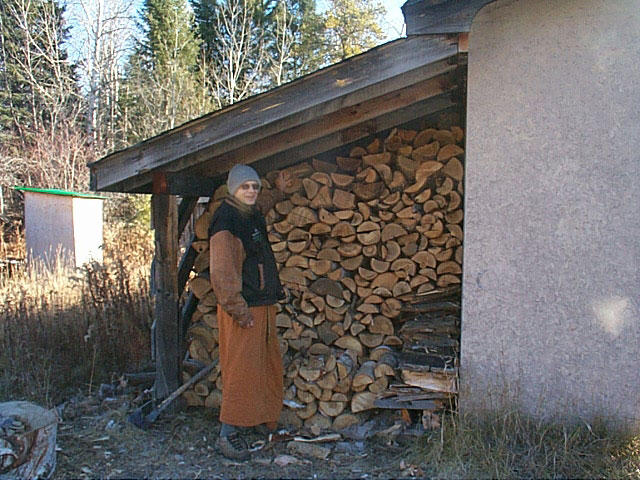
Subscribe to:
Posts (Atom)

![[alsmbowl]](https://lh3.googleusercontent.com/blogger_img_proxy/AEn0k_vblcEZq0f79JksehoBzRGQ1aZUDRvWuWm0qnbNjontJvJZ3OeAhek-vHzZAiYXBwbqC5Jj98HmUEnXnFMJegutwPS-9quxvelMmGwuTu0-XdLjUw=s0-d "donations always welcome")